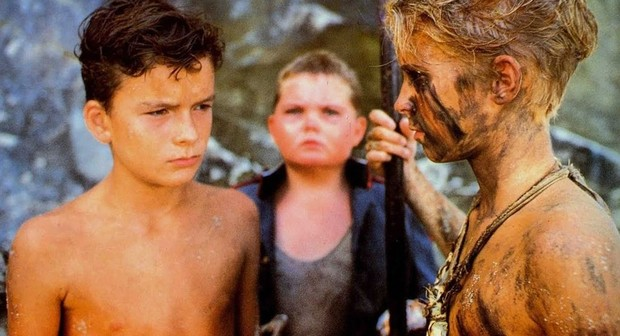
A movie or TV adaptation is like a step-parent. No matter what it does or doesn’t do, people will still be weary. But at the same time, just like a step-parent, it shouldn’t be forced to be appreciated just because someone wants you to.
I read William Golding’s Lord of the Flies over 30 years ago in the ninth grade and I didn’t like it. Yes, I know some people might say it’s blasphemy. But I also think so called classics of literature need to have a connection with the readers. Golding’s debut novel was obviously written about the rise of Hitler Youth in Europe. Jack with his blonde hair and blue eyes is the Nazi poster boy. Ralph is too open minded and feels everyone should be treated the same. Piggy and Simon are the imperfect ones. Whether or not Simon is gay has always been discussed. But I think Simon represents male sensitivity. And Piggy despite his weight is the intellectual who still questions things. These are the things that didn’t happen during the Third Reich.
In 1963, a black and white adaptation was released with mixed reviews that have been re-assessed over the years, especially after the release of the 1990 version switching the boys from the U.K. to the U.S. That alone probably angered more and more people.
But it’s not really warranted. Some books and stories seem only to exist in the time frame they were written and published. We also read A Separate Peace in ninth grade a novel that no one could relate to even the richer kids as it was set in a different time in a different way of life.
There’s a four-part series adaptation of Lord of the Flies streaming on Netflix that takes it back to the era of King George VI. I’ve tried to sit through it but it is trying too hard to be a Terrence Malick style adaptation with scenes of nature and dream-like imagery. Also the kids are very difficult to distinguish. I still don’t know who Simon is and it seems to focus too much on their back stories made up for the series. There was more mystery to Jack.
The 1990 version changes things up from a shipwreck to a plane crash. It also adds a dying airplane pilot (Michael Greene) who eventually passes.
Both the 1963 and 1990 versions are about an hour and a half in length which is basically enough time especially since the book even meanders at times with stuff that can be taken out.
James Badge Dale is hardly recognizable as the small Simon who rarely speaks. Balthazaar Getty is Ralph and perfectly cast as is Chris Furrh as Jack.
But it’s still a hard story to really sit through mainly because it doesn’t seem too believable. Written and published after the Nuremberg trials, the novel seem to be a statement on how people will turn against each other. Yet I don’t think using boys from military school was a good variable to use, especially since the real-life Tongan Castaways in the mid-1960s did the exact opposite after being marooned on the island of Tongatapu. Golding was notorious for his alcoholism and excessive drinking so he may not have been thinking clearly as it’s easy to see how young military kids raised during or after World War II can turn on each other. But even so-called primitive tribes work together because of unity and a need to help others in order to live.
Director Harry Hook and writer Jay Presson Allan had the difficult task of taking a book people have been told to like without question and turn it into something 1990 modern audiences could relate to. And literary and film critics told them to hate it. There’s profanity as characters drop the F-bomb and there’s a glow stick that plays a crucial role. The violence is upgraded as the 1963 version seemed to be bound by the Hays Code. However the series seems to go overboard a little with the violence. Just because it can doesn’t mean it should.
And of course the ending is similar to the book except it’s the American Marines this time. The ending itself has often been mentioned as Golding pulled an anti-climatic deus ex machina as the kids revert back to being kids the moment adults of authority are present.
The best thing about the 1963 version was the look on the face of James Aubrey who plays Ralph. It’s a look that means there’s no way they are going to go back to how things were and his childhood innocence is lost forever.
Getty just weeps at the feet of the Marine out of relief but also horror from the trauma he went through.
It’s not a perfect movie but I would also argue the story doesn’t have the kick it used to. Roger Ebert blasted the 1990 version saying Jack was too much like normal kids at the time. But I’m sure Ebert met a lot of Jacks in his childhood growing up in the town of Urbana, Ill. miles and miles away from Chicago. But even as he moved to the Windy City to work, there was a Jack on every neighborhood corner.
As seen in the Milgram Experiment and Stanford Prison Experiment, you give anyone any type of power and authority and there’s room to abuse it. My stepbrother got promoted to a battalion chief at an Atlanta area fire department and said the comraderie and brotherhood he once had isn’t around much.
But in the years since the 1950s, deserted island stories are now a dime a dozen. And most dystopia survival stories focus on megalomaniacs abusing their power of authority. It’s basically the entire premise of The Walking Dead and its spinoff shows. Yet in reality, people pull together. It does take a village.
I’ll finish the Netflix series eventually but at least it’s not another bloated series that stretches to eight episodes or longer.
And that’s all I have to say as I put down the conch.
What do you think? Please comment.

