Whenever a TV show starts to go downhill, you can see the cracks begin to form very early on. But they’re often so small, no one really seems to know.
The Simpsons started off wirh a rocky beginning with less than stellar animation and a feel that it seemed more like a parody of Married…with Children than a parody of the 1980s nuclear family archetype.
By the second season, the show found its footing and the episodes had great comic timing with jokes both kids and adults could get. This was called the “Golden Age.” Critics had praised it and the show was finally receiving Primetime Emmys.
Fox moved the series to Thursday early on in a bold move to compete against The Cosby Show on NBC. But by that time, America was growing tired of the Huxtables especially with the Cousin Oliver treatment as Raven-Symoné was added. Cosby’s gibberish dialogue was wearing thin as the Huxtable children were either in college or in the adulthood. When the final series of Cosby aired as the L.A. Riots raged in, a promo aired in which Homer and Bart talk about running a show into the ground if they had the choice. Most shows have done that. But Homer and Marge were seen as Baby Boomers and then they became Gen Xers and now they’re Millennials.
Worse, the family archetype of The Simpsons no longer exists. It’s almost impossible for a single income family to raise three children in this day and age unless the breadwinner makes a lot and a lot of bread.
Many people point to the eighth season (1996-1997) as the series’ last great season. That might be true but there were questionable episodes. The X-Files parody seemed to be too cartoonish. C. Montgomery Burns lost his fortune but regains it by processing marine life into a edible liquid called “slurry.” It’s not funny but disgusting.
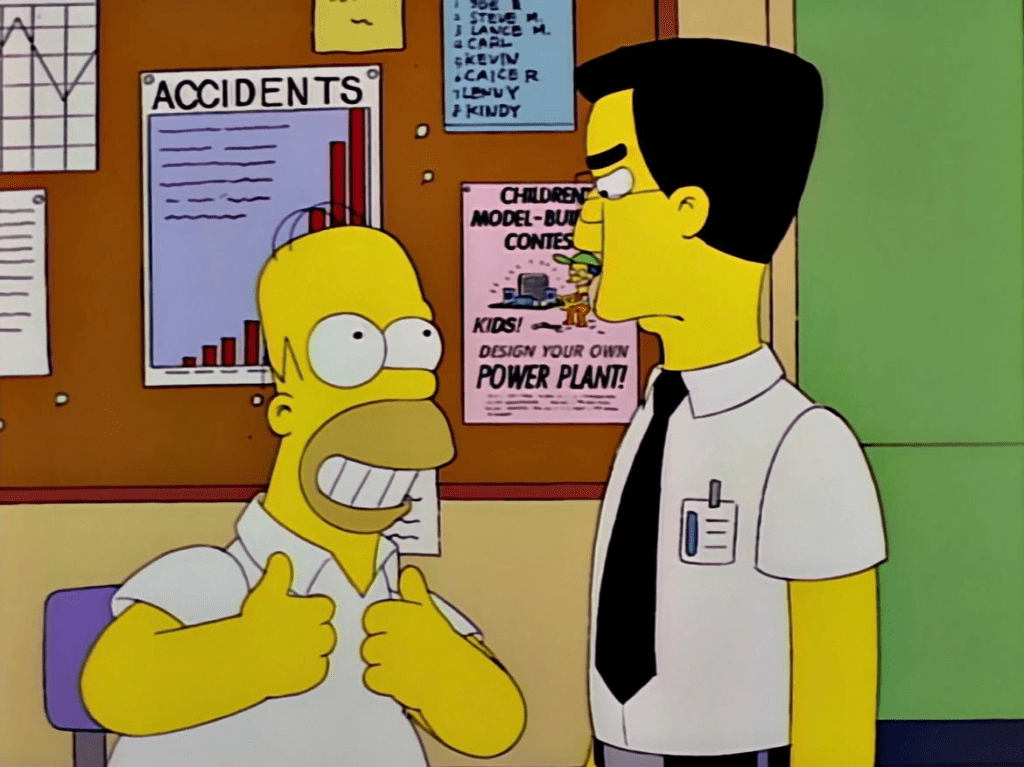
And then there’s “Homer’s Enemy.” This episode aired on May 4, 1997 and became the one that divided fans. It’s also the first instant in which Homer showed signs of “Jerkass Homer,” losing his gullible but loveable appeal and just becoming a crass, obnoxious oaf. This is what the original creators were trying to keep Homer from becoming after the botched initial production of “Some Enchanted Evening.”
The plot involves a middlea-aged man Frank Grimes, who was the focus of a news story on rising over personal hardships, being offered an executive vice president job at the Nuclear Power Plant. But when he arrives, he discovers Mr. Burns has given the job to a dog and throws him in Sector 7-G to work with Homer. So, obviously Grimes is upset and a little bitter that he finally thought his hard work had paid off and now he’s stuck in a menial job after using whatever savings to relocate.
You can’t blame Grimes for being this way. But the problem is it makes Grimes out to be a cruel joke for the sake of cruelty. It’s punching down! And that’s never good. Homer exhibits some of his worst behavior up to this point while being oblivious to the dangers he causes. Yet he seems to not understand why Grimes doesn’t like him even though he doesn’t remember Grimes’ name and calls him “Grimey.”
This might have worked had Grimes seemed like he would rise above but you know it’s only going to get worse. The show was credited to John Schwartzelder but I feel there is some input from the writing staff. I also think they were trying to capture some of the cynicism that worked on Seinfeld. The script had to be written in 1995 and Seinfeld went for the jugular but it did it in a way audiences could relate. A lot of people feel they’re getting the shaft when they’ve tried to do everything they could the right way.
“Homer’s Enemy” aired one year after Seinfeld’s “The Invitations” where Susan, George’s fiance dies of toxin poisoning from glue on cheap envelopes. Susan had been a long-time recurring character and George was getting cold feet. The irony in the next season first few episodes is that Susan’s rich parents open a foundation with her money. That’s money that would’ve went to George. He got what he wanted and what he deserved.
Homer never gets what he deserves. He just becomes more and more obnoxious throughout the episode to the point he’s sleeping at Grimes’ funeral. Frustrated with how Homer keeps being given the benefit of the doubt and behaving like he never sees anything wrong, Grimes loses it in a rant and then dies when he touches dangerous live wires without gloves.
A better ending would’ve been Grimes in a hospital winning a lawsuit against Burns with Lionel Hutz as his attorney. It might have worked. But having Homer sleeping and telling Marge to turn down the TV as everyone laughs at the comment is just shameless.
Homer has grown past this especially after the scene of him staring at the night sky after being reconnected with his mother who he thought was dead only to have to her leave again. Also the Grimes episode comes about five months after “Hurricane Neddy” where the often chipper and optimistic Ned Flanders finally cracks and tells the Simpson family and others what he really thinks of them.
A lot of people felt Ned’s pain and frustration. Bad things happen to good people but when the townspeople did a piss-poor job of rebuilding his house which collapses, he was expected to take it in stride. Sometimes good intentions aren’t a clean slate.
In many ways, “Hurricane Neddy” was a criticism of what the show was turning into – Homer was becoming more of a jerk; Bart had lost his appeal through silly catchphrases; Lisa was becoming too preachy; and Marge was just expected to tolerate and excuse all the problems. Steve Young who wasn’t a regular writer on the show penned this episode and it seemed like a visitor on the outside looking in.
Then in early February of that year, there was Shary Bobbins who tries to help the family only to see they’re beyond it and she gets killed being sucked into a jet engine as she flies off like Mary Poppins. This is funny mainly because of its absurdity as this was a musical episode.
Three episodes within half a season having people rag on the characters is a sign that they’re running out of ideas fast. And the second story of Bart purchasing a factory for $1 only serves as a side joke for Grikes to get angry at.
The rest of the season had a meta-parody of spinoffs that worked and an episode of Bart and Lisa going to military school which feels too cartoonish for this era. The first episode of the ninth season had the family going to New York City and involves the World Trade Center. It has its problems but works. Yet this would be the beginning of the era where Mike Scully is the showrunner and the show went downhill with “The Principal and the Pauper,” a silly concept where it’s revealed Seymour Skinner is actually Armin Tamzarian, a troublesome greaser who was sent to Vietnam where he was mentored by the real Seymour Skinner (voiced by Martin Sheen). The whole episode is strange and even creator Matt Groening doesn’t like it.
At this time Groening was more focused on Futurama which led to the drop in quality. The season also gave the show its worst character, Gil Gunderson, a loser salesman who has a string of bad luck and talks about himself in the third person. While Hans Moleman was unlucky, he’s loveable. Gil is just very annoying, a one-joke character who should’ve remained a one-off character.
Gil became a replacement for Lionel Hutz after the murder of Phil Hartman in 1998. But as z saw the writing on the wall after some of their uneasy episodes during the 1996-1997 season, The Simpsons stayed on for decades finishing 37 seasons and counting.
One day it might end, but I don’t think it’ll happen anytime soon.
What do you think? Please comment.

