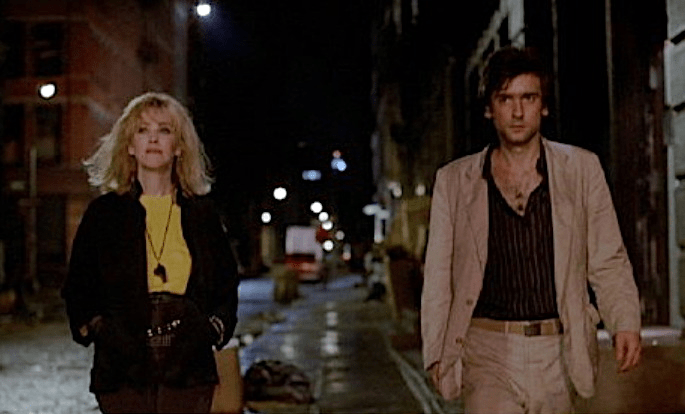
Born and raised in the Toronto area in an Irish Catholic household, Catherine O’Hara was on SCTV with other greats like John Candy, Rick Moranis, and Eugene Levy. She famously went on to Saturday Night Live in the infamous sixth season which would see Eddie Murphy and Joe Piscopo among others like Gilbert Gottfried and Charles Rocket.
She reportedly spent one week working at SNL before leaving to go back to Toronto when SCTV was renewed. It was lucky for her because the sixth season of SNL is one of the worst that was ended with the mercy of a writers strike. Call it the luck of the Irish that O’Hara would continue on SCTV until it ended in 1984.
She had appeared in a few forgettable Canadian movies before adding her voice to the cult classic animated musical feature Rock & Rule. Then, she would go on to work with Martin Scorsese in his dark comedy After Hours appearing in one scene with her future Home Alone co-star John Heard.
O’Hara doesn’t appear until an hour into the movie as Gail, who operates an ice-cream truck in the SoHo neighborhood of New York City. She is one of a handful of women who make the night difficult for yuppie Paul Hackett (Griffin Dunne), who finds himself stuck in the district with no money and no way to return home.
Eventually, Gail meets up with her neighbors and organizes a vigilante posse who suspect Paul of being a serial burglar that is targeting the neighborhood. It’s probably Neil (Cheech Marin) and Pepe (Thomas Chong) who are breaking into all the homes. But Paul can’t get anyone to help him and at first Gail seems like she is going to help him until she sees a poster with his likeness accusing him of burglary.
It was a short role but we can see the madness O’Hara would bring to her later roles in Beetlejuice, Home Alone, Home Fries, Best in Show and her great TV role as Moira Rose, a washed-up narcissistic actress on the sitcom $chitts Creek. O’Hara died on Friday, Jan. 30 after a reported illness. She was 71.
She was only 31 when After Hours opened and she seemed to have a few roles here and there before her role as Delia Deetz in Beetlejuice. Incidentally, After Hours was almost directed by Tim Burton who politely stepped aside when he heard Scorsese was interested in directing the script. Burton went on to do Pee-wee’s Big Adventure and it all worked out well.
After the failure of The King of Comedy, Scorsese was in a rut as funding for his pet project The Last Temptation of Christ had fallen through. The attempted assassination of President Ronald Reagan by John Hinckley Jr. had reportedly had also made Scorsese more concerned if he could continue to make movies. Hinckley had been inspired by the movie Taxi Driver and had sent Jodie Foster numerous letters. It’s mentioned in the documentary on AppleTV that Hinckley was also sending Scorsese threatening letters but he didn’t pay any attention to them at the time.
After Hours is the opposite of Taxi Driver. Whereas Travis Bickle saw New York City as a cesspool of vermin and scum, Paul sees it mostly as a group of weirdos who he thinks he’s better. The people in SoHo might be eccentric but Paul really has only himself to blame.
He meets the young Marcy Franklin (Rosanna Arquette) in a diner. And he goes to her address in SoHo in the middle of the night hoping to have sex with her. However, he soon learns she’s not the one for him as she has an odd, timid behavior. But when he tries to bolt, he runs into a lot of small obstacles. The subway has raised its fare and he doesn’t have enough change and the clerk refuses to let him go even though it’s barely as much of a difference even in 1985.
A friendly bartender, Tom Schorr (Heard) offers to give him the money but his cash register get locked and he gives Paul keys to his apartment to get the extra keys. But Paul is suspected of being a burglar by Tom’s neighbors who are obviously gay. But this movie doesn’t use them as a joke in that way. During a scene in the bar, two men in leather make out. It’s thrown in to show that it’s a different word than what Paul is used to.
Even though he appears in only a scene, Will Patton appears as Horst, the boyfriend/dominant of Kiki Bridges (Linda Fiorentino), Marcy’s roommate. This was one of his earlier roles and it’s funny seeing him this way dressed in leather since he’s known for playing for conservative characters on shows like Falling Skies and Yellowstone.
There’s been a lot of criticism over Dunne’s performance as Paul as he comes off as somewhat unlikeable. That’s the whole point. Dunne, himself, was rising at this time after his role in An American Werewolf in London. Yet, he’s never been the type of leading man actor. And that’s why as things seem to get worse and worse for Paul, we have to laugh at his awful predicaments because it’s not someone more likeable.
If Tom Cruise or Tom Hanks or even Steve Guttenberg had been cast in this role, I don’t think it would’ve worked. I also think Dunne used his own personal trauma because bad things happen to good people without rhyme nor reason. Dunne was grieving the murder of his younger sister, Dominique, in 1982 and the trial of her killer John Thomas Sweeney, a former boyfriend of hers, probably put his family through a rough time.
The movie would also mark the last time Cheech and Chong would appear in a movie until the 1990 Far Out Man, in which Marin makes a small cameo. After that, they wouldn’t work together for about 20 years. The script called for Neil and Pepe to be a Cheech and Chong type so they cast the real Cheech and Chong. However, the comedy duo was going through a rough professional and personal time. Chong had been upset that Marin had written “Born in East L.A.” without consulting him. And Marin was upset that the film roles kept making him the comic foil. Marin would also say he wanted to branch out and do non Cheech and Chong material. He also said Chong was becoming too controlling always wanting directing credit even though they both had acted as directors.
But Scorsese said production on the movie gave him the confidence to continue in filmmaking even though he would say he felt more like a hired hand in his next movie The Color of Money. He was able to make Christ in 1988 and then Goodfellas in 1990, at which point his career surged once again.
As for O’Hara, she should there are no small roles, only small people. One might see that Gail is over the top if Paul hadn’t already had to deal with Marcy, Kiki and Julie (Teri Garr), a goofy bar waitress as well as all the other strange characters of SoHo. I think she used Gail as a template to continue this trend of characters who seem a little off but she makes them so charming, you love watching her.
What’s your favorite role of hers? Please comment.
 Zane Says