In light of recent events, I thought of looking back at the Dirty Harry sequel Magnum Force. This post does contain spoilers!
I’ve argued with a lot of people that Inspector Harry Callahan (Clint Eastwood) isn’t as fascist as people have thought. If you look at the first Dirty Harry, it’s more of a cat-and-mouse movie taking out the bank robbery scene that adds more gunplay and violence to the movie. There are moments in the movie where you feel Callahan’s ways are justified because he wants to stop the Scorpio Killer but finds the odds are stacked against him.
Magnum Force seems intended as a response to the critics of the previous movie. It should be noted the movie is co-written by John Milius, who is well-known for his political conservative views, and also Michael Cimino is also credited. Cimino himself would later become infamous for his tyrannical ways when it came to film directing which would sabotage his career. And Eastwood has conservative views, famously mocking President Barack Obama at the 2012 Republican National Convention. Even though the movie is set in the San Francisco Bay Area, you’re not dealing with a bunch of liberal hippies behind the scenes.
The plot this time has Callahan dealing with much of the the Bay Area’s worst criminals being taken out by unidentified motorcycle cops with the San Francisco Police Department. While it’s pretty much obvious who is doing all of this, it’s implied at first it’s Charlie McCoy (Mitchell Ryan), an aging veterans of the SFPD who’s grown upset and frustrated with how the courts are letting criminals back on the streets.
The movie opens with a Mafia crime boss Carmine Ricca (Richard Devon) and his associates being gunned down when pulled over by a motorcycle cop. A high-powered pimp (Albert Powell) is also gunned down when he’s stopped by a motorcycle cop. We see the pimp the night before killing one of his prostitutes (Margaret Avery) for holding out on money for him but pouring drain cleaner down her throat. (Sadly, this is believed to inspired the deaths of three people in a 1974 robbery-murder in Ogden, Utah.)
It’s obvious the people being killed by the cops are very bad people who don’t deserve our sympathies. But in our society, law enforcement can’t be judge, jury and executioner even though we sometimes act like it. I’m reminding of the scene where Callahan tracks down the Scorpio and wounds him questioning him while he screams for help. Yes, it’s horrible but Scorpio (played by Andrew Robinson) isn’t a nice guy and he’s kidnapped a girl who later dies. He’s already killed a young boy. Most of us in the situation would’ve done the same or worse to find out where the girl is.
This is ironic that critics questioned Callahan’s motives and ways even though they praised the final act of Wes Craven’s Last House on the Left so terrifying. We see normal parents turn into vicious killers to avenge the rape/murder of their daughter and her friend in that movie. Popwell and Avery are both black but the vicious murder of the prostitute turns the pimp’s killing into a satisfying scene even though we hate to admit it.
I guess to dispel the feeling that Callahan is racist, he’s given a black partner this time in Inspector Earlington “Early” Smith (Felton Perry) and he has a love interest, Sunny (Adele Yoshioka), who is of Asian ancestry. But I think there’s just a no-nonsense feel to the way Callahan does things. When the movie was released in 1973, the hippie counterculture was ending. More people were getting into the Sexual Revolution and the rise of consumerism.
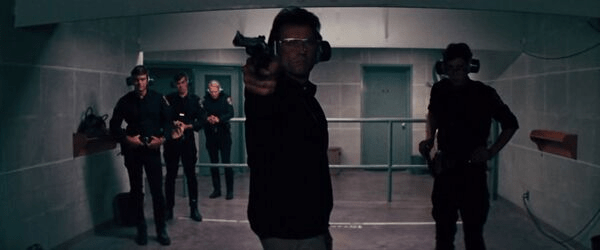
Callahan is constantly butting heads with his supervisor, Lt. Neil Briggs (Hal Holbrook), who doesn’t care for his ways. Needless to say, he fits the Law of the Most Extraneous Character as being the one who is behind the murders of high-crime people with his own hit squad of young cops, played by David Soul, Robert Urich, Tim Matheson and Kip Niven. But as Callahan says, “A man’s got to know his limitations.”
Callahan isn’t a vigilante. He only fires his weapon when fired upon. However, in later sequels, these rules of engagement would be broken. Regardless of what we think, a society without a set of order isn’t a society but a world of chaos. This is the same argument people have today on how much authority should police have.
To me the concept of law enforcement has always been a strange one. It exists only because we say it exists, just like our currency system. Yet, we act like all law officers are commanded by a higher authority and we can’t change it up one iota. This movie came out a few years after the Stanford Prison Experiment at Stanford University, itself also in the Bay Area. The people who were supposed to be guards eventually turned violent and aggressive to the people who were the prisoners. Whenever you give people a sense of authority, no matter how much, some will abuse it.
Magnum Force also came out in the aftermath of the Kent State University Massacre and the 1968 Democratic National Convention Protests in Chicago. With the Vietnam War ending, the anti-war protests were still happening, but the shift had gone from college students in the 1960s to military vets, some of them permanently injured like Ron Kovic. And as San Francisco was known as the epicenter of the hippie counterculture movement, it’s more than incidental the movie focuses on vigilante justice where cops turn on the citizens.
Today, it’s Mafia crime bosses and murdering pimps getting. Tomorrow, it could be someone stealing food because they’re starving. Where do you draw the line? A society where everyone has to walk on eggshells is not a society anyone should live in.
What do you think? Please comment.
 Zane Says