By 1980, the whole Man vs. Animal genre that had become popular with the success of Jaws had gone stale. The giant rabbit movie Night of the Lepus had been released in 1972 and the 1976 adaptation of The Food of the Gods was already in production before Jaws was released.
But movies like Kingdom of the Spiders, Tentacles and Orca all came out in 1977, probably rushed into production in the aftermath of Jaws‘ booming success. But by the time Roger Corman produced Piranha, co-written by John Sayles and directed by Joe Dante, the movie took a more comical approach to the genre. Mainly it’s because piranhas aren’t really as dangerous as the myth goes as well as tarantulas (used in Spiders) aren’t as dangerous either. So, the movies had to make them somehow affected by human’s science.
The tarantulas in Spiders have mutated their venom and aggressiveness caused by pesticides. The piranhas are also part of a scientific experiment. The fact the protagonist are the ones who actually release the deadly piranhas from a contained pool into the nearby natural water shows just how foolish and ignorant “the good guys” are sometimes. And in Orca, we’re actually following the bad people as they are hunted by the killer whale upset over the killing of its mate.
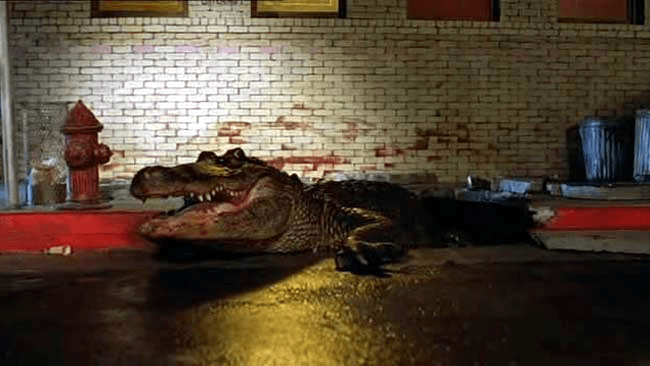
Alligators themselves can be dangerous if they feel they are threatened like most animals. But they’re mostly ambush predators. The 1980 horror flick Alligator, which featured the recently deceased Morris the Alligator, is more or less a parody of the whole genre at the same time an appreciation the same way Scream would do the same thing in 1996. The alligator is even given a name – Ramon, because why not?
The movie begins in 1968 at a tourist trap alligator farm in Florida where a teenage girl purchases a baby alligator. But back home in their Chicagoland area, the girl’s father flushes it down the toilet into the sewers where it lives for the next 12 years. During this time, a nearby industrial factory has been conducting illegal growth experiments on animals who are dumped into the sewers after they die.
Ramon has been feeding on the carcasses which have been supplied by the sleazy Luke Gutchel (Sydney Lassick) who meets his own demise. The thing about alligators is they don’t move fast the way a shark, orca or even a spider would. So, the movie has mostly people foolishly getting too close to Ramon so he can make a snack of them.
Det. David Madison (Robert Forster) begins investigating the discovery of body parts in the sewers but is unable to get his superiors to believe it’s a huge alligator. Madison has moved to the new department after a previous incident in St. Louis that resulted in his partner being killed. He’s also become somewhat of a pariah. He’s developed a bad reputation which is only made worse when a young officer, Kelly (Perry Lang) accompanies Madison into the sewers and is attacked and eaten.
Madison is knocked out by Ramon and no one believes him. No one except Dr. Marisa Kendall (Robin Riker), a herpetologist, who is also the young teenage girl whose father flushed Ramon in the serious. A wealthy tycoon, Slade (Dean Jagger), owns the factory where the illegal animal testing has been conducted. And he’s using his wealth and influence on city officials to keep it under wraps.
But when a tabloid reporter Thomas Kemp (Bart Braverman) gets killed himself trying to investigate the sewers, his camera is found and the film is developed revealing Ramon is real. And this attracts attention especially a pompous big-game hunter Colonel Brock (Henry Silva in a hilarious role). The character of Brock is obviously a parody of Robert Shaw’s Quint from Jaws but without the complex backstory.
Silva, who was known for his distinct facial features, plays the role just serious enough that it’s not overacting. But he also understands his role in the movie and tries to impress women by doing mating calls of animals. And like Quint, he faces an early death by going into Ramon’s mouth feet first. It’s not exactly the best horror movie of the genre but it’s not the worst.
Producer Brandon Chase was influenced about the urban legend of giant alligators in the sewers of NYC. He signed Lewis Teague, another Corman protege, to direct it the script. However, Teague was not happy with the original script by Frank Ray Perilli, so he brought Sayles on to rewrite it who gave it a more comic touch.
You can see in movies that there are miniatures of city streets as Ramon is supposed to be huge. Other special effects basically just focus on Ramon’s head and tail. Why build a huge alligator model when you don’t have to. Just film body parts with crew members operating them just off camera. Mainly it’s because Teague, Chase, Sayles and the cast all know they’re making a cheap exploitation movie that it works.
Alligator didn’t get good reviews on its release, even though reassessments have garnered more praise. It still made about $6.5 million off a $1.6 million budget in US theaters alone. When ABC bought the rights for $3 million, it finished No. 11 the week it aired. That’s not bad. Quentin Tarantino would later cast Forster as Max Cherry in Jackie Brown based on his performance here. It would garner the actor an Oscar nomination and help revitalize his career.
Morris, himself, would go on to appear in other movies, most famously in Happy Gilmore where he appeared on screen with Adam Sandler. He was the alligator who bit the hand off Chubbs (Carl Weathers) and swallows a golf ball. This causes Gilmore to get in a fight with the alligator even though a prop was used for a lot of shots. He was also featured in Interview with the Vampire and Dr. Dolittle 2.
Morris was rescued as an illegal pet in the Los Angeles area in 1975. He was about 11 feet long and measured over 600 pounds. In later years, he retired to The Gator Farm, a sanctuary in Colorado in 2006 and live there until his death earlier this month. It’s reported he was approximately 80 years old at the time of his death.
Rest in peace, Morris. And say hi to to Steve Irwin, Carl Weathers, Robert Forster and Henry Silva for us.
What do you think? Please comment.
 Zane Says