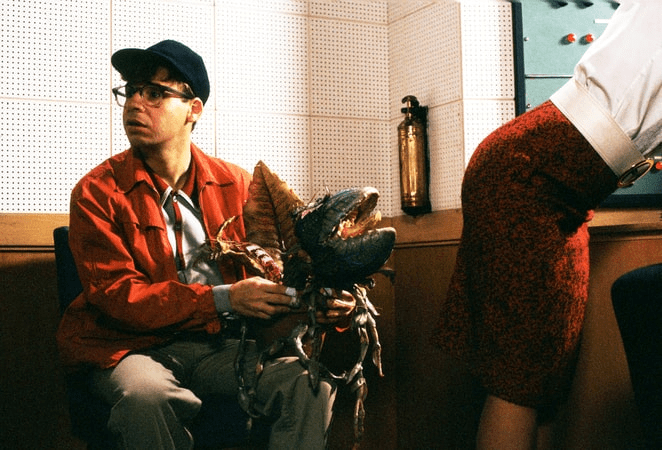
For our senior musical play, we did Little Shop of Horrors. And like the 1986 film adaptation, it suffered its own set of problems. Some of the seniors were upset because it only had a few woman roles but that was changed. It’s not like all the girls I went to school with were Julliard material but there was a higher woman to man ration in the overall casting.
And the original student intended to play Audrey had to drop out for medical reasons. This meant my friend, Kerry, took the role, which everyone thought she’d get anyway. But she was originally one of the three women chorus. (Mind you, there wasn’t much of a high black student body at my school.) So roles were changed because the only Chinese student we had was to play the customer who gets excited about the Audrey II plant. So, I was now splaying The Blind Man who sells Seymour the plant.
In a way, I liked being the catalyst for the entire series of events. It was a non-speaking role that became a speaking role at the end of the play. I also had a walk-on as an “Uptown Jerk.” Anyway, days before the performance, one of the women playing the chorus didn’t care for the play director and left, leading for the role to be recast. Anyway, it played two performances over the weekend and everyone was entertained.
But for anyone who is unfamiliar with the musical that performed Off-Off Broadway and then Off-Broadway before becoming a 1986 movie, there were a lot of changes from stage to screen. SPOILERS ALERTS ahead! The musical ends on a more dark finale with Seymour and Audrey being consumed by Audrey II. But the play focuses more on Seymour’s willingness to trade his conscience for fame. That might work good on the stage for the theater crowd but audiences in the 1980s were expecting something more upbeat.
However, test audiences hated the original ending that followed the play’s climax. Frank Oz who directed the movie said test audiences in both New York City and Los Angeles hated the ending. Every musical number was met with applause and cheers and then the ending was met with silence. “It was a complete disaster,” Oz said in an interview. The score rating average was 13. Studios won’t let a movie be released without a 55 or higher.
So, the movie’s ending had to be changed and delayed. Howard Ashman, who had wrote the lyrics and the book of the play along with Alan Menken who did the music, wanted to keep the original. Ellen Greene, who had originated the role on Off-Off Broadway, had been cast as Audrey in the movie. And Rick Moranis, who was riding high after Ghostbusters was perfectly cast as Seymour Krelborn. Moranis himself was also satisfied with Seymour being swallowed whole at the end.
“”I learned a lesson: in a stage play, you kill the leads and they come out for a bow—in a movie, they don’t come out for a bow, they’re dead. They’re gone and so the audience lost the people they loved, as opposed to the theater audience where they knew the two people who played Audrey and Seymour were still alive. They loved those people, and they hated us for it.” Oz said in a 2009 interview with The A.V. Club.
Oz was still a novice film director. He had co-directed the cult classic The Dark Crystal with his friend and collaborator Jim Henson. Then, he had solo directed The Muppets Take Manhattan. But people going into the movie aren’t expecting Kermit and Fozzie to slaughter Miss Piggy and roast her on a pit. I mean it’s The Muppets not Meet the Feebles.
Also Off-Off Broadway plays are known for being more daring and experimental. So, if you go see a play based on a low-budget Roger Corman movie that’s only popular because a young Jack Nicholson plays a wimpy masochistic dental patient, you know to expect anything. Corman shot the movie in two days using sets that had been built for his previous movies like A Bucket of Blood which featured that movie’s lead Dick Miller as a man who loves to eat flowers.
So, you give the audience what they want. Warner Bros had spent $5 million alone on a doomsday ending where Audrey II’s children spawn and take over the world. That’s about $14 million in today’s numbers. The final price tag on the movie was $25 million, which is about $72 million today. It was a big gamble because traditional movie musicals had fallen out of favor with modern audiences. Movies like The Blues Brothers, Beat Street and Breakin‘ had appealed to younger audiences and been successful.
Popeye and Annie had also been successful at the box office. But The Wiz didn’t even break even and Can’t Stop the Music and Xanadu had bombed. Even The Muppets Take Manhattan didn’t get nearly as good a return as The Muppet Movie five years earlier. Like clothing fashions and hair styles, it can change quickly.
The problem with Little Shop of Horrors is that its one of those movies that develops a cult following and late critic Roger Ebert noted this. Ergo, it wasn’t going to be a big money maker for Warner Bros. who was forced to delay the release to a week before Christmas 1986. It still works for all the reasons the executives at Warner Bros. probably hated it for.
It’s a dark comedy with a mixture of camp and Broadway pizzaz. You find yourself singing along with the music and the songs get stuck in your head. The plot is pretty simple. Seymour (Moranis) is a lowly worker at Mushnik’s Flower Shop in the Skid Row neighborhood of New York City. His boss, Mr. Mushnik (Vincent Gardenia), is constantly belittling and berating him as he lives down in the basement. It’s mentioned Seymour was an orphan who was adopted by Mushnik but mostly for being cheap labor.
The only other employee is the shy but awkward Audrey (Greene) who is the object of Seymour’s affection. When Mushnik considers closing down the shop, Seymour brings the small plant he bought a week before in the front window. It attracts many customers including one (Christopher Guest) who buys $100 of roses. Other customers pile in and Mushnik makes a killing. But he makes Seymour stay home and take care of the plant he’s called Audrey II instead of taking him out to celebrate.
Seymour discovers the plant lives off blood and human flesh when he pricks his finger cleaning up dead roses and blood comes out. Soon Audrey II is growing more and more each day and attracting attention as Seymour spends his nights feeding it, bored and unable to enjoy the success. At the same time he discovers that Audrey is dating Dr. Orin Scrivello, DDS (Steve Martin) who is a sadistic madmen who abuses her mentally and physically.
Audrey II begins to speak demanding “Feed me!” and tells Seymour he needs fresh human flesh and blood. When they observe Orin slapping Audrey, Seymour decides to go to his office and kill him. However, Orin dies from a nitrous oxide overdose when he puts a venturi mask on and the knob breaks off. Seymour chops him up and feeds the body to Audrey. However, Mushnik has witnessed this and Seymour gets closer to Audrey.
This is why it’s best for a director to make a movie that works best with the actors not how the source material is written. (This is something the people behind The Walking Dead series never learned.) Actors bring a special touch to their roles. Moranis and Greene work so great here, we as the audience want to see them succeed. Greene was mostly known for her stage work so give Oz the and production company credit for not wanting a bigger name actress in the role. She nails it perfectly as does Moranis who turns Seymour into one of his most memorable roles.
Also, Moranis’ meek and timid delivery of the character manages to show how Seymour would willingly be pushed around by Audrey II the same way he’s pushed around by Mushnik. Also Orin is a bad guy which Martin plays him with the perfect love-hate performance. (This is the first time Martin and Oz have worked together as they would go on to work on movies like Housesitter, Dirty Rotten Scoundrels and Bowfinger.) Oz also has the type of deadpan sardonic wit to match Martin’s, which is why they’ve been a good director/actor duo.
The additional casting of cameos by comic actors like John Candy as Wink Wilkinson, a radio deejay, Jim Belushi as Patrick Martin, a marketing and licensing executive, and Bill Murray as Arthur Denton, a hyperactive masochistic dental patient, give the more a more light-hearted charm. And the chorus casting of Tichina Arnold, Michelle Weeks and Tisha Campbell as Crystal, Ronette and Chiffon, respectively make this movie one in which audiences expect evil to be punished and the protagonists to live happily ever after.
Belushi was added to do reshoots as Paul Dooley (originally cast) was unable to come back for scheduling. And Campbell was unable to film a scene where the chorus are walking by the suburban home where Seymour and Audrey live dressed as bride maids. So, the camera pans down as a body double stands in for Chiffon as we don’t see her face. And the camera ends focusing on a baby Audrey II plant that lets a little evil smirk as the credits roll and the end music plays.
This a more appropriate ending that implies everything isn’t over but it can make the audience feel like they’ve been entertained for a full hour and a half. If it hadn’t been for the scene with Murray who gets sexually aroused and excited by Orin’s torture, the movie might have been released with just a PG rating. This is a throwback to Nicholson’s performance in the 1960 original even though it doesn’t appear in the musical. I was disappointed with this because I wanted to play the role especially since my good friend, Gardner, was Orin. The audience would’ve loved it but I’m sure the administration would’ve freaked.
The late Levi Stubbs, whose baritone voice made his work as the lead of The Four Tops a successful Motown group, voices Audrey II. I don’t know if it’s intentional that Audrey II has lips that look more ethical toward black people or this was a way the puppetry was made so it could look more believable. But Stubbs really sells the role as a menacing but charismatic villain. Stubbs also appears as one of the Skid Row residents during the performance of “Skid Row (Downtown)” and nails the performance of “Mean Green Monster” during the movie’s climax.
Stubbs would perform the song at the 1987 Oscars as it was nominated for Best Original Song. (And it would be the first nominated song to contain profanity even though it was edited for TV broadcast). The movie would also be nominated for Best Visual Effects. Most of the special effects work was done with puppetry including Brian Henson, son of Jim Henson, even though the latter didn’t have much to do with the production as he was working on Labyrinth in the United Kingdom where Little Shop was also mostly filmed on sets.
Henson would later compliment Oz and the production on their work. And the movie would get rave reviews. However, audiences stayed away as it only grossed $39 million in North America and an additional $15 million. But it found more success on the home video market and cable becoming the cult classic Ebert theorized.
It would also go on to become the first DVD to be recalled for content in 1998 as it contained a black and white workprint of the original ending. However, David Geffen, who produced this movie through his defunct production company, The Geffen Company, was unaware of the DVD release by Warner Bros. and the DVDs were recalled within days.
It was later released during the Fall of 2012 on DVD with the original ending. It can be viewed online here: https://www.youtube.com/watch?v=7RjFvcw6ToQ
In the winter of 2020, there were talks of doing a remake with Chris Evans, of all people, considered for Orin. However, the Covid-19 pandemic postponed it indefinitely and then it was cancelled in September of 2022. I don’t think any other actors or directors can do what this one did. Even audiences would be expecting a more happy ending.
We don’t need remakes. We just need to introduce the originals to younger audiences.
What do you think? Please comment.
 Zane Says