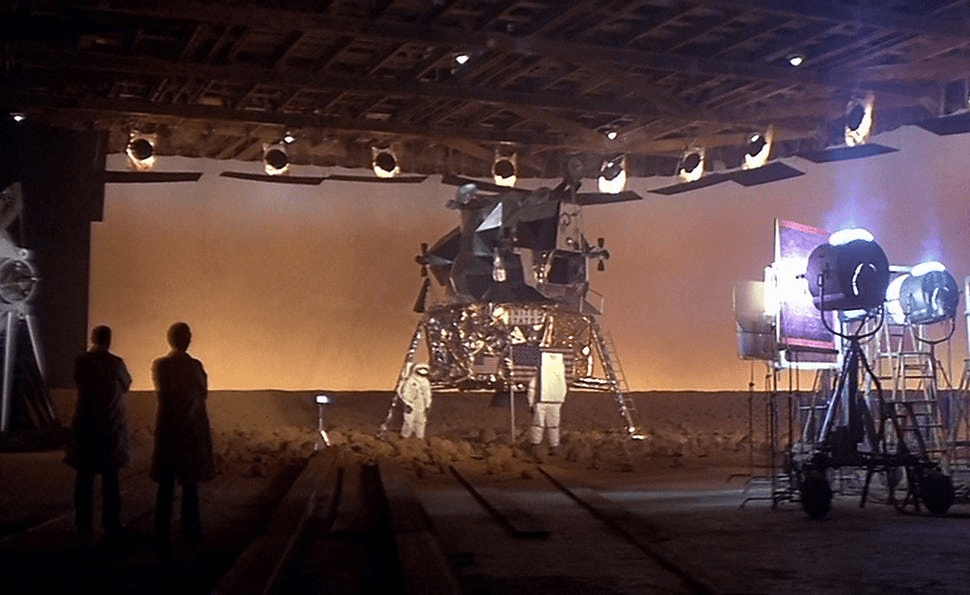
Did we really go to the Moon? That has been the question since 1969 as skeptics believe that NASA used the same set that Stanley Kubrick used for 2001: A Space Odyssey. This was also enhanced by skeptics believing the Apollo 13 mission disaster was faked to keep public interest in the space program.
And then there’s that sweater Danny wears in Kubrick’s The Shining that some people say is the director dropping a sign that he worked with NASA to fake it. Now, there’s stories that the Blue Origin all-woman passenger (not crew!) flight was staged. The footage from inside the phallic conveyance has some people guessing. That and Gayle King’s expression before boarding is leading to a lot of people suspecting it was all a scam to stir up more interest in space exploration as well as making oligarchs like Jeff Bezos feel superior.
Personally, I think some of the Apollo moon skepticism has been perpetuated by Peter Hyams’ Capricorn One, which was released less than 10 years after Neil Armstrong took his steps on the Moon’s surface. You got to hand it to Hyams, who wrote/directed the thriller. He started out in TV and while he worked at CBS, he was directing documentary films. And even documentary films are tweaked and tuned to fit a narrative.
And as a journalist myself, I know you can have 10 people cover a major event and all 10 of them will write or broadcast a different version of the event to their style. So, the question is who do you believe? As The Eagles sang, “There ain’t no way to hide your lyin’ eyes.”
Now, we have deepfakes and AI making us believe something is real even though more and more people are being skeptical. The basis behind Capricorn One is a staged mission to Mars in which three astronauts (James Brolin, Sam Waterston and O.J. Simpson) are forced to fake a landing on Mars. The bigwigs feel that there isn’t much interest in space exploration as much anymore so they have to make something more dramatic in order to keep interest alive as well as private donors opening up their checkbooks.
What’s funny is that Hyams wrote the script in between the Apollo 11 mission and the last one, Apollo 17. Funding was later cut on all future missions and there hasn’t been another mission to the moon since 1972. What helped pique interest was another event that happened in 1972 with the Watergate scandal. Like a lot of movies that sprung up in the wake of that scandal, it follows the political conspiracy thriller genre along with movies like The Conversation, The Parallax View, Chinatown and Three Days of the Condor to name a few.
The astronauts Charles Brubaker (Brolin), Peter Willis (Waterston), and John Walker (Simpson) are informed by NASA top official Dr. James Kelloway (Hal Holbrook) there was a faulty in-support system they discovered that would’ve killed them three weeks into the flight. Kelloway who has worked at NASA with Brubaker since 1962 says the public and even the government has lost interest in space exploration. They knew about the danger but didn’t scrap it because they knew they’d lose more funding.
At the launch, only the Vice-President (James Karen) is present much to the chagrin of Kelloway and Hollis Peaker (David Huddleston), a Washington D.C. Congressman who has spear-heading the Capricorn One project. Whether or not the in-flight system is really faulty or not isn’t really answered because the objective of Kelloway and others is to get more money by any means necessary. That includes leading the astronauts on that they’ll be heroes like John Glenn and Neil Armstrong and then making sure they want spill the beans about the truth.
However, Brubaker becomes upset about the ruse as the weeks and months continue as they are hiding out in an airport hangar that is doubling for a set. At the same time, a NASA employee Elliot Whitter (Robert Walden) begins to notice some discrepancies in reports about the signal lengths between transmissions from the flight capsule and NASA. He brings these issues to Kelloway and others who try to play it off as a glitch in the computers.
Whitter is also good friends with a reporter, Robert Caulfeld (Elliott Gould), who becomes worried when Whitter suddenly vanishes without a trace. Someone else is living in his apartment and NASA officials are saying Whitter never did work there. And then there is an attempt on Caulfeld’s life as the brakes are cut on his car.
Problems are also complicated when Brubaker seems a coded message to his wife that both Kelloway and Caulfeld catch which means more drastic measures have to be taken resulting in reports Brubaker, Walker and Willis all died on re-entry. This leaves the three astronauts escaping and running for their lives as Caulfeld tries to get someone to believe him as federal agents want to ruin his reputation.
Hyams does present a fascinating story. As he said in a 2014 Empire story: “Whenever there was something on the news about a [space flight], they would cut to a studio in St. Louis where there was a simulation of what was going on. I grew up in the generation where my parents basically believed if it was in the newspaper it was true. That turned out to be bullshit. My generation was brought up to believe television was true, and that was bullshit too. So I was watching these simulations and I wondered what would happen if someone faked a whole story.”
Conspiracy theorists have been around before the moon landing. One thing Hyams does catch on is the lack of enthusiasm in space exploration by the end of the 1970s. Even in the 1960s, there was criticism that taxpayers was funding something that wasn’t even benefitting them. Kurt Vonnegut Jr. was a critic of using public money. In 1970, Gil Scott-Heron recorded the spoken word poem “Whitey on the Moon” criticizing how Americans were being spoon fed a lie that we should be happy a few people in America are going into space. It was later used in the movie First Man about Armstrong.
For the most part, there’s been critics over the decades on what it really accomplishes. I think the movie really hints that it’s not really for space exploration but so companies can get big government dollars. How many billions have been spent on fighter jets that are never used in combat, such as the F-22 Raptor? It has never been used in combat since its introduction in 2007. The contractors get the big bucks. One of the reasons is these high-priced jets are way too high maintenance and they can’t be used in combat because of the costs.
Capricorn One also came about eight years before the infamous Challenger explosion, which NASA only went ahead with despite warnings because of all the press and attention. What if they had scraped it? Seven people would’ve survived but it’s quite possible interest would’ve faded. It was a black-eye all the same as millions of kids watched it and the investigation showed just how sloppy it had been handled.
The biggest problem is that there are too many characters. Caulfeld doesn’t even come in until about 15-20 minutes. And after building the astronauts up as major characters, they mostly spend the middle of the movie standing around reacting. At the same time, characters like Peaker seem they will play a more important part but mostly get pushed to the backgrounds.
Also, the casting of Simpson also seems to change how much sympathy we have for his character. Depending on whether you believe he actually was guilty of the murder charges of Nicole Brown and Ron Goldman, watching the movie now is still a distraction when he’s on screen. Hyams noted that he also directed Robert Blake in his first feature movie, Busting. “Some people have AFI Lifetime Achievement awards; some people have multiple Oscars; my bit of trivia is that I’ve made films with two leading men who were subsequently tried for the first-degree murder of their wives.”
Regardless, it is a nice little movie to watch every time you question the government is lying to you. And that seems almost every day with reports that Donald Trump wears 215 pounds and is 6-foot-3.
What do you think? Please comment.
 Zane Says