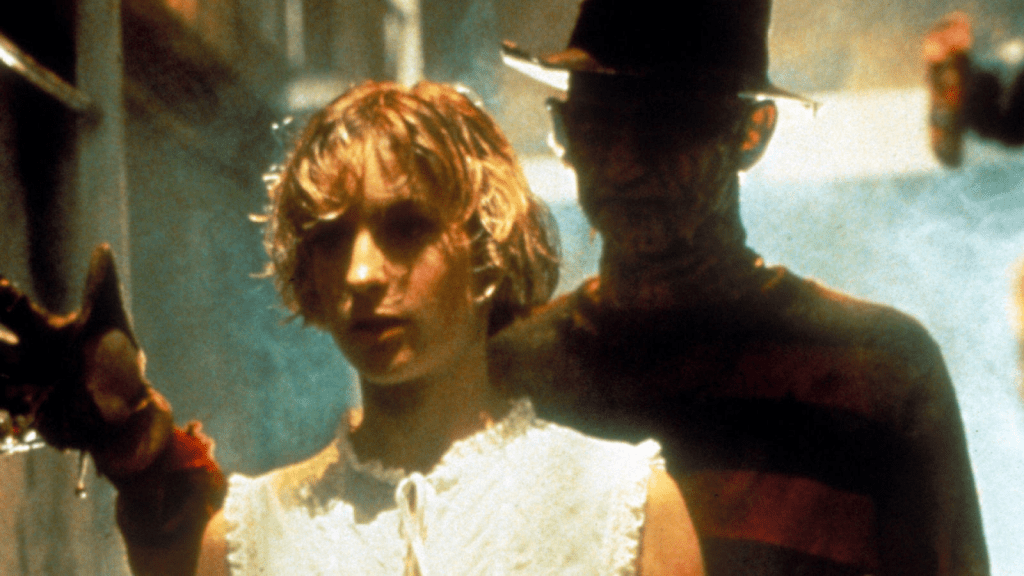
By the Fall of 1984, the slasher subgenre of horror was at the bottom of the barrel of movies. The critics hated them. Parental groups were trying to get them removed from theaters. And major studios realized they weren’t making the money they once did.
Most of the movies were independently produced on the pre-sold money sent out regionally to independent theaters throughout the country. This was right before the home video market was about to take off. Most movies could just be dumped in the months of September, January or February which usually produce the least on their returns. But since they were made cheap, many less than $1 million, they could still turn a profit.
By the time, Wes Craven began to work on A Nightmare on Elm Street he had gone to making Grindhouse flicks of The Last House on the Left and The Hills Have Eyes to more studio projects such as Deadly Blessing and Swamp Thing. For a man who taught English and Humanities at the college level, he began to get intrigued by a series of stories he was hearing of Hmong immigrants escaping war-torn countries of Cambodia, Laos and Vietnam who claimed to be refusing to sleep because of nightmares. I can only imagine what they had to be about considering what they experienced.
Men ranging in ages from 19 to 57 were dying in their sleep. Cause was suspected to be sudden unexplained death syndrome or Brugada Syndrome, which can cause heart attacks, or both. However, Craven couldn’t get anyone to finance the movie because as his response in the slasher documentary Going to Pieces, he was being told no one wants to see movies about dreams.
Disney was interested but wanted it to be more family-friendly. Paramount Pictures passed but instead went with the similar themed Dreamscape which has a man killing people with long fingernails. And Universal refused as well. This led Craven to turn to the fledging New Line Cinema who only handled distribution of independently made movies, some of which were the works of John Waters. With Robert Shaye as producer, he also found himself scrambling to find investors as funding suddenly became an issue before filming was to begin.
It’s been reported that Craven originally wanted David Warner to play the iconic Freddy Krueger. A make-up test was reportedly done. However, one report indicates Warner ran into a scheduling conflict. Others were that he wanted to much for the role. The reported budget of the movie was $1.8 million. And Craven talked and tested with Kane Hodder, who would go on to play Jason Vorhees in the Friday the 13th sequels. Yet, Craven realized he wanted more of an actor than a stunt man to play the role.
And that’s how Robert Englund got the role. The actor had auditioned for the slasher parody National Lampoon’s Class Reunion (which is mostly forgotten except for being John Hughes’ first screenplay credit). Even though he was only 5-foot-10, Englund went in making himself out to be more of a Klaus Kinski character. Englund also said he took the part because he had a break in hiatus from filming V: The Final Battle miniseries and V: The Series where he played the friendly alien visitor Willy.
Freddy Krueger was inspired by two incidents from Craven’s childhood. He said one night, he happened to look out a window and say a creepy older man walking along the sidewalk who stopped and looked at him briefly before going on his way. The name was based on a childhood bully, Fred Kruger. The burned look was loosely inspired by extreme burn victims but also a pepperoni pizza the make-up guys ate while talking about the look.
The plot takes place in the fictional town of Springwood, Ohio, but was filmed in the Los Angeles area (as there are palm trees noticeable in many scenes). Craven begins the movie like a nod to Alfred Hitchcock’s Psycho as we begin in a dream where Christina “Tina” Gray (Amanda Wyss) is pursued through a boiler room by Krueger but unaware of who he is. Tina’s friend, Nancy Thompson (Heather Langenkamp) and her boyfriend, Glen Latz (Johnny Depp) say hey have had similar dreams as well.
Tina invites Nancy and Glen over for a sleepover but her boyfriend, Rod Lane (Nick Cori), who has a history of criminal activities, shows up. Tina and Rod have sex but when she goes to sleep, she has another dream of Krueger who kills her in her sleep. Rod wakes up to see Tina struggling as cuts are made to her body and blood goes everywhere as Tina’s body is dragged by an unseen force up the wall and toward the ceiling.
Rod flees but is later captured by the police as Nancy’s father, Donald (John Saxon), a lieutenant with the department and other officers. He placed in a jail cell where he’s visited by Krueger in his dreams who kills him by strangling with his bed sheets and making it look like a suicide. However, Nancy keeps having dreams about Krueger but can’t get anyone to believe her until during a sleep study, she manages to pull Freddy’s hat and bring it into the real world.
Nancy’s mother, Marge (Ronee Blakely), who has a drinking problem, finally admits that the hat belongs to a man named Fred Krueger, who killed several children many years earlier when Nancy, Glen and Tina were all too young to remember. Originally, Craven had intended Krueger to also be a child molester he didn’t want to include that as the McMartin Daycare Scandal had just made headlines in 1983 and the case was ongoing. However, in later movies, it’s implied more that Freddy was a child molester. In Freddy’s Dead, his daughter, Maggie Burroughs, makes a comment they used to closely touch hands when she was little implying he had molested her.
Marge explains that Krueger was finally arrested after killing 20 children from the neighborhood. However, the case was thrown out on a technicality because the arrest warrant was written incorrectly. So, the parents, including Donald and Marge, banded together and killed Freddy by burning him alive. And it appears that the spirit of Krueger is invading the dreams of the children of the parents to kill them out of revenge.
However, there’s no way to really avoid running into Freddy. Our bodies are conditioned to rest especially when we’re tired. And since he’s undead, there’s really no way to kill something that already has died. That’s the twist Craven brings to the genre.
To be honest, to call Nightmare on Elm Street a slasher is an insult. Depending on what you believe the ending to truly be, there are only four deaths on screen or just one. Slashers up until 1984 were about human killers who could easily be killed off. Ok, Jason Vorhees taking an axe to the brain would kill a lot of people. But there have been actual medical cases of people who suffered major trauma to the brain area and still were capable of functioning somewhat normally.
Nightmare adds more of a supernatural element which makes a lot of people skeptical that Nancy and Glen are really in any danger. Craven also delves into how Gen Xers became latchkey kids who often didn’t have much parental involvement. And when they did, they were often critical of their children doing bad things for their child’s safety. But it was really so they wouldn’t have to put forth much effort. This was the era of the famous, “It’s 10 p.m. Do you know where your children are?
Along with being an alcoholic, Marge puts bars on the windows to keep Nancy from leaving and Glen from coming in. She also adds a deadbolt to the door that only can be opened by a key. Glen’s parents (Ed Call and Sandy Lipton) are critical of Nancy dismissing her mental trauma as a sign of bad behavior which was common with parents of this era. Craven seems to show that most parents who think they’re doing the right thing really aren’t. There’s also themes of how women aren’t taken seriously as they should be. Tina’s death is brutal but it’s a metaphor for rape. And when Nancy is taking a bath, she falls asleep and Freddy’s razor-glove appears between her legs.
Langenkemp was just 19 when she was cast in the movie. A native of Tulsa she had previously been cast as a teenage extra in Francis Ford Coppola’s movies The Outsiders and Rumble Fish but her scenes were cut. She was able to get her Screen Actors Guild card and decided to pursue a life in acting. After she auditioned for Night of the Comet, Annette Benson, who was the casting director on that movie as well, brought her to Craven’s attention. She gives a wonderful performance as Nancy even though the role was intended to be 15. She still gives off feel of a Midwest teenager in the mid-1980s.
As for Depp, he was chosen because he had went with his friend, Jackie Earle Haley (famous for the Bad News Bears movies) to an audition and a head shot of him was taken. Depp was chosen when Craven’s daughters picked his photo out. Glen was originally written as a bleach blonde football athlete type. Reportedly Charlie Sheen came close to being cast but he and his agent wouldn’t accept the SAG minimum at the time for a weekly salary. Haley would go on to play Freddy Krueger in a 2010 remake which incidentally would also star Connie Britton of the TV show Nashville. Blakely had been nominated for an Oscar for appearing in Robert Altman’s Nashville. I just always thought that was an odd coincidence.
Nightmare on Elm Street would go on to gross over $57 million when it was released on Nov. 9, 1984, nowhere near the amounts the first Halloween and Friday the 13th movies made. But take into consideration the backlash at the time, it’s still an impressive turnout. It grossed over $25 domestically while the rest was from worldwide returns. Critics were more generous in their assessment of the movie in contrast to the other movies at this time. I couldn’t find any reviews from Siskel and Ebert.
However, the late Roger Ebert gave a one-and-a-half star rating to the the A Nightmare on Elm Street 3: Dream Warriors which is often considered to be the best sequel. Ebert rightfully so dismissed the 2010 remake with just a one-star review. However, he gave a three-star review to Wes Craven’s New Nightmare for its metafiction touch as well as examination of pop culture on people, especially young children.
While the original movie has received more favorable reviews in retrospect, there has been some criticism toward the cheapness of the movie that still shows. A scene in which a burning Freddy attacks Marge and then we see her burnt corpse disappearing down an abyss in the bed looks bad as does a scene in which Freddy pulls her body (obviously a lightweight dummy) through a door window. And many people have criticized how the blood spurts out like a volcano of the bed when Glen is pulled down into it.
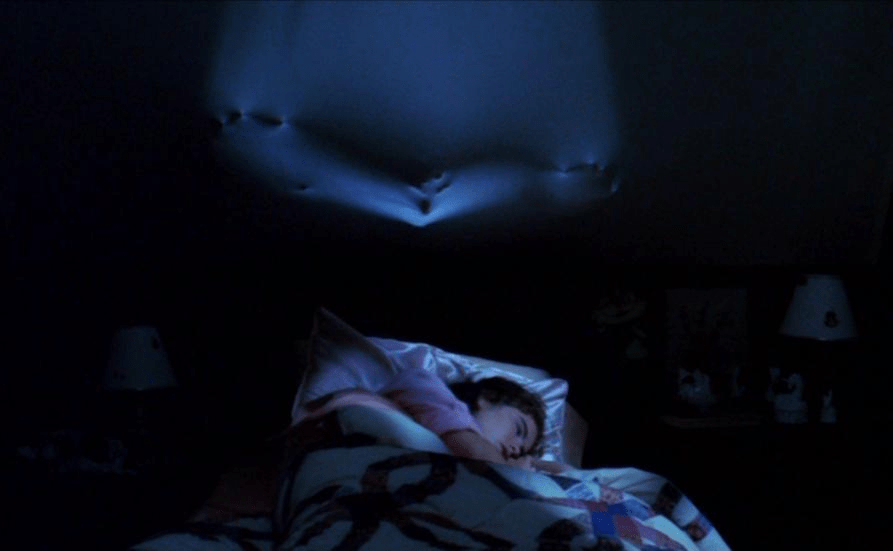
However, other special effects like the one shown below are impressive for their creativity. Below is a scene that was accomplished with good lighting and spandex to make it appear Freddy is coming out of the wall. Also, a scene in which Nancy tries to run up the stairs but her feet sink into the steps as they turn to goo was Shaye’s idea. The special effects team used pancake mix to make this effect.
Even though the movie was a hit, Craven saw little of the money as well as the money off the marketing reportedly. As the movie turned into a franchise that included an anthology horror series Freddy’s Nightmares, that ran in syndication from October 1988 to March 1990 with Englund returning as Freddy as the host. There was also the toy merchandising despite Freddy being a killer of children. It would pull New Line out of financial limbo and become a major independent studio until it was sold to Time Warner in the 2000s. The studio would be called, “The House That Freddy Built.”
Craven had co-wrote and co-produce the third movie as he said to end it once and for all but Shaye produced two more movies before 1991’s Freddy’s Dead. To get Craven to come back for New Nightmare, Shaye reportedly gave Craven a cut of the money he was owed. But the movie didn’t perform well as Craven lamenting he made it more for the actors of the franchise instead of the fans. Englund plays Freddy as well as himself. Seeing Englund without his make-up painting in his house look as normal as possible really makes you appreciate how terrifying he was in the earlier movies before he began to joke more in the later. i
Even though Depp made a hilarious cameo in Freddy’s Dead mocking the “This is your brain on drug” public service announcements, he was absent from New Nightmare. Craven admitted to Depp that he felt Depp’s career had taken off so successfully by the early 1990s that he wouldn’t be available. Depp told Craven he would’ve worked it into his schedule if Craven had asked.
Strangely, the movie franchise would have a connection to a different franchise. In the late 1980s, Langenkamp appeared in Just the Ten of Us, an ABC sitcom about a Catholic family moving from New York City to Eureka, Calif. It was a spin-off of Growing Pains. The parents had eight children, with Langenkamp as one of their daughters. Brooke Thesis and JoAnn Willette played the other daughters. Thesis was in the fourth Nightmare movie while Willette was in the second.
The sitcom also featured Sid Haig in a recurring role. Haig had appeared in many blaxploitation movies as well as 1981’s Galaxy of Terror with Englund. Following his appearance as Captain Spaulding in Rob Zombie’s House of 1,000 Corpses, he would get a career resurgence in horror movies before his death in 2019.
What do you think? Please comment.
 Zane Says