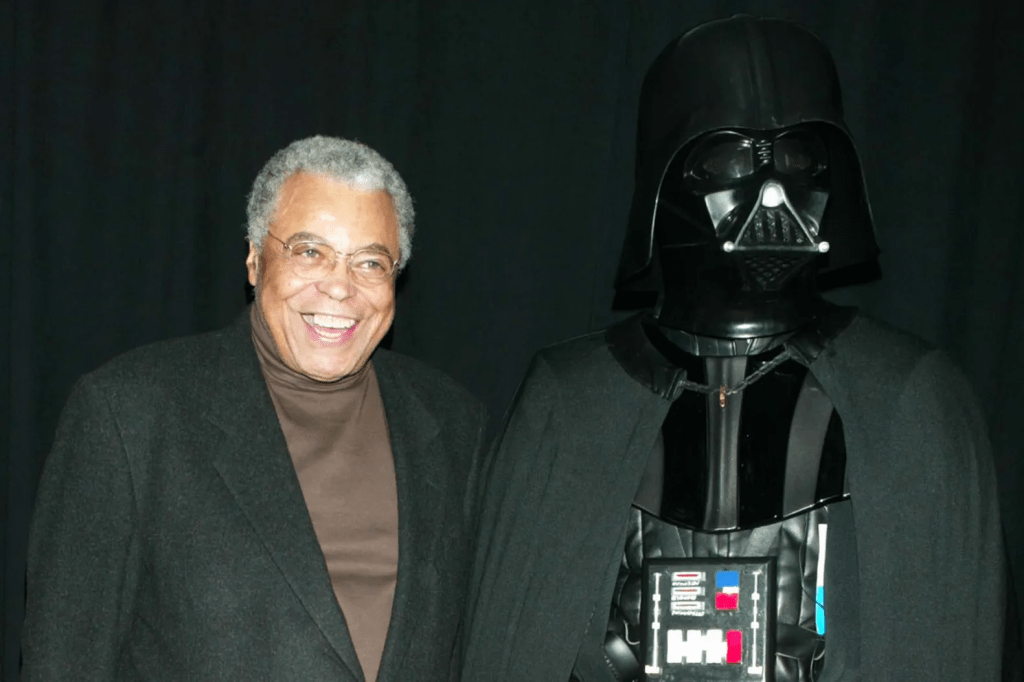
I’ve always bee fascinated with actors like James Earl Jones and their difficult pasts. As a child in rural Mississippi, he had a terrible stutter. For years, he refused to talk as he was much embarrassed. Then, one day, Jones said a teacher made him read aloud.
And when that happened, the stutter was gone. Jones passed away on Monday, Sept. 9 at the age of 93. For many people, he will always be remember for his deep voice that became so distinctive it seemed to resonate with an ASMR calmness but also authoritative boisterous volume. Maybe it was because he worked on the stage where actors are expected to project their dialogue out so everyone can hear that he was able to develop it.
By the time he was called to voice Darth Vader in 1977, Jones had already won a Tony Award for his role in the The Great White Hope and earned both an Academy Award and Golden Globe nomination for the film adaptation. He had played Lt. Lothar Zogg in Dr. Strangelove: Or How I Learned to Stop Worrying and Love the Bomb. In this movie, he uttered the line, “Hey, what about Major Kong?” right before the scene cuts to Slim Pickens as Kong riding the nuclear bomb while waving his cowboy hat around and screaming yee-haw.
Jones would say that Stanley Kubrick, who directed Dr. Strangelove, and George Lucas, who directed Star Wars, were both informal in meeting as they chewed gum and wore sneakers. However, Kubrick was a lot different on set than Lucas who he preferred more. It’s unfortunate that Jones role as Darth Vader is just considered a voice role. If you’ve seen the videos online of David Prowse, may he rest in peace, performing the dialogue of Vader, it’s totally different. It sounds more like like a belligerent leader throwing a fit.
Jones, on the other hand, made the character menacing and mysterious. Just who was it behind the mask and why was he this way? As the original trilogy progressed, we realized that Vader was the main character as the arc was his redemption. Jones was paid $7,000 for his role in the first Star Wars, now called Episode IV: A New Hope. Granted, he doesn’t have as many scenes and dialogue as he does in The Empire Strikes Back or Return of the Jedi. But adjusted for inflation, that’s a mere $36,000 for a well-established actor even though he probably only worked a week in a recording booth at most.
Yet for Empire and Jedi, he brought more depth to the role. In Empire, he seems more demented and violent but there’s a flare of arrogance in him as he sees himself as the most powerful man in the galaxy next to Emperor Palpatine. But in Jedi, he shows he’s more than the Emperor’s right-hand man as he is conflicted. When confronted by Luke Skywalker, he remembers his earlier life as Anakin Skywalker and how he was more humane. In the end, he realizes he was just a puppet all those years for the Emperor.
In a last act of humanity, knowing it will kill him, he kills the Emperor to save his son. And with his last breath, asks Luke to take his mask off looking at his son with his own eyes. It’s more than just a voice role. In the last few decades, we’ve seen that actors can portray animated, CGI and motion-captured characters with emotions, brilliance and depth. Can you imagine Aladdin as good without Robin Williams? Will Smith just didn’t cut it. Or look what Andy Serkis did with Gollum or Caesar in the Lord of the Rings or Planet of the Apes movies respectively.
Jones continued to act in bigger roles, most notably as the savage Thulsa Doom in Conan the Barbarian. He was a powerful wizard and leader of a cult that would use live snakes as arrows. He, himself, turns himself into a large snake in the 1982 movie. But one of my college friends, who is black and a sci-fi/fantasy fan, said seeing Jones made him realize that black actors could play in sword-and-sorcery movies in main roles. Even in the mid-1980s, most black actors were still playing stereotypical roles. Alongside Arnold Schwarzenegger, he has some fun as the evil character giving off a menacing glare to the frightened mother of Conan seconds before he quicky cuts her head off with a sword.
It’s definitely one of the most evil characters to appear on screen. But Jones keeps it from becoming a typical bad guy. Yet, Jones played complicated characters such as Troy Maxson in August Wilson’s brilliant play Fences. It was one of the plays we studied in my first theater class and I remember seeing the images of Jones in my textbook. Jones originated the role for its first production in 1987. Denzel Washington would play the character in the film adaptation in 2016. The play would be used as a basis for the Fox sitcom Roc.
Jones’ theater resume reads like a Murderer’s Row of productions actors would sell their souls to the devil to appear in. He was in Of Mice and Men where he played Lenny, King Lear as the title character, The Cherry Orchard, On Golden Pond, The Iceman Cometh, Cat On a Hot Tin Roof, Othello in the titular role, Hamlet where he played Claudius and Much Ado About Nothing. Altogether he performed in 20 Broadway productions during his lifetime.
Along with the Star Wars franchise, he appeared as Admiral James Greer in three adaptations of Tom Clancy novels (The Hunt for Red October, Patriot Games and Clear and Present Danger). The latter of which reunited him with Han Solo himself, Harrison Ford, who played Jack Ryan. (However, Jones and Ford never did appear on screen together in the Star Wars movies.) Despite his serious roles on stage and screen, he managed to play comedic roles, most notably as King Jaffe Joffer in Coming to America. He would appear on screen with Madge Sinclair. They would both go on to voice Mufasa and Sarabi in the 1994 Lion King animated movie.
Jones’ performance in Coming to America is mostly an reactionary one as he performs alongside comic actors Eddie Murphy and Arsenio Hall. But scenes between him and John Amos as Cleo McDowell are some of the movie’s highlights as two veteran actors in farcical movie. When Cleo is upset over Jaffe upsetting his daughter, he finally lets the King of Zamunda have it and says, “I’m gonna break my foot off in your royal ass” to which Jaffe confused and even a little scared responds, “Pardon me?”
Coming to America is a classic movie that Jones briefly appeared in the sequel Coming 2 America. However, as the movie’s production mostly centered in Atlanta and surrounding areas, Jones’ health prohibited him from traveling from New York, where he was living. His cameo was shot by a crew in New York and through some careful staging and editing was included to make it appear he was with everyone else.
Other comedic roles were in some movies like Three Fugitives, Clean Slate, and Sneakers where he had a cameo as an NSA agent alongside Robert Redford, Sidney Poitier and River Phoenix. But a lot of Gen Xers and Millennials probably remember him as Mr. Mertle, the owner of Hercules, aka “The Beast” who lives near the baseball field in The Sandlot. Mertle had gone blind but was a former baseball player himself who played alongside Babe Ruth.
And speaking of baseball, he played reclusive writer Terrence Mann in the 1989 baseball fantasy Field of Dreams. But some of his best movies are hidden gems, you may not have heard about. In 1987, he played Few Clothes in John Sayles’ retelling of the massacre in Matewan when a battle broke out between hired goons from the mine company and mine workers in West Virginia. And in 1996, he co-starred alongside Robert Duvall in A Family Thing. The movie flew under the radar but it’s a comedy-drama where Jones and Duvall play half-brothers who discover they have the same father upon his death. The script was written by Billy Bob Thornton and the movie came out in the spring of 1996 before Sling Blade made Thornton a household name.
Jones was one of the rare actors/entertainers to receive an Oscar, Emmy, Grammy and Tony, otherwise known as EGOT. The Oscar was an honorary award in 2011. In 1991, he won two Emmys for two productions. One was for a supporting role in the TV movie Heat Wave about the 1965 Watts race riots. The other was for his role on the TV drama Gabriel’s Fire. Along with The Great White Hope, he won a Tony for his work in Fences and received a Lifetime Achievement Award in 2017. And in the Spoken Word category, he won for Great American Documents.
In 2022, Jones officially retired from acting. His final role was as Darth Vader, of course, in the series Obi-Won Kenobi. However, he signed a deal with Lucasfilms for authorization of archival recordings to be used for future productions. It will be used through Respeecher software.
With almost 200 acting credits, Jones was able to cross racial barriers and became an actor whose mere presence on screen was wonderful and memorable. Can you imagine anyone else voicing Mufasa with both a mixture of fatherly warmth and authority of a leader? Not only was he a prolific actor, but he was versatile. He will be greatly missed by many as his appearance in children’s movies opening young minds to his more serious and mature works.
A lot of actors hope for one iconic role, but it’s hard to break his career down to one role. It was impressive and most impressive.
What was your favorite role of his? Please comment.
 Zane Says