Only a comic/actor like Bob Newhart would’ve dared to pulled off the series finale of his second TV sitcom Newhart. Spoilers Alert for anyone who hasn’t seen or heard about it. Newhart had rose to prominence through the 1960s with his deadpan, but clean-cut stammering delivery of humor.
In 1972, he appeared in his first sitcom The Bob Newhart Show as Robert Hartley, a psychologist who lives and works jn the Chicago area. It ran for six seasons before ending in a big-hug finale as an ode to the end of The Mary Tyler Moore Show which had ended the previous year. Both shows were produced to Moore’s MTM Enterprises. And Newhart would also be produced through the same company.
But on May 21, 1990, audiences tuned in to see the end of the show only to discover it had all been a dream. And they loved it! Normally, this is a total cop-out for TVs and movies, with the exception of maybe The Wizard of Oz. Even the TV show Dallas had duped audiences with a whole season they were told it was a dream so they could bring back Patrick Duffy, whose character had been killed after being hit by a car.
It had become a joke throughout the 1980s. When St. Elsewhere, another MTM production, ended with the implication the entire show was from the mind of the autistic Tommy Westphall (Chad Allen) whose father, Donald (Ed Flanders), wasn’t really a doctor, but worked a blue-collar job, audiences were divided. Some said it was too pretentious. Others said it was very imaginative.
So, the series finale of Newhart ended with the Dick and Joanna Loudon (Newhart and Mary Frann) refusing to sell the Stratford Inn to a Japanese real-estate developer while the rest of the cast accept the million-dollar payouts and leave the Vermont town. With the exception of the Inn, most of the town has been turned into a golf course and recreational retreat. When everyone returns wealthier five years later, Dick is so overwhelmed that he accidentally gets hit by a golf ball and knocks out.
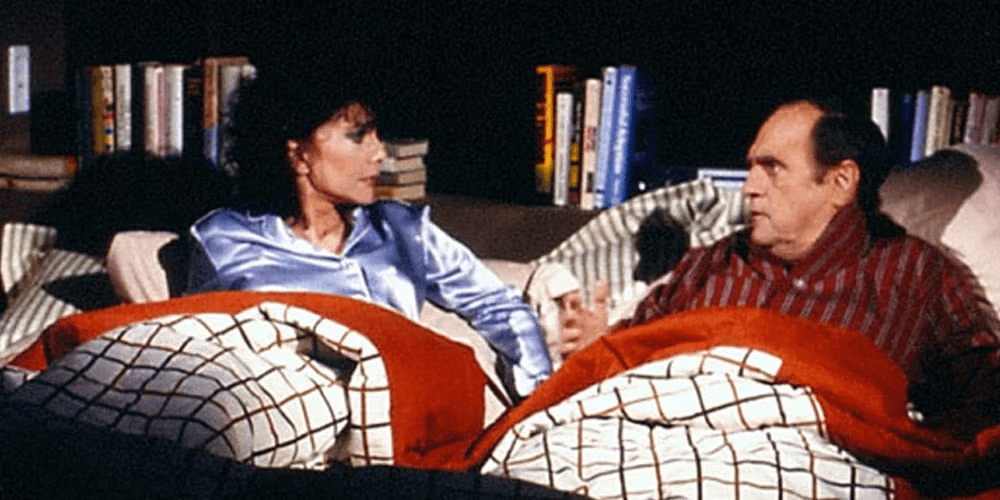
Switch to the next scene is a more modern-updated bedroom on The Bob Newhart Show. And then, there’s some laughs from the audience. Not everyone, but it’s apparent it’s all setting in. Newhart now as Robert Hartley wakes up and tells the person next to him he had a bad dream. She grumbles a little and people recognize her voice. Then the laughter builds and a few people clap.
She turns on the night lamp and turns over to face Robert and it’s Suzanne Pleshette as Emily Hartley. The audiences cheers and laughs. Robert recounts that all the colorful characters that were on Newhart, including the three brothers with only one who talked. (William Sanderson played Larry, and Tony Papenfuss played Daryl and John Voldstad played the other brother Daryl. In the finale, they get mad at their Long Island wives, one of which played by a young Lisa Kudrow, and yell “Quiet!” at them because they’re rambling too much. This also got the audience laughing and cheering. But the genius is to have two characters who never talk tell others to stop talking. It’s like when Mel Brooks had Marcel Marceau say the only spoken word in his classic comedy Silent Movie.) Emily says it was probably a bad dream he had from eating Japanese food too late before going to bed.
But their back and forth banter popular on The Bob Newhart Show continues as Emily wants to know about the blonde wife (Frann) that Robert said he was married too. He doesn’t want to continue and tells her she should consider wearing more sweaters which Joanna often did. And they go back to bed, turning off the lights as the theme song from the 1970s show plays as we even see the credits are in the same font.
Pleshette said that the bedroom set was constructed in secret and only the most important people (director and showrunner producer) knew about it. The cast and crew were only told 20 minutes before the taping. Pleshette had to wait for about six hours hiding out in a trailer before she could come on to the set. Neither her nor Newhart had rehearsed their scene ahead of time.
Yet, it was just like riding a bicycle. They hit every cue and mark on perfect and it was as if the two had been together every day since. Pleshette said she was worried the audience would laugh or get what was going on. The last 10 minutes of Newhart can be seen here: https://www.youtube.com/watch?v=McVWkGWMHKI
It became such a popular ending that when Breaking Bad ended in 2013, fans on the Internet argued the whole series should’ve been a dream Hal (Bryan Cranston) from Malcolm in the Middle was having. Cranston had played Walter White, the science teacher turned drug manufacturer on Breaking Bad, which was a total 180 from his whole as the dopey and quirky suburban dad on Malcolm. Cranston and Jane Kaczmarek, who played Hal’s wife Lois on Malcolm, would actually film this “alternative ending” that went viral months after Breaking Bad ended its run.
The parody ending can be seen here: https://www.youtube.com/watch?v=oVdB36lmbII
There’s been a lot of debate over the decades of who actually came up with the finale. Pleshette said it was Newhart’s wife, Ginnie, who suggested it during Newhart’s second season during a dinner party. However, five years after the series finale, producers Mark Egan, Mark Solomon and Bob Bendetson said they came up with the concept.
Newhart later said it was Ginnie’s idea in his 2006 book I Shouldn’t Even Be Doing This! And Other Things that Strike Me as Funny as well as reiterating it in a 2013 interview: “She said, ‘You ought to end in a dream sequence because there was so much inexplicable about the show.’ She said, ‘You should wake up in bed with Susie and explain what’s so—” and I said, ‘What a great idea,’ and I gave the idea to the writers and they fleshed it out with the Japanese buying the town and our not selling.”
She was right. Newhart had a quirkiness about the characters. It was also becoming very popular in the 1980s to portray New England residents as weirder and more outrageous as normal. Movies like The Witches of Eastwick, Beetlejuice, Baby Boom and Funny Farm portrayed the section of the country as mostly strange country bumpkins. The looniness of a sophisticated psychologist like Robert Hartley living in Chicago imagining eight seasons of a sitcom was one bad dream just made sense.
Married…With Children also paid homage to the “It was just a dream” trope in the sixth season after Katey Sagal who played Peggy Bundy had a premature stillborn. Her pregnancy had been worked into the series. But it was later dropped because the producers felt it was best and Sagal was having to deal with the trauma and grief. Sagal took some time off the show and the whole season was deemed a dream Al (Ed O’Neill) had.
But mainly it was because Newhart seemed to play the same character in just about everything. There really wasn’t much of a difference between Robert Hartley and Dick Loudon. Even his role as Major Major in Mike Nichol’s 1970 adaptation of Catch-22, he gave off his same deadpan stammering style as he instructs Sgt. Towser (Norman Fell) not to let anyone in his office while he’s in his office. However, they can be allowed in his office when he’s not in his office as he prepares a way he can climb out the window without being seen.
Some comics have a harder time adjusting to the big screen because they’ve built up such a persona. Newhart would appear with Dick Van Dyke in Norman Lear’s Cold Turkey in 1971, but wouldn’t appear on screen for another 26 years until he appeared as the principal in In & Out, doing more of his style. Other film roles would include Papa Elf in the 2003 comedy Elf and he appeared in Legally Blonde 2: Red, White & Blonde.
His last on-screen movie role was a cameo in Horrible Bosses as Lou Sherman, the CEO of the company Jason Bateman’s character works for. Seemingly friendly, Bateman’s character learns that Sherman has an employee locked in the trunk of his car for getting his coffee order wrong, thus meaning he’s a “Twisted Old Fuck.”
On July 18, Newhart died at the age of 94 after a short illness. We all have to take our final curtain call sometime. But Newhart made it memorable.
What do you think? Please comment.
 Zane Says
The series ending was memorable. I’ll give them that. I’m not a fan of the dream trope, however. It reeks of lazy writing. This is no reflection on Bob Newhart, however. His deadpan humor was pure genius. He doomed himself to playing himself in everything he appeared in. And he managed to elevate everything he appeared in at the same time.
LikeLike