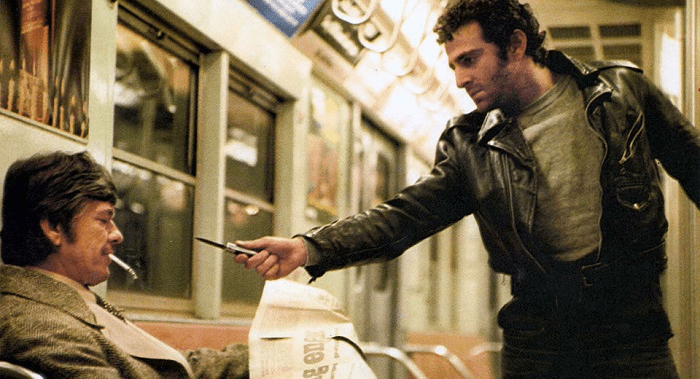
When it was released in July of 1974, Death Wish struck a nerve with audiences. By the 1970s, the war on drugs seemed to have created more crime in metropolitan areas. Brian Garfield had wrote the novel after his wife’s purse was stolen. Last House on the Left had been released the same year as the book. Rape and Revenge thrillers were becoming more popular as filmmakers finally had more leeway with the ratings boards.
But Death Wish would be a totally different style of movie. It was a revenge movie, but it was revenge on a system, not the attackers. Other movies from this era, such as Hannie Caulder and Rolling Thunder, were about people getting back at their attackers. Death Wish, such as Taxi Driver, was about a man who discovers that he has cracked. Just as Travis Bickle blew away the pimp Matthew and the corrupt cop who allows him to operate, Paul Kersey (Charles Bronson), sees crime in New York City as an overall problem.
What director Michael Winner and writer Wendell Mayes do is never make Paul’s politics an issue in the story. His co-worker, Sam Kreutzer (William Redfield), is a political conservative and more than likely a racist. When Paul does architect work for businessman Ames Janeschill (Stuart Margolin), he sees the Tucscon, Ariz., resident is just like Sam but more open about it. It’s Arizona, not New York City.
Even more so, Ames takes Paul for an anti-gun liberal because he was a conscientious objector as a combat medic during the Korean War. However, he discovers that Paul grew up around guns as his father was a hunter, but was killed during an hunting accident. He then promised his mother he would never touch a gun again. This is after Paul is grieving the death of his wife, Joanna (Hope Lange), and the rape and assault of his daughter, Carol (Kathleen Tolan), by some street hoodlums led by a young Jeff Goldblum. They had noticed the address on delivery of groceries to their apartment.
Ames gives Paul a .32 caliber revolver as a gift. In a previous scene that is almost used for comedy but mixes with the hidden brutality that is lurking inside of him, Paul uses $20 of quarters in a sock to practice swinging it at attackers. In an earlier scene, Paul closes the shades while seeing some hoods breaking into a car parked across from his apartment. People like Sam live in the big city but complain about the crime, because they don’t want to do anything. People like Ames live out in the rural areas like Tucscon where they can be windshield cowboys, shoot guns at a club and claim they’re better than the people who live in bigger cities.
But neither Sam nor Ames would know what to do when they are confronted. And neither does Paul. He manages to hit a person with the sock of quarters. But when he takes the gun with him for a walk and shoots a mugger who pulls a gun on him. He goes home and throws up over the trauma. Carol has also had a mental breakdown and is now in an hospital.
The movie doesn’t make Paul into a hero even though the media and the public make him out as a vigilante. Most people either submit to the crime or run from it. The hoods at the grocery store know they can get away with harassing the clerk and the security guard. When goons approach Paul on a subway train as he reads the paper, two black people notice what is about to happen and they get off at the next stop. It doesn’t matter if it was there stop. They’re not going to get involved because it could cause them to get hurt.
Paul’s actions inspire some of the locals to take effect. Some construction workers say they stopped someone from being mugged but ganged up on him. An ederly woman (Helen Martin) says she attacked a mugger with her hatpin. NYPD Inspector Frank Ochoa (Vincent Gardenia) is brought in to investigate the killings and lead a task force. However, he discovers the district attorney and police commissioner don’t want to arrest the vigilante because that would turn him into a martyr. They just want him to stop and maybe move away.
The Ochoa character takes the movie on a different tone. I feel it was done not to romanticize Paul’s actions, especially since most the people he shoots are black or hoodlums. Because Ochoa is constantly dealing with a cold or allergies, it turns him into a more comical character. At the same time, Paul seems to watch as he sees the city changing. At a cocktail party, people discuss the racial overtones even though there are black people there.
The movie ends with Ochoa discovering Paul is the killer and telling him to leave the city so they won’t arrest him. A young Christopher Guest plays the NYPD officer who retrieves Paul’s revolver. Paul Dooley has a small scene as a uniformed NYPD officer at a crime scene. (Despite an online rumor, Denzel Washington doesn’t play a street hood who is shot by Paul.) Actor-director John Herzfeld and Lawrence Hilton-Jacobs (of Welcome Back, Kotter fame) have early roles as street goons.
While the final act seems to rush toward an ending with the police cracking down on Paul, I feel it asks up to ask the question where do we really draw the line. I mean, law enforcement officers are really no different than Paul and other vigilantes. They just do it in a more organized structure. In the olden days when a tribe or group of people were threatened, they fought back. Even as the the American colonies tried to form a modern type of government, they were debated over how to maintain it.
In the annals of human civilization, law and order is still a relatively new concept. The Roman empire had guards who could act as judge, jury and executioner. As the American expansion went west, most towns and communities had to rely on posses to act more as a structured mob to apprehend and detain people who had committed crimes. They were no different than the construction workers who chase down a mugger. And this is all within 100 years of recorded time.
Lynch mobs were a common thing to enforce quick justice, sometimes just on what would be considered hearsay. Even Jackie Coogan, the actor, participated in a lynch mobs. Before slavery was outlawed, people were employed as runaway slave patrol. Even while Death Wish was still in theaters, there was still lynching happening in America, targeting black people. Even though Paul shoots white people, with his first victim being one, it doesn’t shy away from portraying NYC as a society where the wealthier live higher up in condos and skyscrapers and the dregs of society live lower. Even staging a few scenes in subway stations is a way of showing the bad goons live underground like the Morlock species from H.G. Wells’ The Time Machine.
Garfield was upset with the movie adaptation saying it glorified vigilantism. Paul in the book turns into more of the sadistic character he seemed to be in the cheesier sequels. The filmmakers still tried to make Paul sympathetic by putting him in situations where it’s kill or be killed. But I think Winner and Mayes were also building on the public outcry following the incorrect details of the murder of Kitty Genovese. Even when he’s been transferred to Chicago at the end, Paul is the only one at Union Station to come to the aid of a young woman who is being harassed by goons.
I think the movie shows us how people who consider themselves more sophisticated and privileged aren’t as quick to do much to help others. The construction workers are blue-collar working class. The older black woman is probably of simple means. All the people at the cocktail party can’t fathom the “vigilante” is Paul who socializing mere feet away from him.
Strangely, the events of the movie would be echoed in real life. On March 15, 1982, actress Theresa Saldana (of Raging Bull fame) was stabbed by a stalker, Arthur Richard Jackson in West Hollywood while many onlookers were nearby. It was actually a deliveryman, Jeff Fenn, who heard her screaming from inside a building who rushed out to incapacitate Jackson. Serial killer Richard Ramirez, aka the Night Stalker, was obtained on Aug. 31, 1985 when he was recognized by people in East Los Angeles and chased down by a mob of people.
Because he’s an architect, Paul is considered a yuppie and that might be why the muggers see him as weak. Joanna and Carol could’ve carried the groceries home themselves as it appeared they didn’t have much, some people would argue. But why should we live in a society where we’re constantly on guard? This is my issue with people who open carry all the time. Crime is actually down in real life and even NYC is a safer place now than it was in 1974.
But Paul is just like Travis Bickle it would seem. He sees everyone else as the problem and he’s the solution. Travis is a racist and a bad person. Just because he won’t have sex with an underage hooker doesn’t make him an angel. And just because Paul suffered some past trauma, it doesn’t excuse his actions. He even shoots someone in the back while running away and shoots people who are already down on the ground a second time.
People have romanticized Death Wish and the outrageous sequels which gave us more James Bond style villains for Paul to hunt down. Beating up and killing muggers and pickpockets is a quick solution to a growing problem. The police and D.A. are afraid to do things that make them look bad. So they will allow it to happen as long as it makes their job easier.
For all the people who proudly tout “We don’t call 911!” do other people see you as a “good guy with a gun” or a killer?
What do you think? Please comment.
 Zane Says