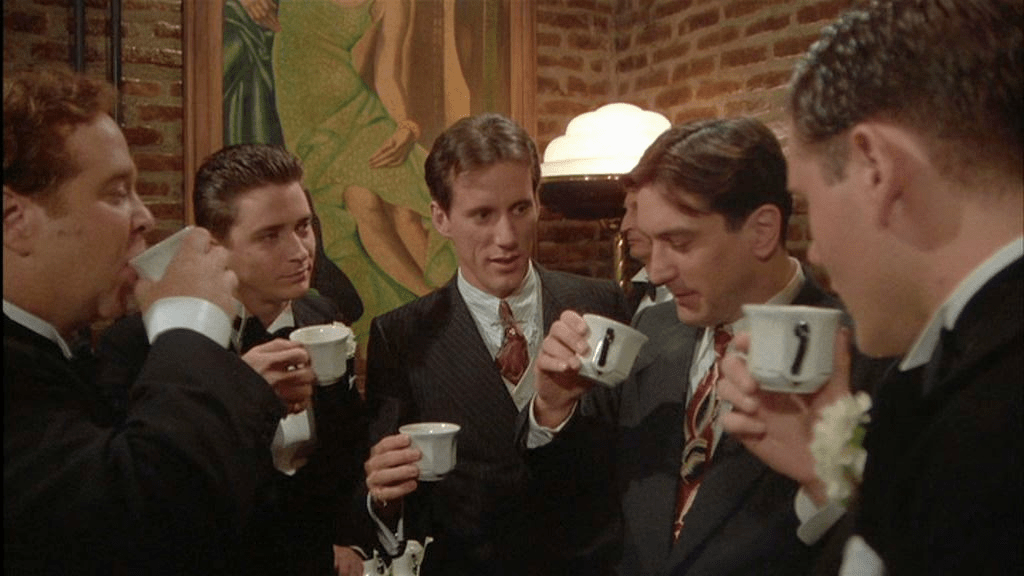
Sergio Leone is mostly remember for his western. He was basically the John Ford of the Spaghetti Western genre, a somewhat misleading term for some good movies. Spaghetti Westerns were known for being filmed in the Iberian Peninsula or Mediterranean area and featured mostly Italian and other European actors. The most famous one is The Good, the Bad and the Ugly with Clint Eastwood, Lee Van Cleef and Eli Wallach. The epic three-hour movie set during the Civil War during the New Mexico territory campaign is a classic along with Ennio Morricone’s brilliant soundtrack and that final climax between all three actors in the cemetery.
But Leone wanted to move away from westerns and become known for something more. In 1968, he made Once Upon a Time in the West, another Spaghetti Western with Charles Bronson, Claudia Cardinale, Jason Robards and a wonderful evil turn by Henry Fonda as the villain. It was a more poetic change with very little dialogue at times with just Morricone’s soundtrack and the imagery to tell the story. After this and the movie, Duck You Sucker!, Leone decided to make an epic movie based on the semi-autobiographical book The Hoods.
He reportedly even turned down the opportunity to direct The Godfather because he wanted to do a different crime epic saga. It would take him over a decade working on the script with numerous writers and trying to get producers and financers to support him. Sadly, when he did get to make his final movie Once Upon a Time in America, he discovered being one of the most revered filmmakers at the time didn’t matter.
SPOILER ALERT!! The following contains spoilers and details of the plot.
In Europe, the movie was released with a run time near four hours. At Cannes in 1984, it received a 15-minute standing ovation. However, The Ladd Company, which helped produced and handle its U.S. distribution through Warner Bros cut about an hour and a half out of a final cut of three hours and 49 minutes Leone had submitted. It didn’t help that many critics had been at Cannes and had seen the longer version, only to be upset when they saw the U.S. theatrical version. But when it hit the the 894 screens across America on the weekend of June 1, 1984, it bombed badly even at a run time of two hours and 19 minutes. It only earned $2.4 million on the weekend and only earned $5.3 million overall in the country.
With a budget of about $30 million, it was going to be one of the biggest bombs of 1984. Late critics Gene Siskel and Roger Ebert ripped the movie apart saying at the cuts did a disservice to the narrative. Some other critics listed it on their Worst lists at the end of the year. The Ladd Company had also made a decision to show the movie in chronological order without Leone’s participation at all. Leone had the movie open in 1933 shortly after Prohibition was repealed, then flash forward to 1968 before finally flashing back to 1922 all within its first hour.
This format was to give some mystery to the main character David “Noodles” Aaronson (Robert DeNiro), a Jewish hood addicted to opium in 1933 who has to go on the run after henchmen kill his girlfriend, Eve (Darlene Fluegel), and rough up his associate, “Fat” Moe Gelly (Larry Rapp). What little we know is that three of Noodles’ crime associates have been killed in a shoot-out with the police. They are Maximillian “Max” Bercovicz (James Woods), Patrick “Patsy” Goldberg (James Hayden), and Phillip “Cockeye” Stein (William Forsythe).
Noodles goes to a get a suitcase out of a locker at a train station only to discover it filled with newspapers instead of the money he anticipated. He walks away penniless and alone taking a one-way ticket on the first departure to Buffalo, N.Y. He changes his name to Robert Williams and makes spends 35 years in upstate New York. However, in 1968, he returns to the old neighborhood, an aging man in his 60s. Moe is still in business but has gone legitimate again turning the family business back into a restaurant. He’s now living in the back where the speak-easy was.
Noodles tells Moe that while he’s been hiding out someone has found him and they know his aliases. Moe lets Noodles stay with him and it brings back memories of his childhood. This is where the movie flashes back to when Noodles was infatuated with Moe’s sister, Deborah (Jennifer Connelly as a teen), who is always practicing to be a dancer and actor. Noodles, played by Scott Tiler as a teenager, is a petty small hood, along with Patsy (Brian Bloom), Cockeye (Adrian Curran) and the youngest, Dominic (Noah Moazezi), are workers for the neighborhood crime boss, Bugsy (James Russo). Bugsy gets the youngsters to do his dirty work so his hands are clean.
However, a teenage Max(Rusty Jacobs), gets the best of them when they are told to roll a drunk. Max is moving into the neighborhood and after an initial stand-off, he becomes friends with Noodles as they blackmail the crooked Officer Whitey (Richard Foronjy) to allow them to operate. They work along with the Italian Mafia on a way to use salt and balloons to keep the bootleggers from losing their shipments when they have to throw them overboard in the harbors. They quickly become rich for their means.
Yet, Bugsy learns of this and at first uses some other teenagers to assault and beat up Noodles and Max to deter them. When that doesn’t work, he shoots at them after they put the suitcase in the locker. Dominic is shot in the back and dies as they scatter to hide. Noodles in anger fatally stabs Bugsy as he tries to shoot Patsy. But Noodles also accidentally stabs the police trying to arrest him. He’s set to prison as a juvenile delinquent for the rest of his teens before he getting released in the early 1930s.
During this time, Max, Cockeye and Patsy along with Moe have a speak-easy in the back of the restaurant. They’re also running a prostitution business organized by Patsy’s girlfriend, Peggy (Amy Ryder). Yet, Noodles quickly finds himself getting back in business with the Mafia with crime boss Frank Monaldi (Joe Pesci), even though he wants to begin a relationship with Deborah (now played by Elizabeth McGovern).
At the same time, they get involved offering protection for labor boss Jimmy Conway O’Donnell (Treat Williams) from corrupt police chief Aiello (Danny Aiello) and other mobsters. But Noodles and Max come to an impasse as Max wants to get more involved with the Italian Mafia and their organized crime while Noodles wants to stay doing their own thing without getting in their way.
As Prohibition ends, Max wants to do the ultimate score by robbing the New York Federal Reserve, something that Noodles think will be complete suicide. And the two begin to grow distant over time leading to Noodles thinking if he can tip off the police as they go for one final bootlegging run, they’ll be sent to prison together and Max will forget about the Federal Reserve. Unfortunately, that doesn’t happen.
As an aging old man, Noodles discovers that O’Donnell is involved with the mysterious George Bailey who is the current Secretary of Commerce living in exile as his mansion on Long Island as an investigation is underway. It’s believed the Teamsters have intended to kill Bailey in a car bombing. Noodles also discovers the bodies of Max, Cockeye and Patsy have been move to a Mausoleum in a cemetery the year before. A plague indicates that Noodles arranged for it and there is a key hanging that is for the same locker at the train station decades before. Noodles discovers a new briefcase with money in it with a note that it’s an upfront payment for a job that he deduces is a hit.
Deborah’s dreams of becoming an actress have come true as she is performing on Broadway as Cleopatra. However, she has become estranged from Moe who hasn’t seen her in years. Years earlier, Deborah left NYC for Hollywood in the early 1930s, a move that angered Noodles who violently raped her the night before she was set to leave. Noodles meets Deborah backstage and mentions about the invitation he received to Bailey’s upcoming social party. Deborah is in fact Bailey’s lover and as he leaves, he notices Bailey’s son is there who is also played by Jacobs.
It turns out that Max faked his death with help from the police and the mobsters. However, his involvement in the Teamsters scandal and investigation will eventually lead to his death. Bailey says he wants Noodles to kill him to spare him what will happen to him at the hands of others. Carol (Tuesday Weld) tells Noodles earlier that Max’s father was put away in a sanitarium and Max never wanted to end up locked up. However, Noodles pretends he doesn’t recognize Max even though it’s obvious he does and refuses to kill Max admitting indirectly he was sorry for double-crossing his friends and he’s lived an uneventful life for all he’s done as atonement.
Noodles leaves through a secret passageway but as he leaves the mansion estate, a garbage truck starts up. He turns to see a man who resemble Max walk alongside it hiding his view from Noodles. As the truck passes, Noodles watches the screw conveyor grinding garbage but the man is nowhere to be found. It’s assume the man believed to be Max jumped into the truck committing suicide.
The final scene of the movie flashes back to 1933 with Noodles visiting the opium den at a Chinese theater to get high again. Leone has said that Noodles’ opium use plays heavily into the movie’s structure as it’s possible Noodles could be hallucinating. One thing in particular that makes this true is the way Max assumes the identity of George Bailey, which was also the name of the main character played by Jimmy Stewart in It’s a Wonderful Life. Bailey in that movie is given a brief glimpse of an alternative world if he hadn’t been born.
Also, anyone who knows their U.S. history and government a little too well knows that during the late 1960s, four people held the position of Secretary of Commerce between a two-year period. It’s also not a huge Cabinet position that gets a lot of attention compared to the others. Maybe it was a joke on America’s infrastructure at the time.
Also, when he visits Deborah, she still looks younger. However, since she’s an actress and attached to a millionaire, she could’ve had plastic surgery as Carol has aged 35 years when Noodles visits her at a retirement home. There’s also the issue of Noodles seeing O’Donnell on a color TV in 1968 as television was still an unknown invention in 1933. Also at the terminal in 1933, there is a huge mural on the wall of the entrance/exit encouraging people to visit Coney Island. In 1968, there’s just the famous LOVE mural.
Whether or not Noodles is actually hallucinating is left up to the viewer. It does seem odd that Deborah would be pleasant toward Noodles after the last time they were together. Deborah is even concerned for Noodles’ well-being advising him to stay away from Bailey’s party. However, I do think it could mean that Deborah really loved Noodles as much as he loved her. She just had to get away from him but as she aged, she knew she’d have to get Max as her lover in order to maintain her lifestyle.
Even with the shorter version, the rape of Deborah was left but cut. A scene in which Noodles forcibly has sex with Carol as she was the inside person on a diamond heist is also shown in the shorter version. Along with the chronological timeline, the movie does away with the garbage truck scene ending with Noodles hearing a gunshot off camera as he leaves. Then the credits roll. That’s it. What a way to cheat people. He also walks out of the passageway without knowing how it’s there.
Also by first focusing on Noodles and Max and the rest when they were kids, it’s hard to sit through the first 30-40 minutes. You keep wondering why it’s done this way. Yes, Francis Ford Coppola had done the same thing with The Godfather Saga, but that was many years after people had seen the first two Godfather movies in their intended format. From the start, Leone had intended to portray us having some sympathy for Noodles as goons are trying to kill him and also kill Eve. However, we discover that Noodles actually wasn’t a really nice guy to begin with.
Sadly, it makes the killing of Eve more tragic because she truly did love Noodles. In many ways, I think Noodles saw her as a rebound woman, someone he could be with after what happened with Deborah. She’s not fully aware of how bad Noodles is, even when they’re on a trip to Florida, she’s lounging in a chair next to Carol who Noodles has had sex with it. And we also know that Max probably sent the goons to Noodle’s home and demanded they kill Eve if she is there. Later, as George Bailey, he was able to get Deborah as he knows it would hurt Noodles in the end.
I think Leone was trying to break down the romance and glorification of the organized crime syndicates of the Prohibition era. Most Jewish gangsters didn’t last long. They worked with the Italian Mafia during Prohibition but then they mostly went straight by the 1940s. Benjamin “Bugsy” Seigel and Meyer Lansky were a few of the famous Jewish mobsters. Noodles represents the gangsters who wanted to take their money and go legitimate while Max wanted to stay with organized crime and make more money with O’Donnell and other labor unions, especially the Teamsters.
Leone spent years working on the script as the book by Harry Grey, whose real name was Herschel Goldberg, a Russian-Jewish former gangster. Leone was one of six writers who are credited with the script. It took him 10 months to film the movie. Ironically, most of the filming didn’t even happen in America except for some necessary scenes. Filming was done in Florida, Canada, France and mostly in Italy as interior scenes were filmed at Cinecitta Studios in Rome. He had reportedly assembled 10 hours of a footage that had been edited down to six hours by Nino Baragli. Leone’s desire was to release the movie as two 3-hour movies. Yet the producers refused because of the failure of Bernado Bertolucci’s 1900 which also starred DeNiro. It had a run time of about 317 minutes before being released as a two-part movies.
Then, Leone also cut it down to about four and a half hours which still was too long, leading to the official three hours and 49 minutes. Yet, I once had a two-cassette VHS copy that was about three hours and 46 minutes if I remember. I think the scene of Deborah being raped had been cut down. There was also cuts made to the rough sex scene between Noodles and Carol. And if I remember correctly, there is a scene of a goon at the Chinese theater intimidating a woman by rubbing the barrel of his pistol around her nipples that is in the version now streaming that was absent from the VHS versions. Funny how the movie’s violence was left unedited.
The shorter version is considered a rare find and isn’t shown anymore. Yet, if I remember correctly, some cable networks like A&E would air it edited in the 1990s. In the mid-1980s, HBO would broadcast both versions because even though I was barely in elementary school, I remember the ending of DeNiro’s face smiling as the credits rolled. HBO would also broadcast both versions of Saturday Night Fever as well as the PG rated version of Excalibur. As of this posting, the only place streaming the shorter version is on Internet Archives, a popular site for bootleg movies and videos. Hulu is currently streaming the European version as it’s known which ran at Cannes.
Even 40 years later, the movie’s legacy is heavily criticized among filmgoers. A lot of criticism I have heard is over the rape of Deborah, which even McGovern defended it as not glamorizing violent sex. “it is extremely uncomfortable to watch and it is meant to be,” she said in a 2000 interview. “And if you say, ‘this violence is wrong,’ you’d have to enlarge that to say, ‘all violence in movies in wrong,’ and then you’d have to say, ‘you can only make movies about good people who obey the law and do right things’ which a) excludes a lot of what life is and b) makes for some very boring movies.”
The misogyny and violence toward women has been one of the reasons most people have denounced it. However, if you look at the era in which it was released, it was considered quite common for men to treat women like this. Or even worse. Leone scholar Christopher Frayling has said the central gang members are emotional stunted still acting like small boys when they are adults. Most of the gang grew up without much adult supervision. Max doesn’t have a father and Noodles avoids his. They’re never taught right from wrong. When mobsters show you more attention, you’re going to gravitate toward them. Child labor laws didn’t fully go into effect until the mid-1920s so school was never really an option for them.
For a little bit of comic relief, they switch the numbers on the newborns at the hospital, so Aiello will work with them. He parades happily around the hospital room because he’s got a newborn son after having several girls telling them the son who is younger than they is going to be the boss of the house when he’s gone. Yet, he’s shocked to realize the nurse gave him a girl. Aiello is played up for laughs as a boorish example that proves just because he is a law officer, he is no different from the Jewish mobsters.
I remember I once heard one critic refer to the movie as the forefather of the Director’s Cut, something that has become all too popular mostly for commercial reasons. Because of pay cable and the home video market, Leone’s European version has been seen by more people over the years. Yet, other filmmakers such as Brian DePalma and Martin Scorsese have worked with Leone’s family to get the four and a half hour version restored where it was shown at Cannes in 2012.
Sadly, Leone never lived to see it as he passed away in 1989 at the age of 60 after years of bad health. Seeing his pet project taken from him didn’t really help him, some have said. Worse, the theatrical version left Morricone’s beautiful musical score off the opening credits, thus disqualifying it on a technicality for an Oscar nomination. Morricone would finally win in 2017 for his musical score to The Hateful Eight. He passed away on July 6, 2020 at the age of 91. Hayden himself would die of a heroin overdose after production ended as he was performing American Buffalo on stage with his friend, Al Pacino.
With DeNiro in the news again following his speech outside Donald Trump’s trial, it’s a reminder of the corruption that still exists today in American politics and the workforce. Ironically, Woods is now a pro-conservative Trump supporter known for his disturbing, creepy behavior. Incidentally, DeNiro and Woods didn’t really get along well making the movie as Woods criticized DeNiro’s method acting.
What do you think? Please comment.
 Zane Says