Back in 1971, a young up-and-coming TV director named Steven Spielberg was given the opportunity to direct a TV movie in which Dennis Weaver played a businessman harassed by the driver of a tanker semi on desolate Southwestern highways. The movie was called Duel. There was such critical acclaim for it that the movie that Universal which had produced the movie through its TV production division had Weaver and Spielberg come back to film an additional 15-16 minutes of footage, and distributing it as a feature movie.
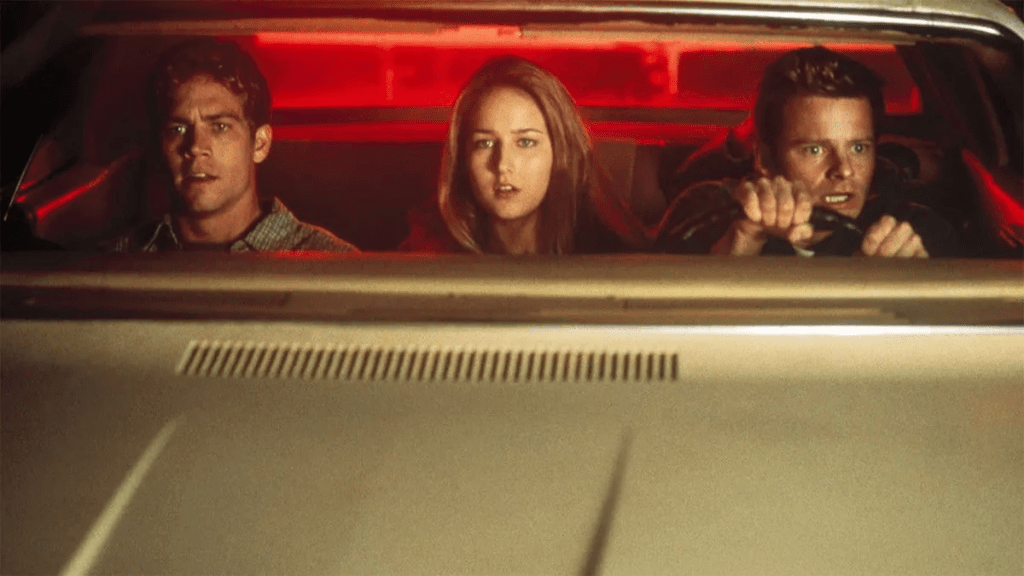
The movie had a profound effect on the public. My mother said she was cautious against passing semi trucks for years. There really was no reason why the driver, whose face is never seen, is upset with Weaver’s character. But it slowly escalates over time from mere road rage to acts of violence. In Joy Ride, released in 2001, it’s quite evident why the driver of a semi truck is harassing two brothers Lewis Thomas (Paul Walker) and Fuller Thomas (Steve Zahn). Considering the movie is co-written by J.J. Abrams who has looked up to Spielberg so much, it’s no wonder it can be compared to Duel.
However, Abrams, who co-wrote it with Clay Tarver, and especially the underrated movie John Dahl, know people going in have some knowledge of Duel. Good filmmakers don’t assume they’re presenting a new idea and even though Abrams has failed as a director in my opinion, he can still manage to write a good script as long as a better director handles it. Also, in the aftermath of Scream and In the Line of Fire, it’s not enough to have someone quietly terrorize people, they have to do it via phone or some other form of telecommunications. Joy Ride switches it up a little and using a CB radio as the form of communication. And with Ted Levine whose voice is only heard as a driver under the moniker Rusty Nail, it adds to the tension.
Lewis is a college student who is a few days away from leaving college in California for the summer when he is talking to his childhood friend, Venna Wilcox (Leelee Sobieski), who he has a crush on. He decides he can cash in his plane ticket to buy a car to drive both of them home. He will pick her up in Colorado and he thinks this will give them the time they need. However, he’s told by his mother on the road, Fuller has been arrested in Salt Lake City on misdemeanor charges.
He makes a detour to bail Fuller out who tags along. But along the way, Fuller installs a CB radio. As a joke, Fuller convinces Lewis to talk like a woman who calls herself “Candy Cane.” Fuller equates it to pranking people on Internet chat rooms. Eventually, they talk to Rusty Nail on the radio but lose the transmission before they can tell him it’s all a joke. They stop at a road-side motel in Wyoming for the night. But as Fuller tries to get a room, a belligerent middle-age man, Ronald Ellinghouse (Kenneth Wise), berates the night manager, who is of east Indian ancestry. He even is rude and hostile to Fuller.
They hear Rusty Nail on the radio before retiring to their room and trick him into showing up to Ellinghouse’s motel room, which is next to theirs. However, when it happens, they hear what they think is a heated argument and assault. The next morning, local sheriff deputies are investigating an assault. Ellinghouse was beaten severely and left for dead on the highway miles away. Lewis and Fuller come clean and tell authorities what they did much to the anger of the sheriff who tells them to leave and never come back.
As they head toward Denver, they hear Rusty Nail on the radio and tell him it was all a joke. But he tells them he is behind them on the roadway and needs to get the tail-light fixed. From there, they believe Rusty Nail is following them. Because he mostly communicates with them at night, the darkness keeps them from knowing who it is or where he is. And because it’s 2001, they don’t have a cell phone to call 911. And the area in which they’re traveling doesn’t have many decent and safe spots to stop for help. The movie works because it was released at a time when CB radios had gone mostly out of fashion and having a cell phone was still not as popular. (Of course, the movie never addresses the notion that other people on a CB might be hearing all this as well.)
The movie works on the tension of being on the road far from home and being terrorized by an unseen presence. I also think the movie has some social commentary about the divide between classes. Both Lewis and Veena are college students. And Lewis has enough money to purchase the 1971 Chevrolet Newport, either by cashing in the plane ticket as a down payment or buying it outright. At several times, Lewis and Fuller flash a credit card and even take the car to a repair shop without worry how they’re going to pay the bill. Yet, we may not know that Rusty Nail is having to haul for long hours to make money. He may have been cheated out of pay.
At a bar at another motel, some locals get into an argument with Lewis as he tries to keep them away from harassing Veena. But the movie also makes Ellinghouse, who is a businessman stuck up toward the night manager of the motel. It’s one thing to pull a prank on someone and I’m not defending the actions of Rusty Nail, but it’s best not to mess with people if you don’t know what they’re capable of.
Not to give many spoilers away but we eventually do see the face of Rusty Nail and he’s played by Matthew Kimbrough. The climax involves an impressive Rube Goldberg style trap in which one of the main characters’ lives is in danger and another is trying to stop it. It’s a tense scene and it works. Mainly because Joy Ride works best as a B-movie road thriller that acts both as an homage and a legitimate entry.
The movie was released in October of 2001 months after Walker appeared in first Fast and Furious movie. It’s crazy how his life, career and early death all revolved around vehicles. Unfortunately, the earlier part of his career revolving around teen movies and the Fast and Furious franchise left much of his latter career with a lot of forgettable movies and roles. He was cast as Marine Sgt. Hank Hansen in Clint Eastwood’s Flags of Our Fathers. But a lot were basic action thrillers that came and went.
What do you think? Please comment.
 Zane Says