With Christopher Nolan picking up two Oscars this past week for directing and producing Oppenheimer, it’s hard to believe it took him a quarter of a century to finally receive this award. From the get-go, Nolan has proven to be an amazing filmmaker and storyteller. He seems to be one of the few directors nowadays who harkens back to the era of New Hollywood where Brian De Palma, Francis Ford Coppola, Steven Spielberg and Martin Scorsese were the new captains of the industry.
The movie was released back in 2001 this weekend and still remains one of the most surprising movies from both a technical and storytelling standpoint. I must say that this post contains spoilers as it’s more of an examination rather than just a review. And even though it’s not a true horror movie, it’s a mystery that asks us who to question only to conclude that we can’t really believe anyone. The horror of protagonist Leonard Shelby (Guy Pearce) having short term memory and unable to make new memories because of a brain injury, he has to put all his faith in what his records and how to read other people. Yet our memories are our own records and we choose which are most important. You can’t tell anyone what you had for lunch two weeks ago, but you can remember a school fight you witness at recess or may have even been in. It’s because you don’t get in a fight every day, but you probably eat lunch.
Leonard used to be a claims investigator for an insurance company. However, some time in the past, he tells people his wife, Catherine (Jorja Fox), was sexually assaulted and murdered during a home invasion. Leonard was knocked unconscious by an unseen assailant as he went to her aid. With his wife dead and unable to convince the police there were two people who assaulted his wife, he has gone on a mission of tracking down the assailant who he only knows by the name “John G.”
Leonard takes Polaroid pictures of people and places with notes on them to remember. (But the $64,000 question is has he ever forgotten to take a photo?) He also has tattoos all over his body to give clues of who to track and what to do. Nolan starts off by showing Leonard shooting a man (Joe Pantoliano) who calls himself “Teddy.” He has a picture with a note on it saying Teddy is the man who shot his wife. But is it? Nolan sets Leonard’s quest in reverse to show how things happened to Leonard shooting Teddy.
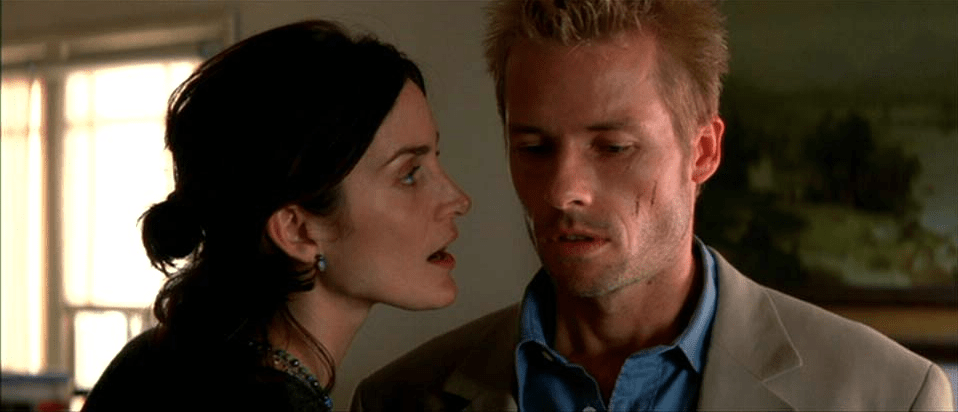
Some might find this concept to be a gimmick, but Nolan who wrote the script based on a story by his brother, Jonathan, manages to make it work as Leonard goes through many days in a neo-noir format as he interacts with lowlifes in a California community who may or may not be connected with the murder. One of those is Natalie (Carrie Ann Moss), who works at a bar where she helps her boyfriend, Jimmy (Larry Holden), deal drugs. Natalie at first mistakes Leonard for Jimmy when he pulls up outside the bar as he drives the same car.
Leonard stays at a run-down shabby hotel where the clerk, Burt (Mark Boone Junior), exploits Leonard’s condition to rent him an extra room. And then there’s Teddy who seems to constantly show up when Leonard doesn’t expect him nor knows why he’s there. Teddy claims to be an undercover cop, but considering that every time Leonard sees him, he can say he’s whatever and Leonard won’t know. All he has is a picture.
At the heart of the movie is the belief we never really do know anyone in our own lives. Even more cerebral is how we remember what we want to. Teddy tells Leonard to write on the back of the picture of Natalie “Do not trust her” which he does in cursive. He prints all the notes on the other photos and when Teddy leaves, he crosses it out. Mainly because Leonard may not really trust Natalie but he discovers he would rather like the fantasy as she shows him some sympathy. But Natalie isn’t what she seems.
And for that, neither is Leonard. Along with the scenes shown in reverse, Nolan cuts to black and white scenes of Leonard sitting in the motel room talking on the phone recounting his life and times as an investigator. He has “Remember Sammy Jankis” tattooed on his hand. He tells the unknown caller about Sammy (Stephen Tobolowsky), who was a certified public accountant who also claimed to have short-term memory loss or anterograde amnesia, which is the technical term. Sammy and his wife (Harriet Sansom Harris) had filed a claim which Leonard investigated. However, Leonard felt Sammy was faking.
With Sammy unable to work as a CPA, their financial problems mounted and the frustrations increased. Sammy’s wife would become upset with Sammy’s inabilities to remember. She ended up trying to call Sammy’s bluff by having him repeatedly administer insulin shots suspecting Sammy would remember. Yet, she dies. This goes back to a medical examination Sammy was administered by a doctor (Thomas Lennon) were Sammy was constantly shocked picking up objects. The theory was that Sammy would eventually remember which object was electrified. And that he kept failing and getting upset with the doctor because he was trying to fake it, everyone thought. So, his claim was constantly being denied.
However, Nolan drops hints that it’s not Sammy but Leonard. Sammy was real but Teddy eventually tells Leonard that he was a conman and Leonard exposed him as an investigator. However, it was Leonard who was the one who couldn’t remember when his wife needed her insulin shots. Leonard has made “Sammy Jankis” the fall guy for his own faults. In fact, Leonard actually saved Catherine who was being suffocated but since he couldn’t remember anything since then, he concluded that others must have done it. He couldn’t have possibly killed his wife by giving her too many insulin shots. There’s a frame of someone passing in front of Sammy sitting at a mental hospital and it quickly switches to Leonard before moving to another scene.
This is where casting works very well in a movie. Maybe it was kismet Memento would be released in the aftermath of The Matrix when Moss was seen as the heroic Trinity and Pantoliano is the double-crossing villain Cyber. Or maybe it’s because his filmography has him playing villains and shady characters in so many movies like Risky Business, The Goonies and Running Scared. Fans of the HBO series The Sopranos were watching Pantoliano as the sleazing murdering Ralph Ciferato. With the exception of The Fugitive and its sequel U.S. Marshals, he’s hardly ever played a good guy.
So, who do we really believe? Teddy says Leonard already killed the other attacker years before. He believed Leonard there were two people in the house and while Leonard killed one attacker in self-defense before he was knocked unconscious. Teddy was one of the cops assigned to the case and helped Leonard track him down, even taking a picture to celebrate the occasion.
But Leonard has refused to accept it or to believe Sammy was a conman. Tobolowsky has been acting for years. But you probably remember him as Ned Ryerson, the insurance salesman who went to school with Phil Connors in Groundhog Day. In that movie, Phil wakes up every day and it’s Feb. 2 as no one in Punxsutawney, Pa. remembers Phil even though he knows everything about them and what’s going to happen. Tobolowsky has said he’s suffered from amnesia in real life. I don’t know if Nolan and producers Jennifer Todd and Suzanne Todd cast him because of the connection to Groundhog Day. In the late 1990s, when Memento was being filmed, Groundhog Day wasn’t as popular as it is now. Yet, both movies have a peripheral connection. It could just be one of those things that falls into place because the universe aligns correctly.
At first, we want to sympathize with Natalie because she seems friendly. Even after she takes away a beer mug that everyone including Leonard has spit in after Leonard drinks out of it, we assume Natalie is going to be a nice character when she realizes his symptom is real. However, later she uses Leonard to go after another thug, Dodd (Callum Keith Rennie). But if Teddy is also a cop, he’s using Leonard to go after drug dealers like Jimmy, who it’s revealed at the end (or the beginning?) that Leonard killed when Teddy steered him toward the drug dealer. Leonard takes Jimmy’s clothes, car and money, forgetting how he got them telling himself and others it was from the insurance money for Catherine’s death. This is why Natalie mistakes Leonard for Jimmy because he’s driving Jimmy’s car.
Both Natalie and Teddy are using Leonard to do their dirty work. Teddy tells Leonard he’s sympathetic but in the end (or the beginning), Leonard manages to get Teddy’s license plate number so he can continue to track “John G.” This makes Leonard an unreliable narrator. I noticed that both this movie and American Psycho, released a year earlier, both have David Bowie’s “Something in the Air” playing over the end credits. Both movies are about unreliable narrators with illnesses that affect their memories.
Yet, it’s uncertain who to believe. I would argue Nolan, himself, isn’t sure after all these years. Just like whether Leonardo DiCaprio’s character at the end of Inception is still dreaming or if Florence Pugh’s Jean Tatlock really killed herself or was murdered in Oppenheimer, Nolan doesn’t want to make a definite answer. Just like the Mandela Effect, we remember what we want to remember. There’s even been some theory that Bruce Wayne did die at the end of The Dark Knight Rises and Michael Caine’s Alfred only saw him in Florence because he wanted to believe Bruce was still alive dating Selina Kyle. Alfred needed the “Happily Ever After” ending because he couldn’t deal with the fact that he had failed to protect Bruce.
Even though he doesn’t remember he accidentally kill Catherine, the idea he did is still out there. So, Leonard has to keep chasing a “John G.” in every town he can. It’s possible he was found mentally incompetent to stand trial in Catherine’s death, released from medical care and still did get an insurance payment, possibly even a disability claim of his own. It’s never really explained how much of a time frame has passed between Catherine’s death and the current story. It’s possible Teddy may have since retired from the police force himself which is how he’s able to constantly tail Leonard.
I’ve covered quite a few cases where family of murdered victims have wanted to talk and others haven’t wanted to say anything. Some people don’t want to remember one of the worst days of their lives. On the other hand, Leonard wants to remember but his punishment is he can’t.
What do you think? Please comment.
 Zane Says