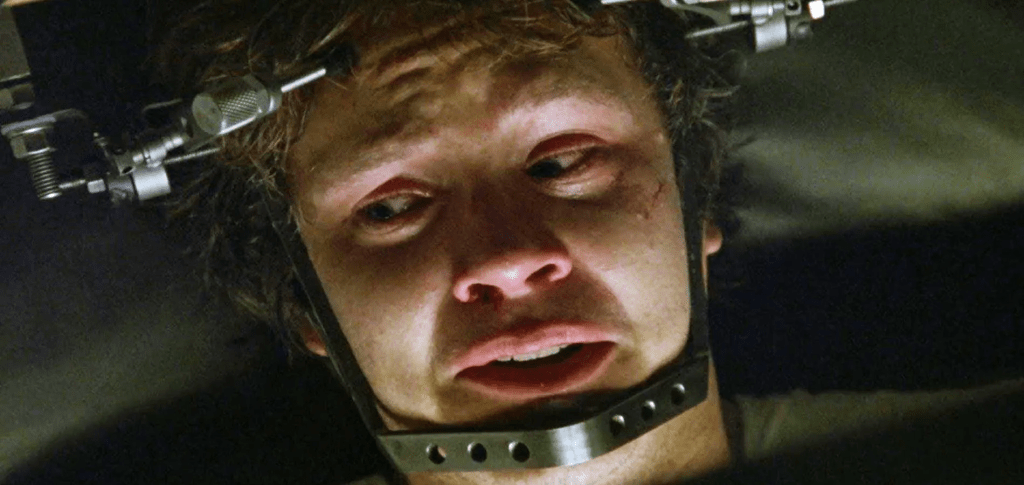
Christmas may be over but a movie like Jacob’s Ladder isn’t technically a Christmas movie. It’s set in the dreary late fall/early winter of December for a reason. It’s about the darkness a man experiences following a traumatic experience.
Jacob Singer (Tim Robbins) was once a philosophy professor but after his youngest son, Gabe (Macaulay Culkin), was killed in a car accident, he says he didn’t want to think anymore and has enrolled in the Army. He’s stationed in the Mekong Delta in Vietnam as an infantryman with the Air Cavalry division. One night in early October 1971, Jacob and his unit are lounging around in the bush when they come under sudden attack.
At the same time, several of the unit members suffer health problems. One of them, George (Ving Rhames), suffers seizures. Another, Frank (Eriq La Salle), vomits violently and suddenly. His other fellow infantryman, Paul Grunegar (Pruitt Taylor Vince), suddenly has a mental collapse and just starts crying. Jacob seeks shelter from the attacks but is stabbed by a bayonet in his lower abdomen by an unseen assailant off screen.
Then, Jacob wakes up four years later on a nearly empty subway train. He now works as a postal worker and lives in a rundown apartment building in Brooklyn with his girlfriend, Jezebel Pipken (Elizabeth Pena), who also works at the same post office as he. But Jacob has been seeing some weird things. On the subway, he thinks he sees something like a tail or tentacles poking out beneath a homeless person’s clothes as they sleep.
Things get worse as he begins to see more creepy images of what he thinks are demons or nightmarish creatures. But what is he really seeing? Adrian Lynne, as director, films these images in such a way that we can’t tell what’s happening just like Jacob. Everything is kind of a “Did I see that?” image. But when he tries to contact his doctor at the VA, the crabby receptionist says there’s no record of him. And when she loses her cap briefly, Jacob thinks he sees horns or some type of growth or tumor on her head. He’s told that his regular doctor died in a car explosion.
Throughout the movie there are flashbacks to the night in 1971 where his unit came under attack and Jacob was airlifted for medical treatment. It seems the only one who he can really talk to is his chiropractor, Louie Denardo (Danny Aiello), whose very sympathetic and during one scene, Jacob says he looks like an angel. His relationship with Jezebel has highs and lows as he suffers a dangerously high fever and she works to get it down until the doctors arrive. Lewis Black appears in an early role. But she gets frustrated with his behavior as he spends too much time inside and looking over old photos of his family that she burns because it makes him sad.
Pena has a difficult job here because it’s easy for people to see Jezebel as the nagging girlfriend, but as Jacob is unable to say exactly what’s happening to him, they both suffer. A meeting with Paul ends with him dying in a car explosion himself after he tells Jacob he’s suffering from the same experiences. After a reunion following his funeral, his unit decide to file suit against the government. However, their lawyer (Jason Alexander) drops them when he can’t find records they were in combat. Then, the unit members say they don’t want to pursue another lawyer. At the same time, there’s a strange man, Michael Newman (Matt Craven), who seems to be following Jacob.
This was one of Robbins’ first dramatic roles after appearing in mostly comedies in the 1980s (The Sure Thing, Fraternity Vacation, Bull Durham as well as the infamous flop Howard the Duck). He turns Jacob into a complex character. And while some might not agree with his political beliefs, what hell he’s put under in this movie will either make his critics happy or his fans like him more. It’s a difficult job and I don’t think a more well-established actor would’ve taken on such a role. You also don’t want a big-name star in this role because the audience won’t be able to relate as much.
Also, I don’t think many people will appreciate the ending. SPOILER ALERT!! It’s revealed by Newman that he had been working for the Army chemical warfare division and designed a drug that was secretly administered to the troops. Unfortunately, it backfired resulting on Jacob’s unit being attacked by another Army unit. Jacob himself was stabbed by a fellow infantryman.
In the end, Jacob returns back to the Brooklyn Brownstone where he lived to see that Gabe is waiting for him and they walk up a flight of stairs together. Then, the scene goes to a triage tent in Vietnam where Jacob is pronounced dead from his wounds. The doctors say he held up a good fight and remark how peaceful he looks. This goes back to something Louie told Jacob about Meister Eckhart who said if people are afraid of dying, then there are devils that tear them apart. But once you’ve made peace, the devils are really angels, freeing you from the earth.
This means that most of what we’ve been watching is a type of alternative life flashing before Jacob’s eyes. He even sees himself waking up in the Brownstone when Gabe was still alive telling his wife, Sarah (Patricia Kalember) that he had a dream he was dating Jezebel who he refers to as the woman from the post office. This Lynchian style of storytelling leaves the audiences wondering what exactly is happening. Jacob has two other sons so if Gabe was killed in a car accident prior to 1971, then his sons should be a lot older in 1975, but they look the same in both time frames.
(Incidentally Gabe’s death is eerily similar to the death of Culkin’s sister, Dakota, in 2009. Even though it’s never really shown, it’s implied Gabe was hit and killed by a car while riding his bike. Dakota was struck and hit by a car while walking on a sidewalk in L.A.)
The movie was written by Bruce Joel Rubin, who had written it 10 years before it was released in 1990. He had a success earlier that year with Ghost, which won him an Oscar for Best Original Screenplay. The two movies couldn’t be more different except for how they deal with characters struggling with grief and letting go. Unfortunately, Jacob’s Ladder didn’t have the success at the box office Ghost did, even though it did have a lot of critical praise.
It was a huge influence on the Silent Hill franchise. Also, Lynne’s use of characters twitching and shaking their heads faster than humanly possible has been used in other horror movies such as the remake of The House on Haunted Hill. Other critics have noted similarities with M. Night Shymalan’s The Sixth Sense. And even Christopher Nolan said he was influenced by the abstract imagery for his blockbuster Oppenheimer.
Audiences in 1990 weren’t prepared for a surreal psychological horror movie like this. That might be why it bombed, making about $26 million off a $25 million budget. Also, I think some audiences may have very cheated that the movie ends the way it does even though this was alluded to in the commercials and marketing. It does raise questions of how Jacob knew about the chemicals in the drugs and how does he know about Eckhart if he never read it. Is it possible Louie is an angel. Since he’s a chiropractor, he’s a healer. It’s possible Newman be dead too having committed suicide over the guilt and they in a purgatory that resembles 1975 Brooklyn.
Rubin, himself, was raised in a Jewish Russian family. But he spent many years studying and practicing Eastern Religions and living in temples throughout Asia. This is more of a spiritual movie about someone finding his inner peace. It’s possible after Gabe’s death, Jacob did divorce from Sarah to join the Army. He may have fantasized about Jezebel, which is why he dreams of her as his girlfriend. Jacob, along with his son Gabriel, and even Jezebel are all names in the Bible.
There’s several people, myself included, who view all religions as a human creation for people to accept their own mortality. The Greeks, Romans, Egyptians and Norse all created gods to explain everything they couldn’t easily explain. Is Jacob ascending to Heaven? It’s possible. But the white light that is shown as Jacob and Gabe walk up the stairs also references recounts of people seeing white lights and visions of people they knew.
Like our dreams and nightmares, they are just visions of things in our memories. This is similar to the Twilight Zone episode where Dennis Weaver dreams he’s a condemned prisoner but everyone he comes in contact with was someone he knew or interacted with in his life.
What do you think? Please comment.
 Zane Says