A movie like Tales from the Hood is mostly a horror flick. But just like Alfred Hitchcock, director Rusty Cundieff throws in enough humor and mischief along with the macabre to remind us that it’s still a movie and we need to relax. The movie poster features a skull wearing sunglasses and a gold tooth. It’s nowhere near comedy or parody but has a little twist to it.
The title is obviously a take on the horror comic Tales from the Crypt that had been turned into a 1972 movie and a popular HBO anthology show which was close to ending when the movie was released in the summer of 1995. It was Cundieff’s direct follow-up to the wonderful Fear of a Black Hat, a parody of the rap/hip-hop/R&B scene from the early 1990s that still holds up fresh now more than 30 years later.
If you don’t remember, there was also a sketch on In Living Color in the early 1990s also titled “Tales from the Hood” in which Marlon Wayans played a parody of the Cryptkeeper and his twisted humor. I mention this because Hood features a segment in which David Alan Grier, who was the glue that helped keep that show together through all its problems, turns in an effective creepy role as a domestic abuser. Paula Jai Parker, who would also co-star along Wayans and his brother Shawn, in Don’t Be a Menace to South Central While Drinking Your Juice in the Hood, also appears.
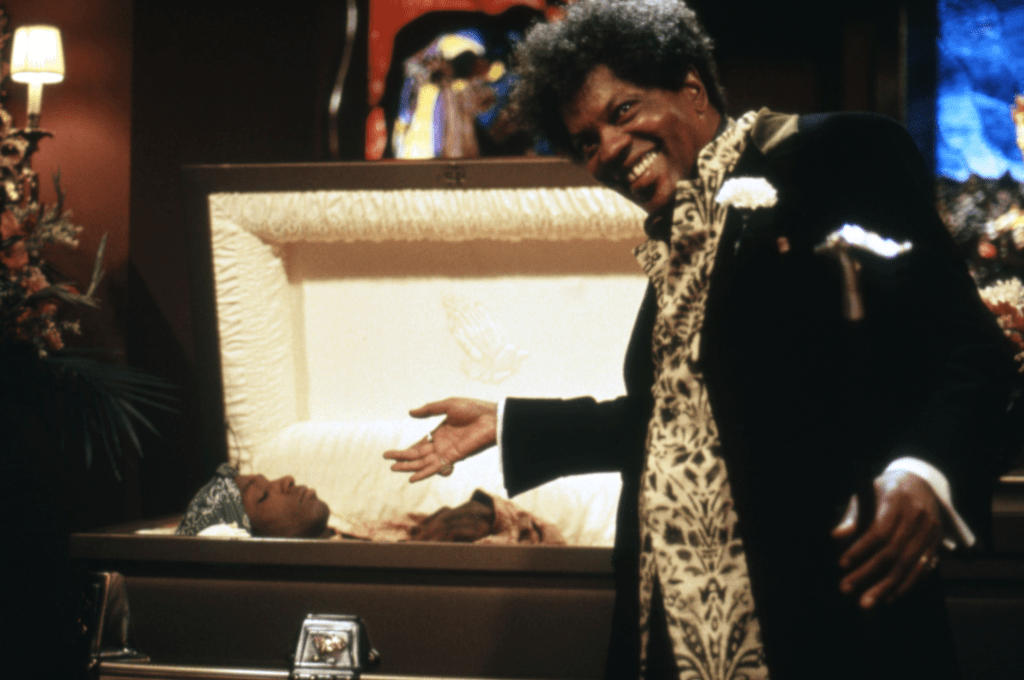
The movie starts in an unidentified rough neighborhood where three drug dealers, “Stack” (Joe Torry), “Bulldog” (Samuel Monroe Jr.), and “Ball” (De’Aundre Bonds) arrive at the Simms Funeral Home to purchase some drugs from the eccentric proprietor, Mr. Simms (Clarence Williams III have a great time hamming it up). Simms has claimed to found some drugs that he will give them but as they walk through the building, he begins to tell stories about people in the caskets, setting up the framing story of the anthology.
The first segment, “Rogue Cop Revelation,” involves a young African-American police officer, Clarence Smith (Anthony Griffith), who witnesses his partner, Newton Hauser (Michael Masse), and other officers, Strom Richmond (Wings Hauser) and Billy Crumfield (Duane Whitaker), pull over a local city councilman, Martin Ezekiel Morehouse (Tom Wright), who is also civil rights activist. From the start the traffic stop is hostile and turns worse when Richmond slams Morehouse’s head through the driver’s side window and him and Crumfield beat him because he mentions he’s going to go after them.
Smith tries to intervene but Hauser takes him away saying the other officers will take him to the hospital and order him not to report what really happened. Since the other officers are white, Smith doesn’t intervene. Richmind and Crumfield take Morehouse down to the docks where Morehouse is shot up with heroin as Hauser, Richmond and Crumfield have been dealing drug within the police department. The corrupt cops place his body in the car with paraphernalia and push the vehicle into the water where Morehouse dies. News reports are made showing how hypocritical Morehouse was as he was taking drugs, ruining his reputation as a civil rights advocate and community leader.
A year, later, Smith has left the police department and turned to heavy drinking. On the night of the anniversary, he receives a vision of a crucified Morehouse instructing Smith to bring the other officers to him. They meet at the Morehouse’s grave where Smith says he’s going to tell what really happened. Hauser, Richmond and Crumfield all urinate on Morehouse’s grave and intend to kill Smith, but a zombiefied Morehouse comes out of the ground and kills all the officers. He pulls the genitalia off Crumfield, decapitates Richmond and kills Hauser by telekinetically crucifying him with hypodermic needles that riddle the streets of a run-down neighborhood. (This is a reference to the crucifixion scene in the 1976 horror classic Carrie.)
The segment ends with Smith gone mad with orderlies saying he went nuts and killed his former officers. Cundieff and co-writer Darin Scott (who also produces) leave it ambiguous as to if Morehouse actually rose from the dead or if Smith in a drunken stupor killed them. This segment was filmed a few years after the infamous Rodney King beating and also touches on alcohol and substance abuse which has been a problem in many African-American communities, as well as suggesting the cops are responsible for it. In Sidney Lumet’s Prince of the City, the cops actually gave their informants seized drugs on a regular basis. Cundieff’s father, who appears briefly in another segment, was also a police officer. I wouldn’t doubt there’s a lot of truth in this segment and it’s their way of getting back at the corrupt law officers who they’ve dealth with.
The second segment, “Boys Do Get Bruised,” focuses on domestic abuse and actually was inspired by a traumatic event Cundieff witnessed. As a child, he said he went over to a friend of his one day, who was white. In the basement, they noticed the friend’s sister had been hogtied and gagged by her parents. He went and told his father who said as a black police officer, he couldn’t go after white people that way. Cundieff plays a school teacher, Richard Garvey, who notices his new student, Walter Johnson (Brandon Hammond) has some serious bruises on his body. Walter just says it’s the “monster” that did it.
Many nights, as he lies in bed, Walter is visited by an unseen creature that we assume is a monster because its growls are heard. Garvey thinks that Walter is being abused by a bully, Tyrone (Chris Edwards). Garvey notices Walter likes to draw so he tells the boy that he can overcome anything he fears by destroying an image of it. He has drawn a picture of the monster, a green figure with red eyes, as well as Tyrone, which he later crumples up in his hands. Yet, while Tyrone is out on the playground, he suddenly suffers injuries.
Later, Garvey goes to speak with Walter’s mother, Sissy (Parker), who says Walter is just clumsy and that’s how he gets all the bruises. But she gets upset at Walter about the “monster.” As he is leaving, Garvey bumps into Sissy’s boyfriend, Carl (Greer), who is very domineering and quick to tell Garvey he needs to leave and mind his own business. However, once he is out of the house, Carl who has a “Monster” tatto, gets angry at both Walter and Sissy and starts abusing them.
Grier is wonderful casting. Even though he was mostly known at the time for In Living Color and comedies like Blankman and Boomerang, he was a Yale graduate who had performed on Broadway for years. There’s something sinister about him because Grier doesn’t look like the abuser often portrayed in movies but the abusers that exists in real-life. He dresses very nice and looks like a typical businessman. But he’s got a mean streak on anyone he can dominate.
I remember working a summer job at K-Mart and watching this guy who looked normal and friendly suddenly turn when his toddler daughter did something he didn’t like and he began to repeatedly slap at her saying, “Stop it!” over and over like a mad man. I was a big guy and thought about saying something knowing at 16-17 I’d be fired. But it angered me how everyone tried to look away but obviously saw it.
Cundieff even said originally, the test audience started laughing when Carl begins to whip Sissy with his belt. But as she begins to cry and plead for him to stop bloodied on the floor, the theater went silent, Cundieff said. But don’t worry, Carl gets what’s coming to him. Even as his body is mangled as Walter crumples the picture of the monster in his hand, Carl still acts tough and defiant.
The third segment “KKK Comeuppence” is more of a dark comedy take on the Killer Doll subgenre of horror, with an ode to the Zuni Fetish Doll from Trilogy of Terror. This segment involves a racist conservative Senator Duke Metger (Corbin Bernsen wonderfully cast) as an obnoxious person who has moved into a former slave plantation house in an unidentified southern state. He’s running for governor and has employed an African-American “image maker” Rhodie Willis (Roger Guenveur Smith) to help him out. Metger was also at one time a KKK member and still harbors racist sentiments toward people.
However, the plantation house he’s in has a dark history and has led to many protestors outside including Eli (Art Evans) who tells everyone the plantation is haunted. Metger’s ancestor, Nathan Wilkes, enslaved many people and was often cruel toward them torturing them. As the Civil War ended and people in the south had to release their enslaved peoples, Wilkes killed them all. Miss Cobb (Christina Cundieff), a voodoo witch at the time, was able to transfer the souls into special dolls she had made that many people say are still on the property.
One of the dolls causes Rhodie to trip on a staircase and die. The same doll seems to show up and terrorize Metger. It’s mostly a silly segment with some strong racial overtones as Merger tries to incorporate a racial slur into a campaign slogan before realizing how bad it sounds when spoken. The segment also examines topics as Affirmative Action which was becoming a hot-button issue in the 1990s. But Metger seems to be inspired by David Duke, the former Grand Wizard of the KKK, who tried unsuccessfully to run for federal offices in the 1980s.
The fourth segment, “Hard-Core Convert,” is probably the weakest and seems more along the style of Spike Lee. As the movie was produced through his company, 40 Acres and Mule Filmworks, it seems it might have been a bargaining tool to get the movie financed. It involves a gangbanger, Jerome “Crazy K” Johns (Lamont Bentley), who guns down a rival gang member, Lil’ Deke (Ricky Harris), but is soon involved in a shoot-out with Deke’s other gangmembers. When the police arrive, a shoot-out ensues and everyone but Crazy K is killed.
Injured, he’s convicted and sent to prison for life. Four years later, he is transferred to a facility operated by Dr. Crushing (Rosalind Cash) for an experiment that could lead to him being released if successful. This is inspired by A Clockwork Orange as Crazy K is subjected to images of street gang violence interlaced black and white visuals of people being lynched and beaten while he is strapped to a gryoscopic modulator. This is obviously meant to convey there is no difference between the gang members who kill each other every day and the racist white supremacy organizations that killed black people in the past for no reason.
He is also subjected to a sensory deprivation experiment where he is confronted by the souls of people he killed, including innocent children caught in the crossfire. The problem with this one is that it’s too short to really be effective. Since so little is known about Crazy K, the segment like some of Lee’s works, has its message first and entertainment value dead last. It feels like the movie might have worked as a longer version of Orange whereas we say Alex in several stages over the course of two-plus hours.
It is later revealed that the other gangmembers were “Stack,” “Bulldog,” and “Ball.” And the events of the segment didn’t really happen the way they’re presented. There’s a twist and they soon realize the funeral home isn’t what they think nor is Simms. I won’t say what but it’s pretty obvious to anyone who’s seen the 1972 Crypt movie.
The special effects leave something to be desired but I think it’s intended the way Crypt was produced on a small budget, and looks it. In many ways, Cundieff seems to be inspired by the style Tobe Hooper brought to Eaten Alive that feels more like a horror comic. It’s meant to be taken more seriously than a comic but Cundieff doesn’t hammer it home too much except in certain areas such as “Strange Fruit” playing in the soundtrack when Morehouse is being beaten.
I feel the movie might have worked better with just the first three segments and the frame story but overall, it’s a real joy to people who want to see a different style of horror. It received mostly positive reviews but didn’t perform well at the box office only about $12 million, which is twice the cost of its budget. I feel it was also poorly marketed as distributor Savoy Pictures, which only was operational 1992-1997, didn’t handle it correctly. Was it supposed to be a comedy or horror movie? Judging by the poster, some people may assumed it was a comedy and maybe were let down.
It’s also that horror movies and “hood” movies weren’t so popular by 1995. It seems that “hood” movies were everywhere hence being parodied in Don’t Be a Menace. They had been infamous for attracting gangmembers or wannabes to movie theaters who reportedly were shooting up the theaters or nearby areas. This is the type of movie you discover on the home video/cable market because you can watch it closer than in a theater to see what Cundieff and Scott have done.
They would spend more than 20 years trying to get a sequel made. Thanks to the success of Get Out, they produced two sequels which weren’t as well-received by critics nor fans.
What do you think? Please comment.
 Zane Says