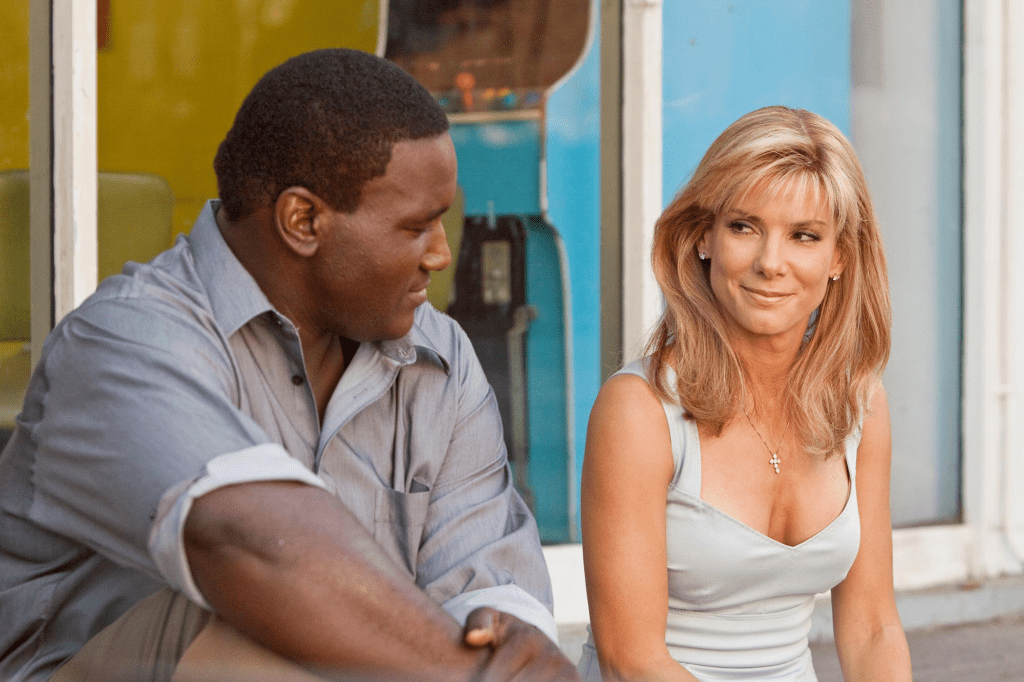
This past week, there’s been a huge back and forth between Michael Oher and the Tuohy Family over proceeds from the 2009 movie The Blind Side and the book on which the movie is based. Oher, who played college football at Ole Miss and then went on professionally to play for the Baltimore Ravens, Tennessee Titans and Carolina Panthers, has reported that he was duped into signing a conservatoreship with Sean and Leigh Anne Tuoy, who are Memphis-area businesspeople.
Oher, who was born one of 12 children to a woman who was addicted to crack cocaine, went through the foster family system before finding the Tuoys at 17 who took him in and helped him. But the story about what actually happened is one of question. Oher is claiming that he was never legally adopted by the Tuoys who exploited him for monetary gain. The Blind Side movie made over $300 million worldwide and won Sandra Bullock an Oscar for her performance as Leigh Anne. But it’s been heavily criticized as a racist white savior movie by many.
Martin D. Singer, an attorney representing the Tuohys has denied Oher’s allegations with the Tuoys calling it a “shakedown.” He added the Tuohys intend to end the conservatorship. But the question is since Oher is 37 and has worked professional football for years, why does he need a conservatorship now? The question will come up how much Oher made versus how much the Tuohys made. I’ve only seen Blind Side once and it seemed the typical white savior Oscar bait.
Other entertainment-related news this week involved Jessica Chastain wanting to have a sequel to The Help focusing on the friendship of her character and the character played by Octavia Spenser which won the latter the Oscar. Of course, there’s been pushback that a sequel to The Help focusing on characters isn’t necessary. And it seems the general public is getting tired of the same spate of movies that involve predominantly African-American characters. So, I would hold my breath for Celia and Minny Together Again.
I think seeing the feedback following 2018’s Green Book, which won the Best Picture Oscar but was heavily criticized on social media, shows the White Savior Civil Rights trope has sailed. In 2019, Taraji P. Henson appeared alongside Sam Rockwell in The Best of Enemies about the unlikely friendship between a community organizer and a white supremacist in the 1970s. The movie got lukewarm reviews and bombed at the box office. Then, Covid hit and we were spared these movies for a while.
But it didn’t take the King of Vanity Projects Will Smith to make a period piece movie Emancipation about “Whipped Peter” set during the 1860s. The movie got mixed reviews and was heavily criticized by many in the African-American community as another tired story about an enslaved person. It does seem to be the only types of movies Hollywood seems to want to make with predominantly African-American characters and a cast.
But why can’t Hollywood make movies that don’t resort to the same tired cliched tropes? Both Henson and Spenser were in Hidden Figures which focused on mathematicians Katherine Goble Johnson (Henson), Dorothy Vaughan (Spenser) and Mary Jackson (Janalle Monae) working with NASA on the Mercury Project. The movie has a scene where Johnson’s supervisor played by Kevin Costner gets upset over her having to walk across a campus to use a bathroom that isn’t for “Whites Only” and tears down the sign. Reportedly, this NEVER happened. People just didn’t care that Johnson was using the restroom.
There’s also another scene earlier in the movie where the typical heavyset law officer stops the three women when they have car trouble and begins the usual racist schtick, even grabbing their work IDs aggressively when they mention they work for NASA. But he relents when he sees it’s authentic. There’s also a role by Jim Parsons who comes off as heavily prejudiced and refused to allow Johnson to look at stuff she had been cleared to review. In the end, he shows he’s her equal by making her a cup of coffee without asking. Ermahgard, gag me with a spoon!
And Jackson herself faces diffuclty trying to attend an all-whites school to get the class she needs. The white people in the movie either sneer at her as if their rabid creatures or they gawk widly at her like Jesus Chris Almighty is walking right behind her. Needless to say, Hidden Figures is directed by a white man, Theodore Melfi.
Green Book was directed by a white man too, Peter Farrelly, who’s previous movies were made with his brother, Bobby, and included Jeff Daniels having explosive diarrhea and Woody Harrelson drinking bull semen. Not that I’m not a fan of Dumb and Dumber or Kingpin but Green Book‘s main focus is on Tony Lip (Viggo Mortensen) who has racial bias. It’s basically this generation’s Driving Miss Daisy.
That’s the problem. Most of these movies focus more on the white people in the black characters’ lives. The Help was really about a pampered southern white woman played by Emma Stone realizing that the black people around her having it a lot worse and the white people she grew up with are now jerks and bigots. While she and her family are good to their help, the rest of the community in Mississippi isn’t the same. The Help was based on a novel written by Kathryn Stockett, a white woman born in 1969, many years after the events in the movie. It’s obvious most of the plot is based on stories she’s heard.
Growing up in the South in the late 1970s and 1980s, I don’t doubt Stockett told a lot of truth in her book. One of my babysitters was an African-American woman. My family didn’t grow up wealthy. We were mostly considered lower middle-class by several of the snobby people in the community. Maybe it was because we were considered part of Appalachia, people really couldn’t afford to pay maids while they lived a socialite lifestyle. However, he said it was true of many other communities south of Georgia and after working in southwestern Georgia, I can agree.
But there still was racism and the community was heavily segregated where the African-Americans were predominantly on the west side of town, literally on the other side of the tracks. Ironically, our school district (which prided itself with snobby people) weren’t too far from “the projects.” I mean, literally, it was down the road a few blocks. I always chuckled about that because the county school for all those who lived in the rural areas was located in the more affluent neighborhoods.
Most of the movies we watched in the 1980s that featured black actors were Eddie Murphy movies. The Cosby Show had become popular but I never did really watch it. I did watch Amen and 227 which probably benefitted from the success of Cosby. Mainly Amen and 227 which both aired on NBC Saturday nights along with The Golden Girls showed a more modern view of African-American families that was needed. This wasn’t the Evans from Good Times constantly struggling and it wasn’t the Huxtables who lived in a fantasy world where racism didn’t exist and an OB-GYN doctor and a lawyer had a lot of time on their hands to choreograph their kids lip-syncing to Ray Charles “Night Time is the Right Time.”
I’d even argue that this was Cosby more or less giving us a modern-day psuedo-minstrel show which is why white audiences like it and remember it. Yet, 227 focused on real issues with working-class African-American people in the Washington D.C. area and Amen‘s plots revolved around a predominantly black church in the Philadelphia. Sherman Hemsley, who was a lawyer on Amen lived in a modest home and was known for his scheming ways. I think Amen and 227 related more to all audiences while Cosby seemed to get more unrealistic as the show went on.
And then there was Family Matters, which tried to duplicate 227 and Amen with more lighter material like The Cosby Show. Yet, the addition of Jaleel White as Steve Urkel in a one-off role resulted in the show focusing mostly around Urkel in some way. Ironically, White had appeared on the CBS sitcom Charlie & Co., which starred Flip Wilson, as a working-class father in Chicago, the same setting of Family Matters, that lasted one season. Some have argued Urkel’s popularity saved Matters from an early cancellation.
While some TV shows were featuring more predominantly black characters, most movies were still like bleach – whites only. Movies like Cry Freedom and A Dry White Season focused on Apartheid in South Africa from the white person’s perspective. Even Edward Zwick said the 1989 Oscar-winning Glory was meant to focus more on the life of Col. Robert Gould Shaw (Matthew Broderick) until Zwick was filming a scene involving the characters played by Morgan Freeman, Denzel Washington, Andre Baugher and Jihmi Kennedy meeting each other. He said at this point, he wanted the movie to focus more on them.
Yet, the movie still had a lot of inaccuracies that historians have noted. Most of the enlisted men in the 54th Regiment had been living in the northern part of the country and were sought out based on their fitness and literacy levels. Very few were former enslaved men. The governor of Massachusetts, John A. Andrew, saw the 54th Regiment has one of his favored projects and worked with his administration to see they were properly equipped. They had uniforms and they had footwear.
A subplot of the movie involves Washington’s character, Pvt. Silas Trip being, punished for seeking shoes as his feet are bruised and bleeding from being barefooted. He is flogged for escaping the camp to find shoes. This is to show that he has been whipped and flogged as an enslaved man. But no one was ever flogged in the Union Army. And many characters are shown to be uneducated. This wasn’t the case either.
Yet, Glory still becomes a white savior movie as showing Shaw working tirelessly with his Maj. Cabot Forbes (Cary Elwes) to make sure the men are properly trained and equipped from a cadre of typical one-dimensional racist white people. I’m not doubting that some people in the Union Army and north were heavily racist and showed it. But Shaw came from a powerful family and I doubt many high-ranking officers would’ve messed with him, especially since he was a full colonel.
Sometimes dramatic licenses ruin movies because Hollywood executives know that movies won’t make more money unless the audience has a white person to root for. This was the case with 12 Years a Slave where Brad Pitt, who helped produced the movie, came in during the movie’s third act as a sympathetic white person from Canada. Pitt’s character, Samuel Bass, was an abolitionist who did help Solomon Northup (Chiwetel Ejiofor) but the casting of Pitt in role does make you question it. Pitt has said he took on the role to secure funding but it also makes you wonder did people turn out to the movie to see a Civil War era version of The Defiant Ones, only to see PItt in a very small role.
Why did 12 Years a Slave make almost $190 million worldwide while Red Tails about the Tuskege Airman make only about $50 million. The latter was a pet project of George Lucas who fully funded it through Lucasfilms with an $58 million budget. Could it be that 12 Years had an impressive cast of white actors such as Pitt, Michael Fassbender, Paul Dano, Sarah Paulson, Paul Giamatti and Benedict Cumberbatch while Red Tails with its cast including Terrence Howard, Cuba Gooding Jr., Michael B. Jordan, David Oyelowo, and Nate Parker only had Bryan Cranston in a supporting role?
It’s no big secret that people probably thought Red Tails was a movie just for black people but 12 Years a Slave was a movie about black people that white people could enjoy. And both movies released within two years had their faults, but they are both enjoyable. It’s been reported the failure of Red Tails which 20th Century dumped in the dead movie winter month of January in 2012 led to Lucas wanting to get out of the filmmaking process and selling Lucasfilm and its property to Disney later that year. It took him over 20 years to get the movie into production.
Red Tails fared better at the box office than Spike Lee’s Miracle at St. Anna, which was about the 92nd Infantry Division, which was mostly an African-American Army unit during World War II. Produced on a budget of $45 million, it only made about $9.3 million. The movie received more negative reviews than Red Tails. But I wonder if it was Lee’s association with the movie that made critics and audiences leery. We can’t deny that many African-Americans served during WWII and did more than labor work. Miracle and Red Tails despite their faults show that WWII wasn’t won by John Wayne, who never served.
Sadly most movie have reduced African-American or other BIPOC to caregivers in Passion Fish, Regarding Henry and My Life. Yet, you rarely ever see the roles reversed. Garrett Morris said he was denied a role as a doctor on a sketch of Saturday Night Live because producer Lorne Michaels didn’t believe Americans would believe a black man could be a doctor. According to the Association of American Medical Colleges, there’s only 5.7 percent of physicians who are black, and over 200,000 black registered nurses in America. Yet the idea of a white person taking care of a black person in a movie is still something out of the ordinary.
Mainly, it’s because black people are seen as the “Magical Negro.” There’s a sense of the helpful African-American who shows the white protagonist things they can’t see inside themselves. They’re like the Magic Pixie Dream Girl and serve about the same purpose as showing something helpful to the white male protagonist. Imagine Charles S. Dutton in Rudy or especially Michael Clarke Duncan in The Green Mile. Lee was critical of Will Smith’s titular role in The Legend of Baggar Vance as he helps Matt Damon’s character learn how to play golf better in the Jim Crow segregated south.
Ad even though Loving v. Virginia made interracial marriage legal in 1967, there is still opposition to interracial couples in movies more than 50 years later. Guess Who’s Coming to Dinner was provacative at the time, but now, it shouldn’t be as controversial. Yet, Hollywood is still afraid to show interracial couples without it being very pertinent to the plot. Take the awful movie You People which was what the movie was all about that Jonah Hill and Lauren London had no charisma whatsoever because every line of dialogue had something to do about race.
And while commercials may show interracial gay couples, seeing it in movies is still something that freaks people out more. Lightyear was a huge controversy because it portrayed a black woman character kissing her white woman wife/partner. It wasn’t anything like the GoDaddy commercial kiss. No, it was just a little kiss you’d give your partner out of love and affection. And people lost their minds. It seems most interracial same-sex couples seem only to exist in independent movies.
Or you have some crazy movie like Love, Simon that thinks it’s being provacative by portraying two black men as gay. The movie is set in the metro-Atlanta area and suburbs in the 2010s. I haven’t lived in Georgia since 2002 yet I can tell you there were more than two openly black young men in the metro Atlanta area. A movie like Love, Simon shamelessly prides itself on being edgy that it insists upon itself so much. I heard it best described as a movie made by straight people about gay people for straight people.
I can go on and on. Movies about White Saviors, seem to have a close Venn Diagram with mainstream movies about the LGBTQIA community and the Physically/Intellectually Disabled people, i.e. the “Supercrip.” Take Radio for instance. Gooding plays James Robert “Rado” Kennedy, a man with intellectual disabilities who assists a football team in a South Carolina town. And even though the movie tries to move away from the White Savior trope by having the adults more concerned about a man in his mid-20s with intellectually disabilities being around teenagers, it’s obvious race comes an issue.
When Radio is given a lot of gifts for Christmas, he decides to share with some of the less fortunate by leaving them on their porches and doorsteps. But he is mistaken by a young white cop who thinks he’s stealing. Of course, the other officers, who are white, recognize him and correct the ignorant (and arrogant) officer, you still sense what the filmmakers did. Even worse, the movie seems to focus too much on Harold Jones (Ed Harris), the kind coach, as this associaton affects his family somehow. Apparently, the life of a football coach in a southern town doesn’t take up a lot of time but being a fucking decent human being to a man people want to avoid is problematic.
I mean, most movies only are made to appeal to able-bodied, straight but tolerant, white people. That’s the goal of the White Savior trope to show how good the white person is in helping someone who is non-white, gay and/or intellecually disabled. It makes the white person demographic feel good about themselves seeing someone else “pull themselves up by their bootstraps.” People like to see themselves as the hero in their own stories, so they can relate to the “White Savior” tropes because it’s about someone showing their tolerance and acceptance.
But shouldn’t we be doing that? I was in a gas station a few years ago waiting to check out and some mom with her baby in her arms dropped something. The dad, some other guy and myself all went from different angles to pick it up off the floor. The dad was able to get it because he was closest. That’s the way things should be. And you should move on without patting yourself on the back for being a decent person.
And that brings me to a question of why the Tuohys took Oher in? At 6-foot-4 and 300 pounds, he’s built like a football player. But what if Oher didn’t want to play football? What if he just wanted to graduate high school, go on to college and pursue other things? Or forget college, he wanted to be a welder or work in drafting. Maybe he just wanted to be a UPS or FedEx driver.
Even though he had been playing football before he met the Tuoys, it looks like that is what attracted them. What if he was 5-foot-9 and weighted 165 pounds but still needed help? Would the Tuoys have reached out? I highly doubt it. Sean played basketball at Mississippi and he and Leigh Anne clearly saw Oher as an investment. There’s a horrible scene in the Blind Side where poor Kathy Bates, playing his tutor, convinces him to consider Mississippi over the University of Tennessee because there’s a body forensic farm in Knoxville and she tries to play on his ignorance to spook him.
Bates is one of my favorite actresses but I feel she either took this because she owed someone a favor or she needed the money. Either way, the whole movie is about how the Tuoys try to show everyone they can be different than all the other racist people in the Memphis area. Yet there’s a foolish scene where Leigh Anne tries to act tough around your Central Casting group of “black hood people.”
I understand it was a different era and the Oscars could’ve been called the “Honkies” because it seemed they cared more about white actors and filmmakers. I don’t think a movie like The Blind Side would work today and would be snubbed in every catergory. John Lee Hancock, who wrote and directed it, is another white man. And judging him from his 2019 movie The Highwaymen, about the Texas Rangers pursuing Bonnie and Clyde, and its very conservative fascist tone, I can guess who he voted for in the last few Presidential elections.
The real blind side is how the Tuoys and others from privileged backgrounds only see people like Oher when they can have a benefit such as playing football. A new schol year has started and thousands of students out there have to walk on eggshells around a sports coach, an administrator or a counselor who can hold a scholarship over their head. All it taker is one phone call and someone who is not white or not from the right family is labeled a “trouble maker.”
It’s a shame our public education system treats so many kids this way. That’s what irritates me so much about the Supreme Court case with Joseph Kennedy in Bremerton, Wash., who was told to stop publicly praying. What if a student who doesn’t believe in public prayer or even God but is a good football player? He knows that his chances of a good scholarship or even more playtime to attract scouts depends on whether or not he particpates in Kennedy’s circle-jerk?
People like Oher come from bad backgrounds and achieve through sports only to be exploited by the same institutions that are supposed to be for their benefit. People are calling Oher ungrateful, but what they are saying, is that he doesn’t know his place. You can go to any comment thread online and I can guarantee you can tell how the people voted in the last few Presidential elections themselves. I’ m sure if some people weren’t afraid he would snap them in half like a twig, they’d use some colorful language to describe Oher. The nicest I can say on here they’d use is “uppity.”
At the same time, I ask that Hollywood move away from the White Savior tropes as well as presenting BIPOC more as magical characters. It is possible for filmmakers of color to make movies about themselves that absolutely nothing to do with making white people feel better about themselves. Everything Everywhere All At Once was about a Chinese family made by filmmaker of Tiawanese and Hong Kng ancestry. Beef was one of the most popular shows on Netflix this past year and it contained a predominant cast of people from southeast Asian ancestry.
And aside from Tyler Perry’s misogynistic faith-based movies, I feel other African-American filmmakers can make movies that appeal to wider audiences. Hollywood just seems to be too scared that somewhere a bunch of white people won’t like it. That hasn’t stopped Barbie from making over $1 billion worldwide in less than a month. The gauntlet’s been thrown. It’s time for Hollywood to change it up.
Maybe if our public education system taught real history, both the good and the bad, rather than focusing on a white-washed “America Fuck Yeah!” style, we wouldn’t need Hollywood to open our eyes to the Tulsa Race Massacre in HBO’s Watchmen or the late John Singleton making a movie about the 1923 Rosewood Massacre in Florida. We shouldn’t rely on writers and producers making movies and TV shows about the 1898 Wimington, N.C. insurrection or the flooding of the Mississippi River in the late 1920s where black people were more or less enslaved in concentration camps to restore the plantations their ancestors were prisoners to get a history lesson when we pay our taxes to fund education.
Martin Scorsese and Leonardo DiCaprio will be releasing their long-awaited Killers of the Flower Moon about the murder of members of the Osage tribe in northern Oklahoma. It was reportedly over four hours before cut to about three and a half hours. Maybe Scorsese cut some of the white savior tropes out to focus more on the Osage people.
Basically, the only movie I can remember from the last 50 years or so that didn’t provide a saccharine treatment of a horrific event was The Killing Fields. Maybe there has something to do with the fact that it’s considered a British movie because of its funding. The movie is about the genocide in Cambodia during the Khmer Rouge years where it was called Kampuchea and the events that led up to it. The Brits point the finger at us Yanks for the Vietnam War that spread into other parts of the area (Laos, Cambodia and even China, just admit it). The movie starts out by focusing on journalist Sydney Schanberg (Sam Waterston) and then halfway through following the Fall of Phnom Penh in 1975 becomes the story of how Dith Pran (Dr. Haing S. Ngor), a colleague of Schanberg’s, suffers through the years of hardship and violence.
Director Roland Joffe doesn’t hold back on the violence and Ngor himself suffered the same hardships as Pran even losing his own wife, because he couldn’t let on he was a medical doctor. His wife died during child birth when she needed a C-section and the Khmer Rouge was targeting anyone who had higher education knowledge as they viewed western culture, civilization and influence as a menace on traditions. Ngor is in the movie longer and should’ve been nominated for Best Actor over Waterston who only appears briefly during the second half. Ngor famously won the Best Supporting Oscar even though it was his first role and he hadn’t acted before.
If the movie had been made by an American production company, I feel it would’ve focused more on Schanberg’s efforts to locate and find Pran, who had been sent to a concentration labor camp from 1975 to 1979. All Schanberg could do back in America was write to relief efforts and make people aware of what Pran and others were going through which he is shown doing in a few small scenes. I admit the ending where they finally meet again at a Red Cross camp in Thailand as John Lennon’s “Imagine” is playing is totally sappy but imagine how worse it would’ve been as a White Savior movie.
It’s been almost 200 years and we still don’t have anything on the Trail of Tears. Maybe that’s because there’s no way to make the white people involved out to be the heroes. Come See the Paradise mentioned the Japanese interment camps of southern California but it’s main focus was on Dennis Quaid’s character. Same thing with Snow Falling on Cedars which was about anti-Japanese sentiments but decided to focus more on Ethan Hawke’s character.
This is becoming the same thing as bragging about helping out homeless people or people bragging about their kids getting baptized or leading some prayer. You’re trying to make yourself look better at someone else’s expense and exploitation. We shouldn’t be trivializing horrible and sometimes very gruesomely violent moments in history just to make ourselves feel better.
What do you think? Please comment.
 Zane Says
Thanks. I don’t agree with all your conclusions; but very well done.
People (humans) are complicated.
I love the picture you chose to post with your piece. Says a lot about our (human) commonality.
LikeLike