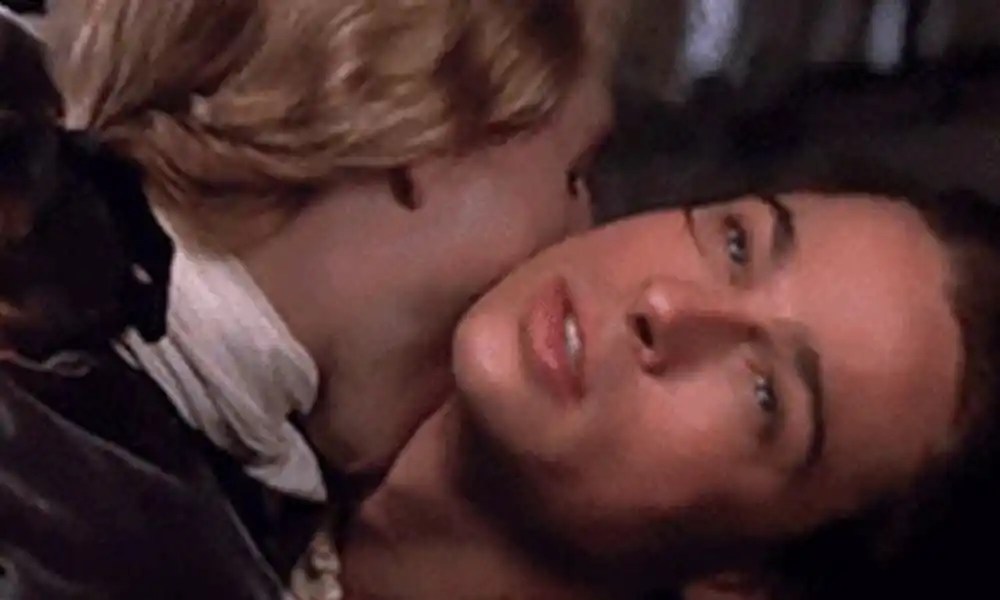
Note: This focus will be on horror/thrillers that have featured the LGBTQIA community and/or have themes as June is Pride Month.
In the 1970s, when Anne Rice was hired to write the screenplay based on her novel Interview with the Vampire, she was concerned about changing the main character, Louis, from a man to a woman. She was afraid audiences wouldn’t understand nor accept the homoeroticism in the script. Even though it was the swinging 70s, the Sexual Revolution was still mostly accepted as a heterosexual conquest.
But there’s always been something seductive about the world of vampires. They represent the lust and sexual pleasure we were told we shouldn’t have. A werewolf wants to tear human flesh off and eat it. It was a representation of the animals that exist in all of us. We’re really nothing more just that. But a vampire gets close to us. The seductive way Dracula would get close to his victims, biting them on the necks, sucking their blood. It’s sexual pleasure. We need sex to survive. Sex is how we all stay alive, even though we don’t want to admit it. Our parents had sex. Their parents had sex. Our kids will have sex one day.
By the time the film adaptation finally hit theaters in the Falls of 1994, Louis de Point de Lac was still a man. (Rice had considered turning him into a woman to entice Cher in the role.) But there still was controversy. Tom Cruise, who at the time was one of the biggest celebrities of all time (and still is) had taken on the role as the villainous, blood-thirsty (in more ways than one) Lestat de Lioncourt. It was awkward for many reasons. One, Lestat isn’t the main character. Why was Cruise willing to sign on for a supporting role other than a huge paycheck and top billing? Second, the character isn’t in most of the third act. Third, the character was the first time since his role as Cadet Capt. David Shawn in i in which Cruise is very horrible violent person when you think of it.
Rice wasn’t a fan of the casting. She even encouraged the filmmakers to switch the role with Brad Pitt, who had been cast as Louis. Pitt had played a menacing killer before in Kalifornia and his star-making turns as a young man who cheats Geena Davis’ character out of money after a one-night stand in Thelma & Louise. Ironically, Pitt was secretly trying to get out of the movie altogether. Pitt later said the production took place in London during the winter months and there was so much darkness and gloom it made him despressed and miserable, which is actually reflected on the screen.
But Rice probably dined on a nice bowl of crow after she saw an early version of the movie and realized she was wrong. She had actually campaigned for Julian Sands to be cast in the role. May he rest in peace. Granted, the pre-buzz made a lot of people interested in seeing a period piece vampire movie. Bram Stoker’s Dracula had been a big hit two years earlier. But would audiences really want to see a movie that has male characters getting so close to each others they in some scenes look close to kissing?
Granted, many women (and men) probably were lined up around the block to see Cruise, Pitt, Antonio Banderas and Christian Slater in a movie together. Banderas plays Armand, the defacto leader of a legion of vampires in Paris. Slater was hired to play Daniel Molloy, a role that had originally been offered to River Phoenix but he died from a drug overdose on Halloween night 1993. So, there would be a minor True Romance reunion as Slater and Pitt had briefly appeared in that movie the year before.
Set mostly from 1791 to 1870, the movie follows Louis recounting to a modern-day Daniel, who is skeptical at first, his life story starting out as a young plantation owner outside New Orleans. When Louis’ wife and unborn child dies, he wanders the seedy parts of Spanish Louisiana welcoming death hoping to join them in Heaven. One night after supposedly cheating to win a card game and calling the other player’s bluff to kill him, Louise walks along the nearby wharf with a prostitute whose pimp is waiting. But Lestat is watching them all and kills the prostitute and pimp before feasting on Louis.
But he spares Louis life after raising them both up in the air and drops him in the waters below. Louis becomes ill and Lestat approaches him telling him about what his new life will be. Lestat turns Louis into a vampire and initially, he enjoys being undead, but isn’t too comfortable with the killing involved. Lestat is a murderer and enjoys feasting on the blood of anyone who crosses his path. But Louis can’t bring himself to do it instead feasting on the blood of animals (dogs, rats and chickens).
Eventually Louis has to come to grips with the notion he’s a killer and this is his new life. Over the voice-over narration, he doesn’t let it slip that he’s accepted this life, but there are hints. In many ways, Louis is like many gay people living in denial and sometimes in pain so much they want to end their lives. And Lestat represents the flambouyant gay people who accept who they are and don’t hold it back. Louis says Lestat enjoys killing aristocrats and wealthy people.
There is a scene of Lestat getting close and even seducing a young man. But there are also scenes in which he uses his charm and good looks to get close to the women so he can kill them. It isn’t until after Louis accidentally bites an orphaned girl Claudia (Kirsten Dunst) that he begins to accept his life. With the help of Lestat, she is turned into a vampire and Lestat says they are a “family” now.
And they live together that way in the New Orleans area as a family, with few people questioning them. Claudia helps Louis become fulfilled in the child he never had while Lestat becomes the partner he lost. And both Louis and Lestat have a power struggle over Claudia. Even though Claudia becomes a killer like Lestat, going as far as feasting on the strict piano teacher who keeps whacking her hands for playing the wrong notes, there’s still some distance between the two. Lestat becomes the disciplinarian parent while Louis becomes the sensitive loving parent.
Because Claudia becomes angry at both for turning her into a vampire, she becomes obsessive over Louis, trying to kill Lestat. But he survives. Louis and Claudia go to Europe, Africa and Asia where they search for others like them. Louis feels like he’s isolated and alone. But when he finds Armand and the more sinister Santiago (Stephen Rea), he is also disappointed. I feel that Louis thinks vampires should act a certain way and becomes horrified as Armand, Santiago and others feast on a live frightened woman during an avant garde play in front of regular people who think they’re humans playing vampires.
This openness frightens and concerns Louis but he takes a liking more to Armand, who seems more friendly and sympathetic. Santiago, on the other hand, is more violent and since he’s able to read Louis’ thoughts, he knows of the attempts on Lestat’s life. Louis feels that he has killed Lestat and Armand is an old acquaintance who said he knew Lestat enough not to mourn his passing.
But Claudia feels that Louis wants to be Armand’s companion. Unlike other vampire movies, this is the only one I’ve seen or can recall that as of 1994, didn’t have a human out to harm the vampires. There’s no Van Helsing or even the Frog Brothers from The Lost Boys. The vampires are their own enemies and they live by a code. The Paris vampires also view Louis and Claudia as outsiders. It may be because of what Armand says, they’re from the “New World” or that they suspect Louis and Claudia of killing Lestat.
I read something here recently, that there appears to be a power struggle in the LGBTQIA community as the LGB are feeling overshadowed by the TQIA. In If These Walls Could Talk 2, Chloe Sevigny played a lesbian who dressed more like a man while the other lesbians played by Michelle Williams and Natasha Lyonne dressed more like women. And there was a divide. Recently, at a LGBTQIA forum, I heard a transgender man say there’s always division even in groups that promote inclusion. With more talk and news stories about restricting HRT and preventing transgender people from competing in sports, it doesn’t mean that gay, bisexual or pansexual people are being left out.
The fact that the Paris vampires want to kill vampires who harmed or killed other vampires makes the whole concept feel illogical. While Claudia tried to kill Lestat, Armand says that someone that young shouldn’t have been turned. Lestat should’ve known what he was getting himself into. Also, when Louis throws a candlebra with lit candles toward Lestat, he’s trying to save Claudia from Lestat’s wrath so it’s self-defense. Armand doesn’t stop Santiago and the rest from leaving Claudia in a locked chamber with a skylight, nor does he stop Louis from being locked up in a wall. At the same time, Armand allows Louis to exact his revenge killing all vampires but Armand.
Armand wanted Louis for himself and quite possibly, Louis would’ve gone with Armand, if he wasn’t having to grieve another loss. At the end, Louis has finally accepted his life and it finally able to move on. Even if you look pass sexual orientation, I feel it also tells us some people work best when they by themselves.
Produced on a budget of $60 million, it made almost four times that much worldwide at $223.7 million, with Cruise’s performance getting rave reviews. And while he has fought rumors of his sexuality himself, I think it begs the question of why should we care. Cruise has had a who’s who of partners and spouses including Cher herself, Rebecca De Mornay, Mimi Rogers, Nicole Kidman, Katie Holmes and Penelope Cruz. If he’s gay, he’s not too good at it.
It’s a gothic horor movie and there’s always been sexual innuendos and allegories in those novels. Rice’s novel was a lot more graphic. Vampires don’t have sex so they kill people to drink their blood to get off. There’s almost an orgasmic way people in the movie act as they’re drinking the blood. I remember one passage from the novel in which Louis makes a note that he could feel a man’s penis from inside his pants when the person got close to him.
I haven’t seen the TV show and I really didn’t care for the sequel Queen of the Damned, which took all of what director Neil Jordan and Rice had brought to the table, and threw it out as a star vehicle for the late Aaliyah. Out of his career spanning over 40 years, it remains one of Cruise’s most ballsy roles.
What do you think? Please comment.
 Zane Says