
By the time Batman Forever hit theaters in June of 1995, the franchise was already running out of steam. Tim Burton had back way from directing the third movie following criticism of Batman Returns. He later admitted that Warner Bros. didn’t want him returning. Burton remained on as a producer. Joel Schumacher had been added as director based on his work on the adaptation of John Grisham’s The Client.
But then Michael Keaton had stepped down as he didn’t like the direction the series was going. It was later reported, Schumacher had actually considered doing a loose adaptation of Year One, which Keaton was interested in. However, the powers that be at WB wanted a sequel, not a prequel. This left the studio scrambling to find a lead to replace him. The question was would audiences accept someone new? This was ironic since there had been initial backlash against Keaton in the role of Bruce Wayne/Batman prior to the 1989 movie.
Val Kilmer, who was rising high, following his role as Doc Holliday in Tombstone was hired with fans being enthusiastic. Kilmer had also appeared as Madmartigan in Willow, which was popular among the same fanbase. Warner Bros. who had a surprise hit with Ace Ventura: Pet Detective cast Jim Carrey as Edward Nygma/The Riddler after Robin Williams reportedly turned down the movie as he had been the leading contender for the role. Tommy Lee Jones who had worked with Schumacher in The Client took on the role of Harvey Dent/Two-Face after other actors were consider. It also helped that he had just won an Oscar for his role in The Fugitive.
Billy Dee Williams who played Dent in the 1989 has denied rumors for years that he was paid millions to be bought out of his contract. However, Marlon Wayans, who was originally scheduled to appear in the second Batman as Dick Grayson/Robin, was paid to be released and reports indicate more than 30 years later, he still receives residuals for a film franchise he was never in. Chris O’Donnell who was rising high following roles in Scent of a Woman and School Ties was cast instead. O’Donnell was chosen from a who’s who of young actors, including Leonardo DiCaprio, Matt Damon, Mark Wahlberg and even Christian Bale, who would go on to play Batman in The Dark Knight trilogy.
Rumors weren’t favorable when early pictures came out that Batman would have nipples on his batsuit. Also, Jone’s make-up as Two-Face looked too comical. The seriousness that Burton brought to the first movie seemed to go out the window. Also, buzz from behind the scenes indicated that Schumacher and Kilmer butted head. Production had started in early Fall of 1994 and didn’t end until early March of 1995 a mere three months before it was scheduled to hit theaters.
When I first saw a video of Carrey in his role in the spring of 1995 while visiting Underground Atlanta, I grimaced a little. It was almost like Carrey was doing a parody of Carrey imitators. But still, my friends and I held out hope. Kilmer had nailed it in Tombstone. So, when the local movie theater was advertising a midnight showing, we jumped at it. We ended up leaving the theaters sometime after 2 a.m. thinking what the hell was that?
My friend, Garder Linn, said it bluntly. “Val Kilmer sucks!” And after seeing Kilmer in the documentary Val, I can understand why his performance was awful, but still. Kilmer said that he could barely hear when he had the Batman costume on and felt claustrophobic. But he knew what the role was when he took it.
There was just something off about the movie. O’Donnell who was almost 25 when the movie was released looked like he was almost 25. And he’s supposed to be playing someone who is 16, 17? It’s never known. Then, there was Carrey’s costume as The Riddler which looked off. With a red-headed buzz cutt and pale white make-up for some reason, he reminded me of Annie Lennox. Carrey would later say he was inspired by Larry Storch who played the role on the 1960s TV show.
But the whole movie seem like it was trying to be the a film adaptation of the 1960s series rather than an adaptation of the comics. And that’s the problem. Which period were they adapting? Following the publication of Frank Miller’s The Dark Knight Returns in 1986 and Todd MacFarlane’s Spider-Man: Torment in 1990, comics had taken on a darker edgier tone. It didn’t help matters that Alan Moore’s Watchmen had pretty much turned the whole superhero comic book industry on its head.
By 1995, more people kept reading their comics into their late teens and into adulthood. The success of the 1989 Batman also helped revive interest. Anyone who was alive during the summer of 1989 knows there was nowhere you could go without seeing the Batman logo and merchandise. Everyone had to have a Batman shirt. Yet, Hollywood still hadn’t learned how to make superhero movies.
Also, the homoerotic innuendos became very questionable. Schumacher, who was openly gay and claimed to have had up to 20,000 sexual partners, scoffed at the notion the nipples were homoerotic. “The bodies of the suits come from Ancient Greek statues, which display perfect bodies. They are anatomically correct,” he said. O’Donnell said he was more concerned with codpiece he had to wear. People have pointed out that when Dick appears in his new Robin suit, his bulge from the codpiece is obvious and it’s the first thing Bruce/Batman notices.
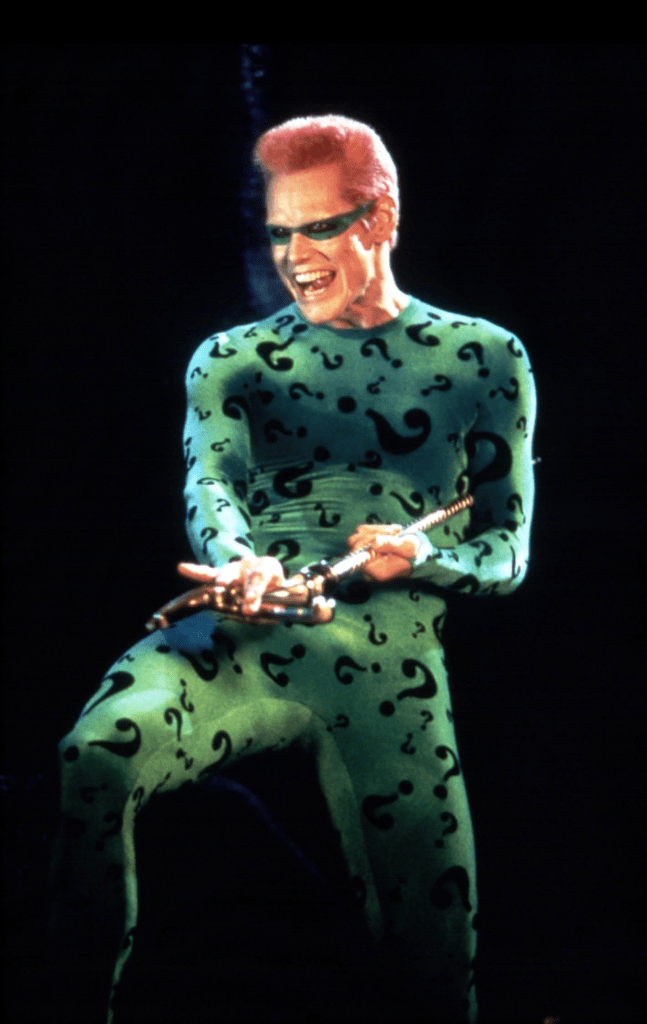
Also, Carrey as The Riddler seems to resemble a gay stereotype. During one scene dressed as the Riddler, he’s wearing a princess tiara. There’s also a dominant/submissive role between Riddler and Two-Face. Carrey later said he had Jones didn’t get along. I also think Carrey plays Nygma/Riddler as if he’s a gay person. I never understood why he freaks out so much over why Wayne rejects his device that beams television signals into people’s brains. He takes on the persona of Glenn Close in Fatal Attraction.
Later when Nygma builds a fortune on licensing and manufacturing the device himself, he appears at a gala in a tuxedo with Spice (Drew Barrymore), one of Two-Face’s assistants, on his side. I finally realized that Spice comes off as Nygma’s “beard” at the gala so people can presume he’s straight. But I think Nygma may either be a closeted homosexual. Carrey gives a very over-dramatic performance that makes us wonder with his panache for wearing tight clothing throughout the movie.
Questions about the homoeroticism has been around since the 1950s and people have questioned the relationship of a 30-something man taking in a young teenage boy. Because the comics took on a softer and more camp tone in the 1950s, people felt the relationship was awkward. Late Batman writer Alan Grant has denied that he ever wrote Batman as a gay character. He has said neither him nor Denny O’Neill, Marv Wolfman and even Bob Kane thought of Batman as a gay character.
However, he did say Schumacher may have “opposing views.” Burt Ward, who played Dick/Robin in the 1960s series said that the two could be interpreted as lovers. Comic Robert Smigel created The Ambiguously Gay Duo, which is obviously a parody of the relationship of Batman and Robin as Ace and Gary are an older/younger crime-fighting duo. Could it be that people don’t think two straight men should be living together? There’s rumors circulating that Randolph Scott and Cary Grant were secret gay lovers when they lived together in their “bachelor pad.”
Later comics since the 1990s have moved away from this concept as Dick went on to become Nightwing and even Batman himself in some comics. Jason Todd was brought in as the next Robin, to be killed off and then replaced by Tim Drake who has actually been written as a gay character. Other comic-book characters, such as Bobby Drake/Iceman have been written as gay characters.
Whether or not Schumacher intended the movie to be a homoerotic allegory isn’t known. He passed away in 2020. He has denied it. Kevin Smith has recently admitted that there was a darker version that the studio forced him to cut. But a lot of people have examined it as a look at a man struggling with his own bisexuality. In the climax, Batman is put in a situation by Riddler and Two-Face where he must choose to save Robin or his love interest, Chase Meridian (Nicole Kidman). Is this a metaphor between choosing to be straight or gay with him finally realizing he can be both?
The question of bisexuality or pansexuality has often been criticized by both sides. Can a gay person be attracted to a member of the opposite sex? If so, does that mean, they are bisexual or just attracted to one person? Can the same work for a straight person who might fall in love or be infatuated with a member of the same sex? I theorized this was the case in Heath Ledger’s character in Brokeback Mountain, but that’s a topic for another post.
The movie’s focus is on duality on whether Bruce can function as both the millionaire leader of Wayne Enterprises while also being the crime-fighting Batman? But could this be an example of the conservative mentality that homosexuality is a choice. Bruce says he is both and can’t stop being one of the other. He has to be both, meaning that it’s in his nature, the same as people who are gay, bisexual or pansexual have it in their nature.
I think people wouldn’t have been saying much if Schumacher hadn’t been gay. For the most part, Robin has been seen as an unpopular character. Christopher Nolan kept mostly him out of the Dark Knight trilogy with a subtle joke that Joseph Gordon-Levitt’s character is implied to be him. He hasn’t appeared in the DCEU. In both Forever and the sequel Batman & Robin, Dick/Robin is played as a heterosexual person. When he steals the Batmobile for a joyride, he tries to woo a young woman he helps save. In the other movie, he seems to be attracted to both Barbara/Batgirl and Dr. Pamela Isley/Poison Ivy.
People have noted how Schumacher’s vampire movie The Lost Boys has subtle hints of homoeroticism including Corey Haim’s character who has a Rob Lowe poster. This was intended to be a reference to Schumacher’s previous movie St. Elmo’s Fire in which Lowe starred. But c’mon, what teenage boy in 1987 is going to have a Rob Lowe poster and not be gay? I’m not psychologist, but I think Bruce Wayne’s inability to get married and start a family as well as mentoring young men who lose their parents is based on his own trauma. Does that make him gay? No. Does it matter if he is gay? Not at all.
However, you can’t deny, the look and feel of Forever is a lot more flashier with some pizzazz. It’s a complete different look and feel than what Burton brought to the movies. Most directors incorporate their own tastes into their movies. Even if Schumacher didn’t intend for it, I think it still shows. While B&R was more cartoonish, this one is definitely homoerotic and just has that feel to it like it’s more suited to be shown on TVs at some of the flashy gay nightclubs out there.
What do you think? Please comment.
 Zane Says
I actually really liked this Batman. Kilmer was hot, there was good chemistry with Nicole Kidman, the soundtrack was a hit. I know it’s cringe now, but back then, I loved kiss from a rose. I actually like that it was more fun and less dark than the other Batman movies.
LikeLike