Note: This focus will be on horror/thrillers that have featured the LGBTQIA community and/or have themes as June is Pride Month.
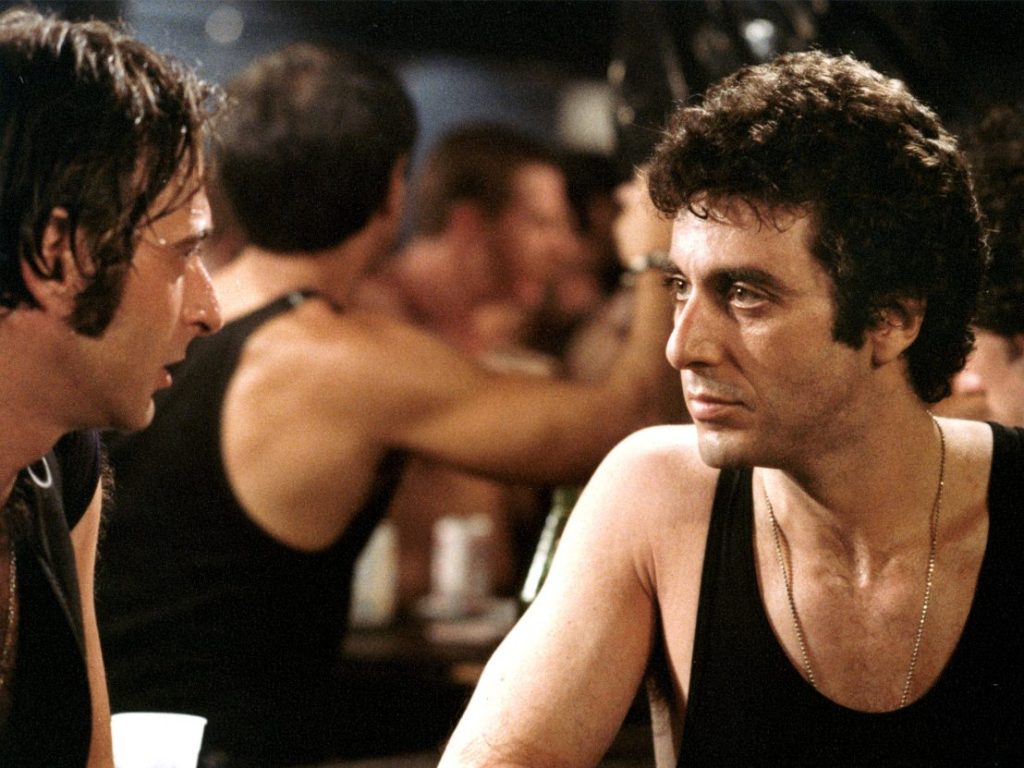
By the time William Friedkin’s Cruising hit theaters in February of 1980, there already was a lot of controversy over the movie. Set mostly in gay men nightclubs and bars, it follows an undercover NYPD officer Steve Burns (Al Pacino) pretending to be gay so he can find a person who is killing gay men. Protests erupted in the summer 1979 during the filming as the movie and the novel on which it’s based were inspired by true-crime murders of gay men in New York City.
Captain Edelson (Paul Sorvino) assigns Burns to the undercover work mainly because Burns fits the description of the victims and Burns himself wants to make detective. But Pacino who was 39 at the time of filming is a good 10-15 years older than what the character should be. Initially concerned and nervous about going into the leather BDSM world of the era, Burns has a girlfriend, Nancy Gates (Karen Allen), who he has to keep in the dark. He hangs out in the clubs and bars in the Meatpacking District where many bars were located.
Even though no sex scenes are shown, it is implied that Burns takes part in gay male sex with men. The closest we see is Burns being fondled during a meeting and tied up nude during a sting operation. There’s also scenes of Burns and Nancy having sex somewhat rough. Sadly the movie never really implies how far into the world Burns has gone. If he has sex with another man or engages into sexual activity, is it part of the job or does Burns himself have his own sexual tendecies toward men? A scene in which Burns dances wildly in a drug-fueled moment with other men at a bar implies that he’s enjoying the nightlife.
I get the sense that Friedkin made a more raw and detailed movie that was cut apart by the studio, United Artists, and the MPAA. He claims he took it to the board 50 times at an extra expense of $50,000 to get an R rating. This meant that about 40 minutes of what he intended to show was cut out of the movie. And it shows. The movie feels more episodic rather than having a well-constructed plot.
While the first half of the movie seems to focus on the bars and the lifestyle, the second half seems to be more of a slower-paced tale as Burns discovers a new lead in a Columbia University student Stuart Richards (Richard Cox) who suffers from schizophrenia and is stilling grieving over the death of his father. The plot suggests that Stuart might be the killer but there’s a twist at the end that even points the finger at Burns himself.
This ambiguity has angered fans over the years as well as the notion that Stuart is innocent and the killer is still at large. Edelson arrives at a murder scene where Ted Bailey (Don Scardino), who had become friendly with Burns, has been violently killed. A corrupted uniformed patrol officer DiSimone (Joe Spinnell) says it may have been a lover’s quarrel turned deadly. But there’s a sense Edelson doesn’t believe that. In an earlier scene, DiSimone is shown harassing two transgender women forcing them to perform sexual acts on him and his partner. It’s also implied that DiSimone himself is gay as he is spotted in one of the bars checking Burns out.
For the most part, many in the gay-male community felt the portrayal of the club life might be interpreted as a generalization. A disclaimer was added reading: “This film is not intended as an indictment of the homosexual world. It is set in one small segment of that world, which is not meant to be representative of the whole.” The scenes of Stuart and his friend, Paul Gaines (William Russ), carrying on regular conversations seem to show that what most stereotypes people had of gay men weren’t true. However, Stuart having schizophrenia seems to perpetuate the idea that all gay men have a mental illness.
In an ironic twist of his earlier movie, The Boys in the Band, Friedkin here portrays gay men as either sexual maniacs, predators (as in the case of DiSimone and others), suffering from mental issues, and/or just victims. It’s never implied if Paul Gaines is gay or not or just a close friend of Stuart’s. I can understand why many in the gay-male community, not just in the NYC area, but America were mad at a movie like Cruising.
As featured in The Celluloid Closet, many gay men all over the country found themselves threatened and harassed by people who said they would meet the same fates as the victims in this movie. It’s probably no surprise that Cruising was met with mixed reviews and bombed at the box office, barely making close to $20 million off a $11 million budget. Mainstream audiences stayed away because of the subject matter and those in the LGBTQIA community refused to watch it protesting theaters.
Now, it’s mostly remember for its infamy. Friedkin is one of those directors who has often tried to push the boundaries. But sometimes you can push too much. He became a persona non grata with many in the NYC LGBTQIA community following this movie. His next movie would be the poorly received Deal of the Century in which Friedkin was hired just as a back-up director. It’s no surprise he never talks about that movie.
While I wouldn’t be one to argue for a Friedkin Cut of Cruising, it might show what he had intended. The recent season of American Horror Story seemed almost like a remake of the movie focusing on the same time frame in America where a serial killer is targeting gay men. There’s also a certain scene in AHS that is an homage to Cruising. Those who’ve seen both know what I’m talking about. The movie is very dated but like the series, it’s a reminder of how things were 40-50 years ago.
What do you think? Please comment.
 Zane Says