Note: This focus will be on horror/thrillers that have featured the LGBTQIA community and/or have themes as June is Pride Month.
By the time, Child’s Play hit theaters, for some reason after Halloween, in 1988, the horror genre had become a step up from porno. The slasher genre of the 1980s had soured the market so much that Michael Myers had been brought back from the dead to do battle with Freddy Krueger and Jason Vorhees at the box office.
But to call Child’s Play a slasher is an insult. The movie owes a lot more to Trilogy of Terror, Dolls and the “Living Doll” episode of The Twilight Zone. There’s something that’s just creepy about dolls. Maybe it’s because they’re so lifeless with smiles and expressions that are more like thousand-yard stares. The Cabbage Patch Doll craze of the early 1980s gave rise to the My Buddy dolls of the mid-1980s. The concept was that dolls didn’t just have to be for girls.
I had my mixture of G.I. Joe and Star Wars action figurines along with my Alf doll and a cheap Chabbage Patch-like doll that I think a relative had made for me. The Alf doll had one of those squeeze voice boxes. Another person I went to school with had the Alf doll that talked and moved its mouth, eyes and ears. There was also the Teddy Ruxpin dolls that had become famous. But by 1988, most kids had grown out of it.
Madison Avenue, Wall Street and the corporate greed that was the 1980s was selling us toys faster than Apple Computers can manufacture an iPhone. Fisher Price, Worlds of Wonder, Hasbro, Mattel and Kenner were wolds elementary school kids learned along with TV slogans like, “Where’s the beef?” and “By Mennen.” Looking back the Transformers, He-Man and G.I. Joe shows, among any and every Saturday morning and afternoon syndication cartoon show was nothing more than a commercial so you could buy things.
Someone had to put their foot down and say enough is enough. And that someone was Don Mancini who only in his mid-20s saw what the problem was. Mancini’s father was an advertising executive and had a troubled relationship being a gay man in an era where it was better to stay in the closet around some people. This is how the story became a centered around a young boy with a single mother and no father figure.
But Mancini’s original story titled Batteries Not Included and then Bloody Buddy was more of a whodunit as it deals with a boy who mixes his real blood with the fake blood of a doll. It would’ve also toyed with the notion more of whether it was Andy or Chucky doing the killings. David Kirschner, who had previously worked with Steven Spielberg and Don Bluth on the family friendly An American Tail, was interested in a killer doll story and became the producer for movie and its sequel.
The script was rewritten with the help of John Lafia and Tom Holland, who directs. Holland’s directing debut Fright Night had been more obvious with its homoerotic overtones. Holland has admitted that he wanted to make the Good Guy Dolls look like the My Buddy dolls. There’s still some of the advertising critiques as the protagonist Andy Barclay (Alex Vincent) wears Good Guy pajamas and toys while he’s only 6. Get ’em while they’re young, I guess.
In a very comical scene, Andy gets up bright and early on his birthday to make his mother, Karen (Catherine Hicks), breakfast in bed with burnt toast with a baseball-size glob of butter and cereal with enough sugar in it to make anyone a diabetic. After seeing a toy commercial of the Good Guy dolls, he mistakes a present that is clothes for a doll and becomes disappointed.
Karen tells him that she didn’t have enough time to save money but her co-worker, Maggie Peterson (Dinah Manoff) at the department store in Chicago tells about a homeless man selling a doll in the back alley. They slip away where she buys it for $50. (Wonder what the actual retail price was of something like that in 1988 if $50 is a bargain?) Karen has to cover for a co-worker so Maggie agrees to babysit Andy.
What no one knows is that the night before Charles Earl Ray (Brad Dourif) was fatally shot in a toy department store by Chicago Police Det. Mike Norris (Chris Sarandon). Ray was a serial killer the police were tracking. Dying, Ray collapses near an aisle of Good Guy Dolls and uses voodoo he’s learned to transfer his soul into the doll. His incantation causes a huge thunderstorm cloud to form over the store bring down bolts of lightning that cause an explosion. Norris discovers Ray’s body and thinks the case is closed.
But it’s far from over. Calling himself Chucky to a very enthusiastic Andy, he overhears a news story about the escape of Eddie Caputo (Neil Giuntoli), a partner in crime who ditched Ray as the police were closing in on him. But it’s Andy’s bedtime and Maggie doesn’t believe it when Andy says Chucky told him he wants to watch the news. And when Chucky turns on the news anyway as Andy is brushing his teeth, Maggie gets on to Andy. Later, Chucky whacks Maggie in the head with a toy hammer causing her to fall out of the apartment window toward her death.
Norris and his partner, Det. Jack Santos (Tommy Swerdlow), report to the apartment and are confronted with a frantic Karen. But the police wonder if Andy is a suspect despite her objections. Andy tries to say Chucky did it but no one believes him even after Caputo dies in an explosion at an abandoned house. (I’ve always wondered why the gas was still turned on). Andy tries to tell the police it’s Chucky but no one believes him. You could argue the feeling of isolation and disbelief is a metaphor for how Mancini felt as a young gay man. Sometimes adults don’t know what’s best.
They suspect Andy might have some psychological problems which was how some people saw homosexuality in the 1960s and 1970s when Mancini was growing up. It’s almost like some payback to mental health doctors who used shock therapy when Dr. Ardmore (Jack Colvin) is killed by an electroshock therapy device. But Chucky needs to get inside Andy’s body after learning the longer he stays in the doll, the more he begins to experience pain and human sensations.
While the movie doesn’t play on the homoerotic overtones as much as the sequels, the focus is more on the dangers of advertising. Andy is disappointed by his mother bought his Good Guy toys but not the doll. And there’s a feeling that Karen is upset too but when she is able to buy a doll, she can be happy because Andy’s happy. Toys have been around forever but by the 1980s, it was as if parents were being told they were bad if they didn’t get their kids everything they wanted.
Sometimes it’s best not to get what you want. Of course, there are the questions of why didn’t Chucky just come alive and leave the toy store. Why did he remain pretending to be a doll when at any given time he could leave? And why have Andy take him to the run-down neighborhood where Caputo is hiding out unless it was to make people think it was just a young boy with his doll.
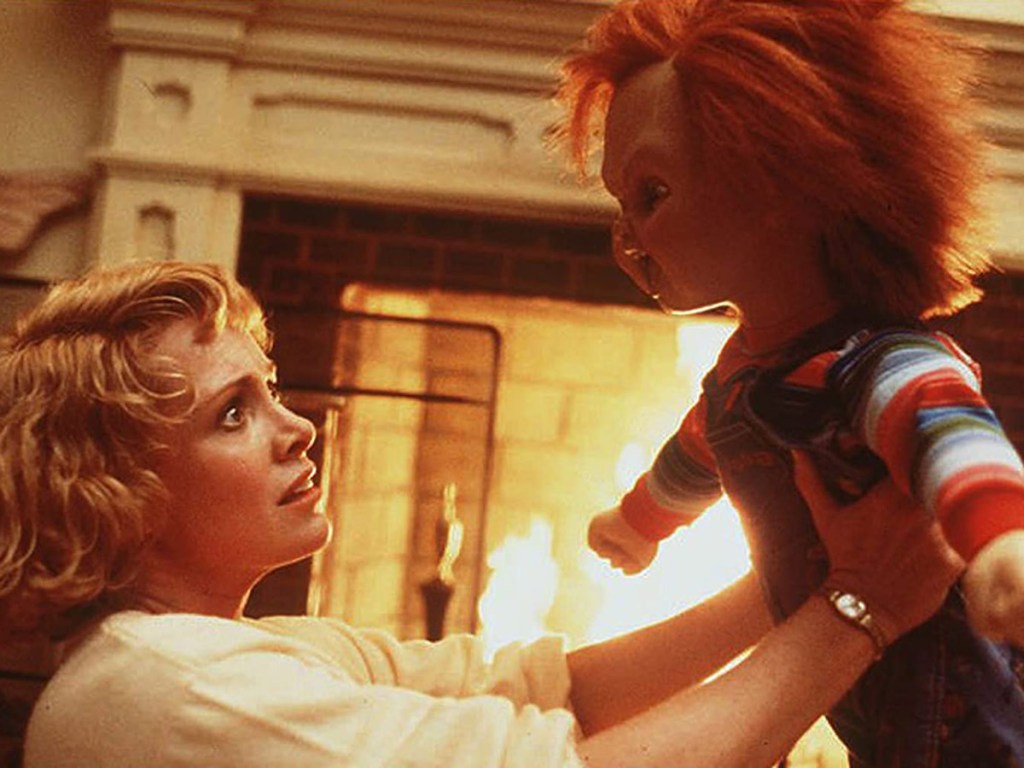
Like most people, I found Chucky more terrifying when he’s trying to be a doll and almost comical when he’s come alive. During a scene that is supposed to be scary but is really funny, Chucky comes alive swearing at Karen as she threatens to throw him into the fireplace after discovering he doesn’t have batteries in him. Dourif said he gave Chucky a voice more like Jack Nicholson, his One Flew Over the Cuckoo’s Nest co-star. I’ve often thought, and others have noted this as well, but there’s a little bit of Michael Keaton’s madness in Chucky’s face in some scenes.
The movie would go on to become a modest success for United Artists and their parent company MGM. Even critics, such as Roger Ebert, were more favorable to it as they had been critical of the slasher movies. But unfortunately there was some controversy as parental groups thought it would incite more violence in children. Because of this and a potential sale of MGM/UA Communications led to a bidding war by other studios for the rights to the sequel. It was Spielberg, of all people, who helped negotiate the rights to Universal Pictures.
Sadly, the parental groups’ concerns became a reality as James Bulger, just a month shy of his third birthday, was murdered by two child killers who said they were influenced by Child’s Play 3. Bulger was from Kirby, England and was lured away by Robert Thompson and Jon Venables, both 9, on Feb. 12, 1993 at the New Strand Shopping Centre in Bootle. This along with the diminishing returns on the movie led to the franchise going dormant for most of the 1990s until Scream revitalized the slasher genre.
Bride of Chucky would be released in 1998 and become a success at the box office with it’s more comical parody tone leading to Seed of Chucky in which Chuck and his girlfriend, Tiffany, has a son who is actually a transgender woman. While this was meant to be comical, over the years, people have viewed Glen/Glenda as a breakthrough in LGBTQIA horror. Mancini would rely more heavily on the gay pride overtones for the Chucky TV series.
Chucky himself has been seen more and more as LGBTQIA pride symbol, probably for the rainbow colors of his shirt underneath his overalls. Now at 60, Mancini has come a long way in the horror genre than the aspiring writer trying to get his foot in the door. Like Clive Barker, Ryan Murphy and Kevin Williamson, they have proven that horror can explore more themes and entertain wider audiences. More importantly, you don’t always have to uphold the status quo and play by the rules.
What do you think? Please comment.
 Zane Says