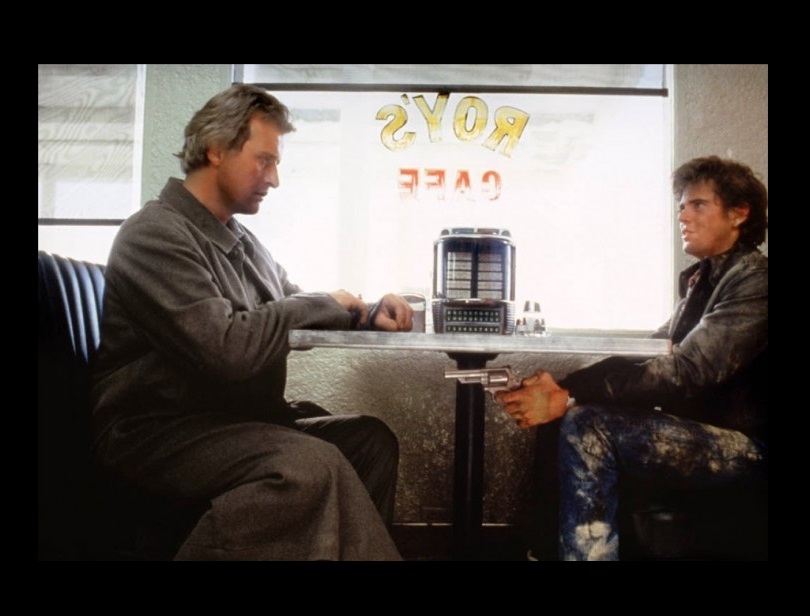
With the recent ground stop by the FAA last weekend and with the Thanksgiving holiday travel coming up I thought I’d look at one of the most underrated, and underappreciated horror movies of the last 50 years.
In the winter of 1986, The Hitcher was released a few weeks after the infamous Challenger explosion. Ronald Reagan was still riding high after the 1984 election with his Morning in America campaign, it seemed that most Americans were getting tired of negative, nihilistic and entertainment. They wanted something that was just fun and exciting like Top Gun.
was released a few weeks after the infamous challenger explosion. Wanna reagan was still riding high after the nineteen eighty four latchen with his morning in america campaign, it seemed that most americans where getting tired of negative depressing entertainment n wanted something that was just fun and exciting.
I guess in someone’s point of view, The Hitcher is a fun and exciting movie. However, it is also a very violent, very bleak movie. I also think there is something to be said about he casting. Rutger Hauer plays the title character who goes by the name John Ryder. The main protagonist is played by C. Thomas howell, who I think was only about 18 at the time of filming. After Nighthawks and Blade Runner, Hauer had become a very prominent villain actor in a lot of movies. Howell himself was just a young kid at the time, not only not four years away from appearing in the E. T. Yet he looks a lot older than 18.
When the movie was being filmed, I think the casting is important because it shows us how much young people were and are still underappreciated and undervalued by society. No one believez thaf Howell’s character, Jim Halsey, who is taking a Cadillac from Chicago to San Diego as part of a Drive Away is in any way innocent killings that Ryder does along the highways of western Texas.
At one point, when he is in custody at a sheriff station, a supervisor played by John M. Jackson says to his colleagues that he doesn’t think that Jim is a murderer, but he does not say it in front of Jim, who has already been taken back to a holding cell. I think this kind of shows you how law enforcement and especially people in authority are afraid of letting their guard down.
For the majority of the movie, Jim is running for the law who is more quick to shoot him and claim self-defense especially after the deputies who first arrest him are killed by Ryder. At one point while he is being detained and arrested a sheriff’s deputy tries to make it appear that Jim is grabbing for the deputies service revolver. The deputy is trying to make it appear to the people witnessing the arrest that Jim was going for his gun, so that’s why he had to shot him.
But Jim is saved by his only ally in the movie, Nash (Jennifer Jason Leigh), who is a an employee of a roadhouse cafe where gym is first arrested after he tries to report the murders committed by
Director Robert Harmon and writer Eric Red pull an old-fashioned plot device in which we know a person is completely innocent, but they are placed predicament in which it might be presumed they are guilty. Alfred Hitchcock used to do a lot of this. But Harmon gives the movie this ethereal almost dreamlike vibe in which Ryder isn’t just toying with Jim but more like terrorizing him to drive him mad.
When The Hitcher was released, it was heavily criticized. Roger Ebert gave it 0 stars, blasting the graphic violence and the brutality of it. I think so many people at the time were turned off by the slasher horror craze that they just dismissed the movie as another slasher. Yet I think it’s something else. It shows us how, as a society, we live in a kill or be killed mentality at the end of the day.
Law enforcement can find no past history on Ryder. I mean, his name is John Ryder. That’s probably a fake name. I’ll probably would use it if I was a hitchhiker, because I didn’t want anyone knowing who I was. In the mid-1980s, it was a lot harder for people to find out who you were. You could live off the grid a lot asier than you can now.
The plot hints at a relationship between Jim and Nash, but since the movie takes place over what is probably a 36-hour period I feel that Jim cares more about Nash’s safety than he does about having sex with her or a relationship. I also think Nash is a representative of the people who believe that there’s still good decency in a good marjority of people and sometimes law enforcement steps out of line, and they need to be held accountable. It’s crazy that a deputy wants to act like he is entitled to shoot Jim on a false claim. But yet, when Nash intervenes, she suddenly is deemed an accomplice to Jim. What is the line get drawn between who was in the right and who was in the wrong?
And not to spoil anything, but there has been some criticism about the way Nash’s fate is handled. It’s one for the books. I must say it’s very creative. I mean, this was before Saw and Final Destination presented us with elaborate Rube Goldberg-style violent deaths. Now that’s all over the place. So I can understand how people were a little uncomfortable in the mid-1980s.
It’s because at the time, Leigh was on her way to becoming a more prominent actress. She still was coming off Fast Times at Ridgemont High and grieving the gruesome death of her own father Vic Morrow who was killed on the set of the Twilight Zone: The Movie. But the way it’s used having to give Jim the option of stopping Ryder but at the risk of Nash’s presents a bold morality dilemma. What’s really the difference between justice and vengeance?
What do you think? Please comment.

