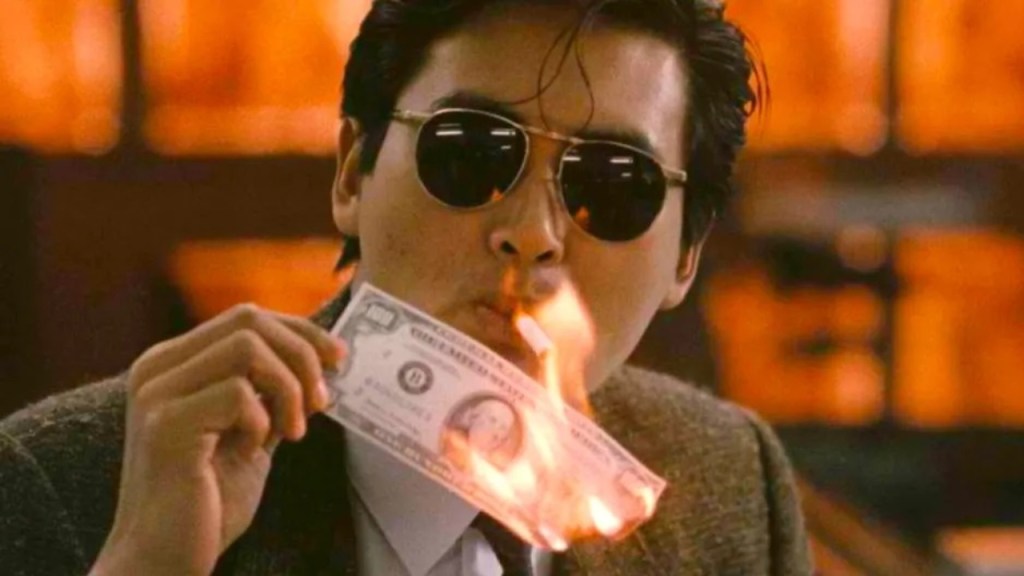
By the mid-1980s, people of Southeast Asia still weren’t equally represented in American mass media. (Just look at Lonf Duk Dong.) Movies like The Killing Fields portrayed them as victims, villains or friends of white people who were the lead. Even though that movie is based on a real story of violence and genocide, you could argue Dith Pran played by Dr. Haing S. Ngor is the real main character. Yet his story is only being told because of what happened during the Khmer Rouge massacres during Cambodia or Kampuchea as it was called for a few years.
That’s what makes A Better Tomorrow so different. The three main characters are complex and three-dimensional. Yet there’s no need for them to be Chinese. They could be white, Hispanic, Latino, Indian, black or African. It’s a crime drama about trust and loyalty where a former triad member Sung Tse-ho (Ti Lung) is trying to go straight and rebuild his relationship with his brother Sung Tse-kit (Leslie Cheung) and protect his other “brother” and partner in crime Mark Lee (Chow Yun-fat).
Starting in the early 1980s, Ho is a high-ranking triad in the Hong Kong crime syndicate. But Kit has taken a different route joining the police in hopes of rising through the ranks. Kit is unaware of Ho’s criminal history and just thinks he’s a legit businessman. However their ailing father knows of Ho’s activities and pleads with him to go straight. To honor his father, Ho takes a young up and coming triad, Shing (Waise Lee), with him on a business trip to Tiawan only to discover it’s a double-cross. It’s later revealed Shing was involved even though he initially denied it.
Ho takes a fall when the police pursue them getting arrested so Shing can escape. Yet the Tiawanese gang sends someone to kidnap Ho’s father but the ailing man puts up a fight and Kit returns home in time to kill him but his father has been mortally wounded telling Kit to forgive Ho before he dies.
To get revenge, Mark is tipped off by a crime boss the double-cross wasn’t officially authorized and he guns down the rest of the gang members at a restaurant. But since he denied the crime boss’ suggestion of sending extra men, Mark is wounded shot twice in his right leg. He never fully recovers and become disabled.
Ho spends three years in a Taiwanese prison before being released.
In that time, Kit has turned bitter and gruff toward Ho and all organized crime willing to do whatever it takes even if it’s excessive. He’s become romantically attached to Jackie (Emily Chu) who was his father’s caretaker.
Ho gets a job working as a taxi driver for a company owned by another ex-convict, Ken (Kenneth Tsang). Yet when he checks on his old stomping ground, he’s shocked to see that Mark has become nothing but a lowly gopher mostly keeping clean the limo belonging to Shing who has risen in the ranks to being the next in command behind Mr. Yiu (Sek Yin-tsi) the aging crime boss. Ho and Mark reconnect but Ho tells him he’s going straight and wants to rebuild his relationship with Kit.
Yet Shing wants to bring Ho and Mark back on the condition they use Kit as their inside man on the police force. Along with drug trafficking, they run a counterfeit operation of U.S. currency they trade with American criminals for Hong Kong Chinese currency.
It’s a very complex story that director John Woo who is also a co-writer carefully puts in about an hour and a half run time. Working with Tsui Hark as producer, the movie would be released in early August 1986 with little marketing but became a major hit. Chow had become a star in Asia early in his career around 1980 but by the mid-1980s, his star was fading as most of his movies didn’t make much money. Just as American audiences had with Bruce Willis and Die Hard, it was reported people even joked and laughed initially seeing Chow in an action crime movie which Chinese translation means True Colors of a Hero.
Not to say A Better Tomorrow is a better title as it feels like a family drama, which it is, but it would have an effect on Hong Kong cinema and culture as well as Hollywood itself. Young men were walking around Hong Kong and even southeast Asia with Alain Delon sunglasses, trench coats and long-coat slickers. The sunglasses reportedly sold out fast. There’s a joke in the 1988 sequel about young men and teens trying to walk and look like Mark.
The movie revitalized Chow’s character and established him as a leading actor as the heroic bloodshed genre exploded in the late 1980s and early 1990s. Woo and Chow worked together for many years on hits like The Killer in 1989 and Hard-Boiled. Hark and Ringo Lam as well as others went on to make similar movies. Filmmaking in Hong Kong was reportedly very quick pace with actors even helping crew members move set furniture and lighting. Chow discovered he didn’t have to do this when he made movies like The Replacement Killers and The Corruptor in America.
Yet Chow never really had a huge success with American audiences in American made movies the way Jackie Chan or Jet Li did. Woo had a brief time in the 1990s and early 2000s making Face/Off and Mission: Impossible 2. But he found himself having to compete with his imitators. There’s also rumors that Tom Cruise barred him from the editing room on M:I 2
Filmmakers like Quentin Tarantino, Robert Rodriguez and the Wachowskis would use some of his style such has having characters fire a hand gun in each hand. Woo expanded on Sam Peckinpah’s use of slo-mo during a character’s death. But he’d also have characters jumping through the air while firing guns. There almost was a dance to with would later be more stylized in the John Wick movies as it seems the characters are being hounded by baddies and have little time to full respond except aim and shoot. This has been called gun fu.

