I haven’t seen the Cape Fear series and I’ve only seen parts of the 1962 version. But the 1991 version directed by Martin Scorsese as a followup to Goodfellas brought him the best commercial success of his career so far.
While the original with Gregory Peck and Robert Mitchum is set in the last days of post-WWII “innocence” before the JFK assassination changed everything, the 1991 version is set in the dysfunctional early 1990s. The Cold War has ended and so has the concept of the Nuclear Family. On the service, Sam Bowden (Nick Nolte), his wife, Leigh (Jessica Lange), and their daughter, Danielle (Juliette Lewis), look perfect. But they’re not.
Leigh admits during a spat that she’s mad they’ve moved from the Atlanta area to the fictional New Essex, somewhere close to the coast in North Carolina where Spanish Moss hangs from the trees. It’s also implied Leigh has had a problem with depression and alcoholism as she works from home as a graphic designer. Sam has had marital infidelities that are never fully addressed and he appears to be getting too close to a colleague, Lori Davis (Illeana Douglas), who is younger and works in the court clerks office. It seems she likes Sam more than Sam likes her as they play racquetball and get a little too close.
Danielle, 15, is in trouble after being caught smoking marijuana, presumably at school or a school-related function. Scorsese and writer Wesley Strick don’t fully explain the problems the Bowdens have. This is possible as a way to make them more sympathetic as they are walking a fine line trying not to get too wrapped up in small-town gossip, especially southern small-town gossip.
Bowden was once a public defender in Atlanta where he buried a report that a violent rape victim was promiscuous knowing that the courts would’ve probably given Max Cady (Robert DeNiro) a slap on the wrist and been allowed to rape again or worse. (I’ve seen it before. It happens. In the 1970s, men could still rape their wives.)
Sam feels it was the right thing to do despite being unethical. And Max was illiterate and described as part of the “Pentecostal crackers.” He’s gone into private practice and lives in a nice home.
But Max has been released and he’s learned to read, only to discover what really happened. And he wants revenge.
But it will be too easy for Max to come out and assault Sam or even kill him. He’s read law books and considers himself a lawyer and equal to Sam having represented himself on appeals.
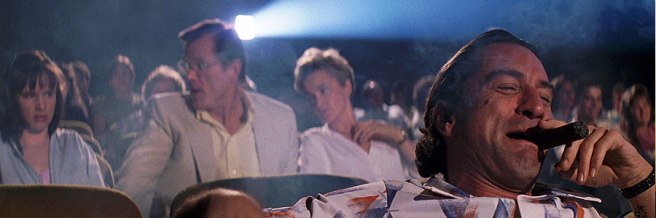
Max does a lot to keep himself from committing any true offenses. He goes to a theater showing Problem Child smokes a huge cigar and laughs outrageously at things that aren’t even funny. I don’t know if it was still legal to smoke in movie theaters in the early 1990s. But I think Max knows how no one will really do anything.
As he’s sitting right in front of the Bowdens, Sam tries to be courteous and when Max doesn’t respond, they move to another spot away. It’s funny how people would expect Sam as the man of the family to become violent or even go get an usher/theater worker.
Later Max somehow poisons the Bowdens’ dog off camera and it’s never really explained which makes it harder for local police lieutenant Elgart (Mitchum in a role reversal as the good guy this time) to even charge him with a crime. Also, Max has the proceeds from his family farm being sold so he’s not a vagrant. And Max doesn’t even drink alcohol.
He knows what to do and what not to do. During a discussion with Sam, Max explains he was gang-raped at least twice in prison (once by white convicts and the other time by black convicts). It’s obvious Max doesn’t see what he did to get him into prison as bad but what happened to him in there as traumatizing. Max is religious and has Biblical scriptures tattooed on him. Since his victim, who was only 16 at the time, was promiscuous, he probably feels her moral sins were worse than his legal crimes.
Max is an awful person and one of DeNiro’s best villains. He’s akin to the real-life William King Hale from Killers of the Flower Moon, a white man who felt it was wrong for the Osage to have land rights in Oklahoma for oil companies when it should’ve gone to white people. The late Louise Fletcher said she approached her iconic role as Nurse Ratched in One Flew Over the Cuckoo’s Nest as a person who felt everything she was doing was for the best of people and the right thing to do.
And there’s nothing more scary than someone who always thinks they are right.
What’s intriguing is how Sam underestimates Max just because he grew up in the northern Georgia backwoods. Max begins to flirt with Lori in a bar where she continues to drink as he just drinks water. Later he takes her to her house where he handcuffs her and beats her. Originally Lori was supposed to begin screaming when Max puts her in handcuffs but Douglas and DeNiro decided to act like it was sex play which makes it more disturbing.
Max knows Lori won’t turn him in because SA victims are blamed for their attacks, even though Max just beats her. But she was in a bar getting drunk.
It’s crazy how years have passed but women are still scrutinized for SA and assault and battery. Usually when characters use the law loopholes in their favor, I cringe because the actors overdo it and it’s hard to believe. (Rosamund Pike in I Care A Lot is a prime example.)
But DeNiro holds it back. During a visually stunning scene, Max sits on the stone fence of the Bowdens looking at the house while fireworks erupted in the sky above. When Sam tells this to his law partner, Tom Broadbent (Fred Dalton Thompson), he’s told that’s not even trespassing.
There’s also the feeling that Max knows the death of the family dog and Lori’s assault will do more damage between Sam and Leigh than he can at first. And he’s right. They are fighting a lot that Danielle goes to her room, turns up the stereo and calls her friends for support.
That’s what makes the sequence where Max contacts Danielle pretending to be her drama teacher more disturbing. He knows how to talk to young teenage girls who need attention their parents don’t give them. Sexual predators often prey on troubled children.
And that’s why when they meet in person, Danielle is attracted to him somewhat. Max even asks if he can get closer to her knowing that as long as he asks and she consents, it’s ok. It’s a reminder of the porno theater scene in Taxi Driver where DeNiro’s Travis takes Cybil Shepherd’s Betsy to a porno movie on a date.
It’s supposed to make us uncomfortable because it is.
This is the catalyst that makes Sam take violent action against Max. There have been numerous true crime cases of parents and relatives going after sexual predators with the general public defending the vengeance. Before our current laws, it was the way we settled things. If someone is hurting children, women or someone elderly/invalid, posses were formed to take care of things. But in the aftermath of lynchings, it’s viewed as barbaric and savage. Laws may have made us more civilized but it’s also put a strain on matters as people are expected the benefit of the doubt and innocent until proven guilty.
Originally Sam wanted to stay civil. They don’t even have a firearm in their home.
Sam even talks about it with a private investigator, Claude Kersek (Joe Don Baker), about how the courts consider him more dangerous than Max and even if Sam kills Max in self-defense, he could still go to prison.
Yet he realizes that some lawyers don’t have any scruples. Tom recommends he get Lee Heller (Peck) his old military buddy to represent him. But Heller represents Max and proves his loyalty to Tom doesn’t matter especially as Heller recommends Sam be disbarred on allegations he hired people to beat up Max. Casting Peck in this role is a nice move because Peck pretty much set the litmus test with good fathers and legal advocates fighting uphill as Atticus Finch. However, Heller is the antithesis of Finch with how he an ambulance-chasing old South Charlatan representing whomever can pay him first and probably more.
Sam moved his family from the Atlanta area to Mayberry for the affluent for their safety but they brought their problems with them. Also, since Max is very religious, if Sam kills him, he thinks he’ll still go to Heaven. Not to ruin the ending, but Sam must find himself defending his family from Max while trying not to turn into the monster that Max is.
In nature, animals will turns violent to protect their young. Roosters will fight humans if they feel the hens or chicks are being threatened. Elephants will stomp people who get too close to them. Lions, gorillas and even the family dog will resort to aggression and violence easily if they feel an immediate threat.
But the movie ends with the Bowdens wondering if it is really over and how they’ll never be rhe same again. The question is did Max really succeed when he told Sam he “would learn about loss.” Sam protected his family and possibly other families by making sure Max went to prison. But no one really gets over trauma. It hangs on you like the Spanish Moss.
Cape Fear was originally put in pre-production by Steven Spielberg who realized he realized it wasn’t the right movie for him at the time switching with Scorsese who had been considering doing Schindler’s List. It was a good trade.
I can’t think of anyone by Spielberg doing Schindler’s List but also Scorsese himself has the personal experience. He had originally considered the priesthood before filmmaking. He was also on his fourth marriage to Barbara De Fina, a producer, which was on the rocks as he was in a relationship with Douglas at the time.
Like Sam, he’s a flawed person whose professional life might be riding high but his personal life is a mess.
Scorsese with long-time editor Thelma Schoonmaker give the movie more of a Hitchcockian vibe thanks to Elmer Bernstein’s use of Bernard Hermann’s original music that was used in the 1962 version along with music from Hitchcock’s Torn Curtain.

