In a world where it seems there’s superhero fatigue, at one time, movie producers really didn’t see the point in doing a superhero movie. And there was a good reason – they really didn’t have a good track record.
While the first two Superman movies were well-made and received, popularity was waning. Superman III wasn’t the best. Even Taika Waititi could find many faults with it. And Supergirl: The Movie was easily forgotten by the time people Superman IV: The Quest for Peace hit theaters which is why that movie didn’t make much money. They were terribly made.
It didn’t help matters the much-anticipated Howard the Duck opened in the summer of 1986 to horrible reviews and a poor box office return. Even movies like King Kong Lives and Masters of the Universe were so shoddily made, audiences seemed not to care. It weas almost like Tyler Perry movies of today. Producers just thought a certain demographic would flock to the theaters in droves.
This might explain why the 1989 version of The Punisher wasn’t released in American theaters but in other countries Also, there was no way it was going to beat Batman at the box office. The summer of 1989 was the “Summer of Batman” and the movie showed just how well a superhero movie could be made.
And that also created a problem, I remember reading how a Captain America movie was slated to appear in 1990 for the 50th anniversary of the comic-book character. But nothing happened before the movie was released in 1992 straight to video. It’s pretty bad. There’s no way to sugarcoat it. Cap’s suit looks like cheap rubber which is probably while Matt Salinger is often seen in regular clothes as Steve Rogers.
Yet, fans still had hope when news of The Fantastic Four movie spread. The Internet wasn’t in massive use back then, but the word was still going around the old fashioned way through journalism and world of mouth at comic book conventions. However, little did fans know what was happening behind the scenes. Marvel Comics had sold film rights of several properties to producers and companies in the 1980s. Unfortunately, no main production companies would touch the properties.
So, the rights to Spider-Man and Captain America went to the Cannon Group, mostly known for producing low-budget schlock action movies. When Cannon was dissolved due to bankruptcy, the two heads of the company split. One of them, Menahem Golan became CEO of 21st Century Film and put Captain America into production. But Spidey was split three ways. TV rights went to Viacom. Home-video rights went to Columbia which itself was in the process of being sold from Coca-Cola to Sony and the theatrical rights were sold to to Carolco Pictures.
Carolco was going to get James Cameron to direct and write the script. However, Carolco itself also went bankrupt in the mid-1990s and dissolved. This meant the rights were again in limbo. And following the controversy over the Fantastic Four, they might have stayed there. Four had been sold to Neue Constantin, a German production company based in Munich. One its key people, Bernd Eichinger, had purchased the rights in the early 1980s in hopes of getting a major Hollywood studio to start a big-budget Fantastic Four movie.
The only problem was no one was interested. And Marvel wasn’t going to extend the rights. Eichinger had two options – get production started by Dec. 31, 1992 or let the rights expire. Following the success of the first Batman movie, he probably wasn’t going to let the rights expire. So, like most people, he did the cheapest thing because it was the most accessible for the time being.
He approached Roger Corman, who was a low-budget American movie filmmaker who agreed to help him produce it. According to Jay Underwood who played Johnny Storm/Human Torch, he read for the part in the middle of December 1992 and only days later learned he had the part without a second call-back. Alex Hyde-White who plays Reed Richards/Mr. Fantastic says that while they were allowed to have Dec. 25 Christmas Day off as it was a Friday, they actually had to return to the set the next day.
And they said the set was located in a rundown industrial park in the Los Angeles area that actually had been condemned. Production crews say in the documentary Doomed: The Untold Story of Roger Corman’s The Fantastic Four that they had to bring in a cat who was a good mouser to take care of the rodent problem. They had also used the sets that had been left over from a previous production Carnosaur.
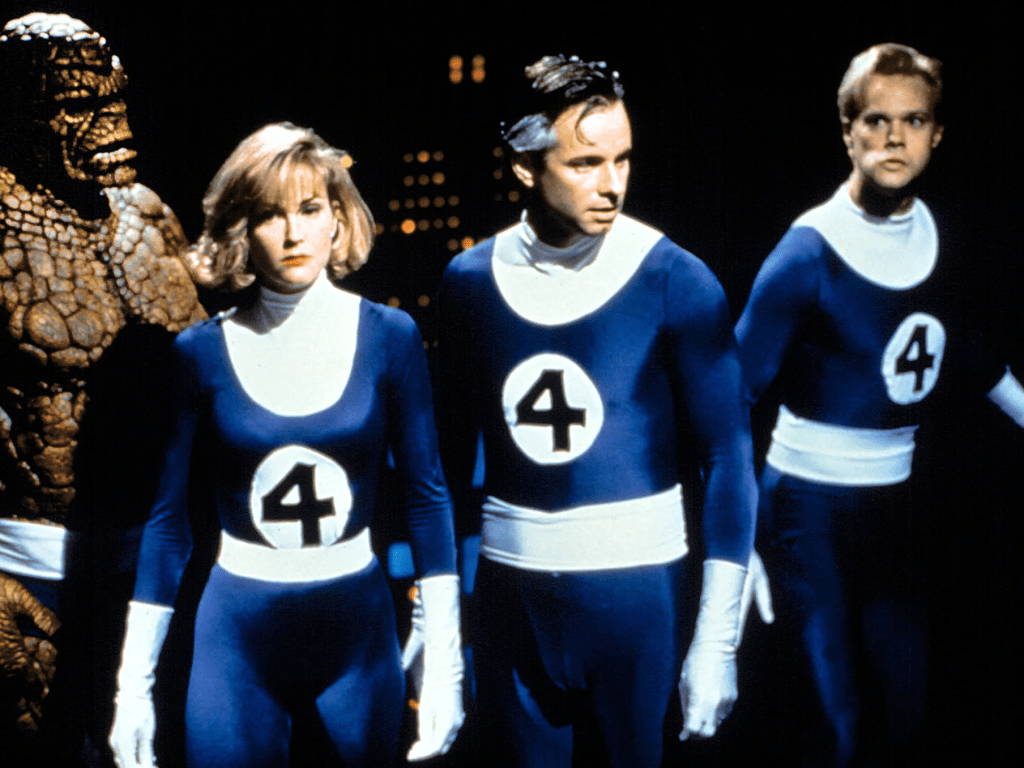
I’m gonna cut to the chase. It looks like crap. Everything in the movie looks terrible. They use darkness and poor lighting to hide the cheapness of the sets. And the space suits they wear are basically Haz-Mat suits. Even the Fantastic Four costumes they wear look cheap. But there’s a way they get around that by saying Sue Storm (Rebecca Staab) made them herself. So, they’re not supposed to look they’re professionally made, you see.
Hey, at least give the film production an A for effort. Well, I wouldn’t say A. It’s definitely a B-Minus, more closer to a C-Plus than a regular B, you see. It’s impossible to make a movie based on a popular comic book franchise on a very small budget. It’s been reported the budget was about $1 million or $1.5 million. The 1989 Batman cost about $50 million.
But, hey, that third Ant-Man costs upwards of $400 million and it was terrible. And the fourth Thor movie cost $250 million not including promotion and marketing costs and it looks like shit as well. I mean, Disney probably spent at least $1 billion on the production and marketing of Eternals, Ant-Man 3 and Thor 4. And none are as watchable as this movie. I’ve sat through them once but have no desire to see them again. However, this movie has nice moments especially if you know the production’s back story.
It’s not a great superhero movie, but the cast and crew went in to it as if they were going to make the best movie they could with what they had. Most of the cast are character actors. There’s a big difference from between an actor working for SAG-AFTRA scale pay and an A-lister just wanting a paycheck. Many big names have openly said they won’t do movies with a lot of VFX because of the difficulties as they act against a green screen or can’t move their head or hands two millimeters without ruining a whole take because it won’t match.
This is basically an origin story as Reed and his college friend, Ben Grimm (Michael Bailey Smith), are living in a boarding house where Johnny and Sue are young kids. Reed and his college classmate Victor Von Doom (Joseph Culp), try to do an experiment as a comet, Colossus, is passing Earth in space, but it goes wrong. Victor is injured and burned badly believed to have died.
Ten years later, Colossus is coming back and now Reed, Ben along with Johnny and Sue as they are grown, attempt to do an experiment in a space shuttle. But things go wrong because of course they do and they get all the powers as they are exposed to the radiation. Reed can stretch his body. Johnny can generate fry out of nowhere. Susan can be invisible. And Ben eventually turns into a rock-like creature The Thing (Carl Ciarfalio).
Most of the movie seems to take place indoors or outside where there’s not much around for exteriors. But Netflix movies do the same damn thing and they cost a lot of money too. The actors here give it all they can with the material they have. Culp, son of actor Robert Culp, said he modeled his version of Dr. Doom on Benito Mussolini with all his posturing. Underwood, who began his career in teen movies like Not Quite Human and The Invisible Kid, plays Johnny like a child who doesn’t want to grow up.
Hyde-White, the son of English actor Wilfred Hyde-White, makes Reed a very noble character. He had previously had a supporting role as the grandson of Ralph Bellamy’s character in Pretty Woman alongside Julia Roberts and Richard Gere. He had also appeared briefly in the prologue of Indiana Jones and the Last Crusade as the younger Henry Jones Sr.
Also Staab and Kat Green who plays Alicia Masters had just started out acting in small roles in movies and on TV. So, they don’t have the big heads other actresses might have had. You really get the sense that even though the production was fast pace and they didn’t have anywhere near the amenities big-name actors get, they enjoyed what they were doing.
And that’s what missing nowadays. It’s easier to see where the actors just don’t give a fuck as the phone it in these roles. Because of copyright issues, The Jeweler (Ian Trigger) was created in place of The Mole Man. Despite being an obvious substitute, Trigger, a student of the Royal Academy of Dramatic Art, makes the character very memorable.
Shortly after the movie was completed in post-production, it became apparent to the cast and crew something was more amiss. Hyde-White, Smith and Culp said they began a grass roots campaign to promote it, on their own dollar only to get a cease and decease letter before a reported premiere in the winter of 1994 at the Mall of America in Minnesota.
Depending on who you talk to, Eichinger paid Corman for all the expenses he had incurred to buy the rights. Eichinger died in 2011. Stan Lee said in 2005 that it was basically an “ashcan copy,” a term for something only produced to keep the rights. Other people point the decision to keep the movie from being publicly seen to Avi Arad, the founder of Marvel Studios, now rebranded as Marvel Entertainment. The rumor is Arad was successful in getting the X-Men cartoon started in 1992 and was afraid a low-budget movie would hurt the brand of all Marvel properties.
Corman, who passed in 2024, said he was unaware that the movie went into production with the intention of being unreleased. Throughout his career, Corman wrote, directed, and/or produced about 130 movies. All of them were released in one market or another except this one,
The negative was meant to be unreleased or destroyed. Oley Sassone, the director, said he had hoped to find the official negative before it was taken away. He did say in Doomed he took a copy of the movie to a little-known company that would do VHS dubbings so he could have extra copies. He hypothesized that the people working there might have made a secret copy for themselves which led to the evolution of bootlegs on the Internet. Green said she didn’t even know the movie was available until she was approached by a fan of the bootleg who told her about it.
But its notoriety worked out in the favor as fans of Marvel, Fantastic Four and just bootlegs in general have clamored over the years to buy copies and view it online. It’s currently on DailyMotion, InternetArchive and YouTube becoming one of the most popular unreleased bootleg movies of all time.
Yet if surviving is the best revenge, then after three other Fantastic Four movies that didn’t get the best results producers might have wanted, the latest version The Fantastic Four: First Steps, released only a week ago, has received rave reviews and about a quarter of a billion dollars worldwide in box office receipts. And the icing on the cake is Hyde-White, Smith, Staab and Underwood have all made cameos in the movie and introducing a younger audience to the 1994 version.
Hopefully, with good SAG-AFTRA contracts, they might get some residuals too.
What do you think? Please comment.
 Zane Says