There might not be any time frame for a movie like Soul Man ever to be made without it being controversial. But that’s part of the reason the movie works…and doesn’t work.
White people have appropriated every other culture, the controversy over Kendrick Lamar at the recent Super Bowl halftime show as well as Beyonce winning Best County Album at the Grammys seem to come from a lack of history or a fear of admitting the ugly truth. Black people have always performed for the amusement of white people and sporting events have become less violent mandingo bouts. Yet, white people who live a life of privilege fail to see the oppression others face every day.
Soul Man tries to go for the same delivery Mel Brooks brought to Blazing Saddles. And for half of the movie, it works. Even the main character, Mark Watson (C. Thomas Howell) is ignorant. The son of a wealthy father, Bill (James B. Sikking), he’s recently graduated from a college in L.A., presumable either the University of California at Los Angeles or University of Southern California. Despite his lifestyle, which seems to be of a party college student, Mark and his friend, Gordon Bloomfield (Arye Gross), have been accepted to Harvard Law School.
Despite having a son accepted to Harvard, Bill feels it’s important for Mark to pay his whole way. On the advice of his therapist, Dr. Aronson (Max Wright), Bill has taken money he set aside for Mark’s tuition and bought a condo in Barbados. Realizing, it’s going to cost him over $50,000 for three years, Mark searches for scholarships and loans that he can’t get. Also, he is unable to get financial aid assistance.
Without much luck, Mark turns to a friend of his who has started working for a company developing pills that tan skin. Mark decides to take extra pills so his skin turns brown and he pretends to be black. He successfully wins a scholarship for the best black applicant from Los Angeles but Gordon is skeptical. However Mark foolishly says the 1980s are the “Cosby decade” as “America loves black people.”
Yet, Mark soon realizes that’s not true. When they move to the Greater Boston area, their apartment superintendent Ray McGrady (Jeff Altman) is worried that Mark is a “black Negro” and contacts the building owner, the wealthy Mr. Dunbar (Leslie Nielsen), who is also a racist, so they can find a way to kick him out if he breaks any rules or regulations. Dunbar’s daughter, Whitney (Melora Hardin), has also moved into the building as she’s attending Radcliffe College. But Whitney is only attracted to Mark because she think he’s black.
And around campus, Mark witnesses prejudice and racism. Two white students, Barky Brewer (Wallace Langham credited as Wally Ward) and Booey Fraser (Eric Schiff), are constantly making racist jokes. When Mark and Gordon go to play a pick-up basketball game with other students, the team captains, Frank (Ron Reagan) and Ernie (David Reynolds), fight over who gets to have Mark, since because of his skin, they think he will be a good player. Eventually, he is put on Frank’s team who refers to him as “Marcus” and “Washington.” And they all discover he is terrible at basketball as he has to guard Leon (Wolfe Perry) who is actually black and good at the sport.
The fact that Ron Reagan, the son of the American President at the time, is in this movie is a wonderful casting choice. Ron’s father, Ronald, was well known for his very racist and prejudice views as well as how he got the American public to believe that all black people were on welfare and food stamps. Even though Ron tried his hand at acting earlier in his life, this is his only feature film credit even though he appeared on TV in other roles.
Mark soon realizes that it’s not going to be as easy as he thought. He takes criminal law because the “prof is a brother” but soon learns Banks (James Earl Jones) is not easy on anyway and is possibly a bit harder on Mark and a fellow student, Sarah Walker (Rae Dawn Chong), because they are the only two black people in the class and he knows they have to succeed. A fellow student Bruce Wizansky (Jerry Pavlon) is critical thinking Mark got in Harvard because of affirmative action.
All this alone would make for a great movie about the foolish world Mark was unknowingly a part of. He and Gordon see themselves going to Harvard to become big corporate lawyers making millions. And while Mark has everything paid for through his scholarship, Sarah doesn’t. She has to work at one of the eateries on campus as she is also a single mother to a son, George (Jonathan “Fudge” Leonard) and has to live with her grandparents.
Mark eventually learns that Sarah and George were from California as well and she was the leading contender for the scholarship even though she wasn’t from L.A. Initially, she is friendly to Mark before realizing how foolish he acts, even appearing at a black law student group dressed like a militant Black Panther. The Mark/Sarah story is the movie’s biggest misstep because it’s a foolish plot point in many movies where a character has to have a love interest.
I agree with other people that Howell and Chong have little chemistry together. In real life, they would be married in 1989 and then divorce a year later. It’s any unnecessary plot device. Sarah only seems to come more three-dimensional when she tells Mark about how she and George are treated by snippy grocery clerks who think they have food stamps and goes outside to see the snow falling. Other than that, she just seems to react to Mark and what he does and says. While I do think it is a little stereotypical Sarah would be a divorcee with a son, I think it shows Mark how some people are really busting their humps at all schooling while he’s gotten a free ride on a lie.
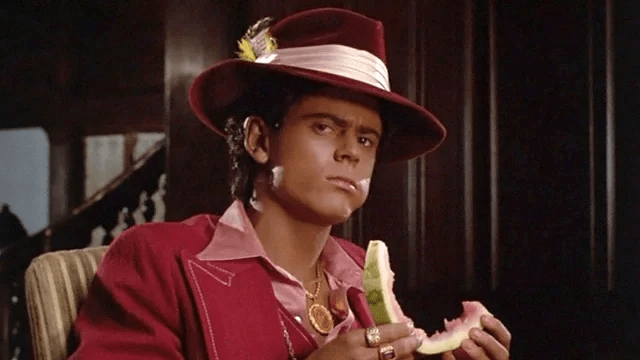
It’s a hard sell for a movie. The humorous scenes are the movie’s highlights. During a scene where Mark is invited by Whitney to a family dinner, there is a lot of unease and tension as the Dunbars are stuck up and have black people as their servants. Whitney’s mother (Ann Walker) has a sexual fantasy of Mark as a savage ripping her clothes off. Bundy Dunbar (Bo Mancuso), a child, sees Mark as Prince in a daydream. Then Mr. Dunbar imagines a horrible future where Mark, dressed as a 1970s pimp, eating watermelon berates a pregnant Whitney calling her a “white fat-ass slut” while he tells her to get some heroin and a hypodermic needle. Then, Mark breaks the fourth wall and screams, “What’chu lookin’ at?” at the camera.
The dinner scene is only about a minute and a half long but it has a huge bite to it how Americans 40 years ago and still today only see black people as stereotypes they themselves have created out of sheer ignorance. This would be the first non-horror movie Steve Miner would direct even though he did work on comedies with filmmaker Sean S. Cunningham. His previous movies were the second and third Friday the 13th movies as well as the first House movie. (Incidentally, Gross would play the lead in House II.) It could be that Miner doesn’t have that spark that Brooks or the Farrelly Brothers could’ve brought to the controversial material.
Still, it did have people divided even though it was a big success at $35 million worldwide just against a $4.5 million budget. Critics tore it apart saying that Howell in blackface wasn’t funny. I’ll admit the scenes in which Mark’s parents make a surprise visit while Whitney is in his bedroom in lingerie as Sarah has come over to study has the wrong tone. It’s too sitcom instead of farce. But it shows Mark hasn’t really thought things through. He has also forgotten a couple from his former college, Brad Small (Mark Neely) and Lisa Stimson (Julia Louis-Dreyfus), are nearby at Boston University. And there’s some minor subplot about Brad being next in line at Harvard Law if someone drops/flunks out.
There’s way too much going on in this movie. Yet, we never do see the difficulties Mark has with his other classes. From my friends who have gone to law school, the scenes of Gordon, Mark, Sarah and everyone else with their nose in a book while they’re eating breakfast and falling asleep from exhaustion in a library is accurate. Yet Mark and Gordon seem so cocky and arrogant at first, you have to worry what were they prepared for at Harvard because they’d have to have stellar grades in their undergraduate as well as nailing their LSAT exams.
The movie had a lot of controversy with filmmaker Spike Lee and members of the NAACP protesting it. A screening at UCLA was met with a protest with students picketing. “We certainly believe it is possible to use humor to reveal the ridiculousness of racism. However the unhumorous and quite seriously made plot point of Soul Man is that no black student could be found in all of Los Angeles who was academically qualified for a scholarship geared to blacks,” said Willis Edwards, president of the the local chapter at the time. (There is a reference that a black student from L.A. got a better offer from Stanford and Sarah says it would’ve gone statewide if Mark hadn’t been selected.)
Chong, who is the daughter of Tommy Chong (who is of Chinese and Scots-Irish descent) and Maxine Sneed (who is Black Canadian) defended the movie in 2016 in an interview about its 30th anniversary. “It was only controversial because Spike Lee made a thing of it. He’d never seen the movie and he just jumped all over it… He was just starting and pulling everything down in his wake. If you watch the movie, it’s really making white people look stupid… [The film] is adorable and it didn’t deserve it… I always tried to be an actor who was doing a part that was a character versus what I call ‘blackting,’ or playing my race, because I knew that I would fail because I was mixed. I was the black actor for sure, but I didn’t lead with my epidermis, and that offended people like Spike Lee, I think. You’re either militant or you’re not and he decided to just attack. I’ve never forgiven him for that because it really hurt me. I didn’t realize [at the time] that not pushing the afro-centric agenda was going to bite me. When you start to do well people start to say you’re a Tom [as in Uncle Tom] because you’re acceptable,” she said.
Lee has been controversial in his movies as his movie School Daze showed a bias between dark-skinned and light-skinned black people at a college. Also, Bamboozled, despite not one of his best, is probably one of his boldest as it shows how even black people appearing in blackface themselves will humiliate themselves for entertainment as long as it brings fame and wealth.
Howell said they were were just wanting to make a funny movie that had a message about racism. “I’m shocked at how truly harmless that movie is, and how the anti-racial message involved in it is so prevalent… This isn’t a movie about blackface. This isn’t a movie that should be considered irresponsible on any level… It’s very funny… It made me much more aware of the issues we face on a day-to-day basis, and it made me much more sensitive to racism… It’s an innocent movie, it’s got innocent messages, and it’s got some very, very deep messages. And I think the people that haven’t seen it that judge it are horribly wrong. I think that’s more offensive than anything. Judging something you haven’t seen is the worst thing you can really do. In fact, Soul Man sort of represents that all the way through. I think it’s a really innocent movie with a very powerful message, and it’s an important part of my life. I’m proud of the performance, and I’m proud of the people that were in it. A lot of people ask me today, ‘Could that movie be made today?’… Robert Downey Jr. just did it in Tropic Thunder!… The difference is that he was just playing a character in Tropic Thunder, and there was no magnifying glass on racism, which is so prevalent in our country. I guess that’s what makes people more uncomfortable about Soul Man. But I think it’s an important movie.”
In the years since its release, there’s been more and more criticism toward white appropriation of other cultures. You can see white people in suburbia using “blaccent” as a way to talk. And we’ve seen people like Woah Vickey and Rachel Dolezal living heir lives by “acting black.” At the end of the movie when Mark has finally revealed his ruse, he tells Banks that he could stop “being black” anytime he wanted.
The ending seems to be a little iffy. In reality, for what he’s done, Mark would face suspension/expulsion and fraud charges. This is the part of writer Carol Black, who works more in TV, and the tone of movies at the time to wrap things up in under an hour and 45 minutes with credits. Soul Man works and doesn’t work at times and that might be why a lot of other actors (Val Kilmer, John Cusack and Anthony Michael Hall) all passed on it. The brutal honesty of the movie is that most people live their lives with blinders on until something affects them personally.
Yet, it shouldn’t have to come down to personal experience for you to feel empathy for others.
What do you think? Please comment.
 Zane Says