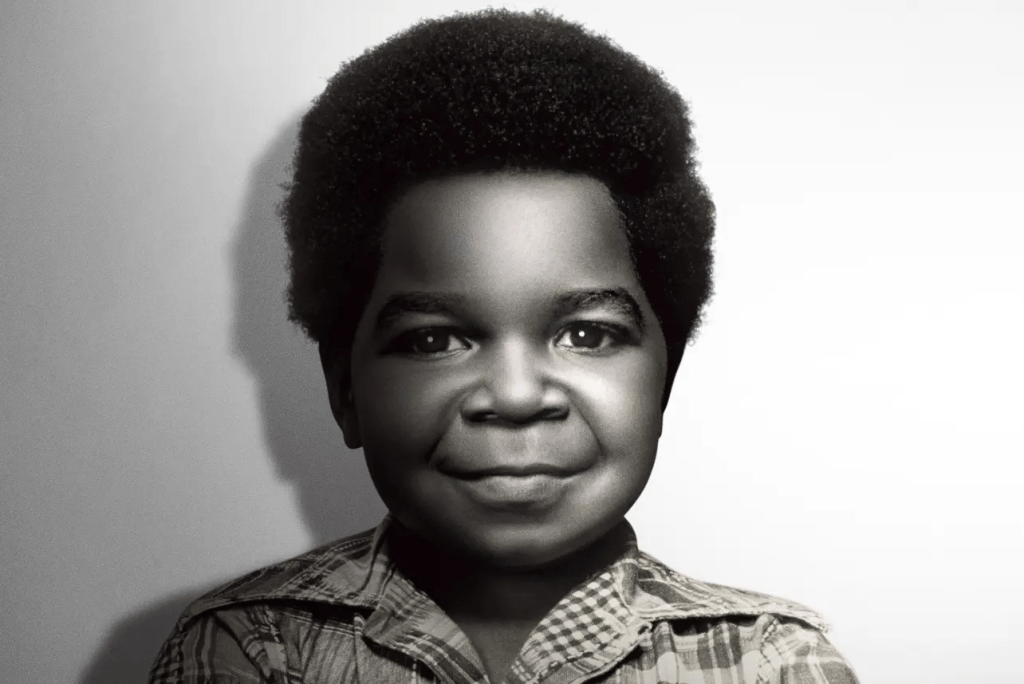
If Gary Coleman stood six-feet tall, it’s highly unlikely so many people would’ve taken advantage of him as much. Even if he was 5-foot-6, it’s quite possible people would’ve thought differently or at least given it a second thought.
But Coleman never grew taller than 4-foot-8. Even Danny DeVito is taller. Peter Dinklage is only 4-foot-5. But it’s a different time. We don’t look down, literally and figuratively, on little people or dwarves with the same disdain and mockery we once did. I mean, watching a movie like Tiptoes where Gary Oldman plays a dwarf seemed hard to watch 20 years years ago. Now, it just seems tasteless in so many ways as Oldman has to walk around on his knees with modified clothes to make it look like he’s a dwarf.
It also didn’t help that Coleman’s catchphrase “What’cha talkin’ bout?” would become to akin to a Stepin Fetchit routine similar to Jimmy Walker’s J.J. Evans’ “Dy-no-mite!” But Coleman’s popularity soared through the 1980s when child actors became more and more popular. As mentioned in the new documentary, Gary, Coleman will forever be remembered as one of the best child stars of all time. But Coleman didn’t just want to be a child star.
Dion Mial, Coleman’s long-time friend and associate, says that Coleman wanted to be cast as a cop in a movie or take on more adult-oriented roles. And while people may have mocked him for becoming a security guard, Mial says that was Coleman’s chance to be the closest thing to a police officer. Following the cancellation of Diff’rent Strokes, Coleman was even wanting to stop being an actor altogether.
Coleman was 18 at the time of the cancellation, the second time it was canceled after moving from NBC to ABC but yet everyone around him was still pushing him to do more movies and TV shows. That’s because they were making money off him. It was money, Coleman would eventually learn, had been finagled out of his savings by legal loopholes.
The documentary by Robin Dashwood assembles several people who were close to him professionally and/or personally. Yet, you never know who really to believe. Coleman’s mother, Willie and Sue, took out many six-figure loans of the money that was supposed to be put in a savings tryst account per California child labor laws. However, they argued that the loans were actually “personal gifts.” In other words, they were his parents and therefore, they had a right to take the money and not be obligated to pay it back.
The money was taken out to be put in business developments that all went sour. It’s not mentioned here, but Todd Bridges, one of the interviewees, has said in other interviews online, his parents invested in Orion Pictures, a movie studio distribution company that went bankrupt in the early 1990s. Both Sue and Willie are interviewed and you can just tell they’re a little angry people are still blaming them for the bad investments.
The savings trust fund was supposed to be valued at $18 million. However, Coleman learned there was only $220,000 left by the time he was 17. Gary sued his parents but was only able to settle about $1.3 million. He also cut off all communication with his parents. Bridges says Willie would call him from time to time wanting Gary’s phone number which Bridges wouldn’t give out. It’s reported Willie would push others around on the set of Diff’rent Strokes as he consider Gary the star which would lead to the young actor acting high and mighty at times.
And of course, Coleman’s ex-wife, Shannon Price, is interviewed at length because she says she wanted to set the record straight. If you don’t like Willie and Sue Coleman, you will downright loathe Price. She is a total basket case of self-victimization and extreme narcissism. No wonder her and Coleman’s marriage didn’t last too long. But sadly, I think Coleman stayed around with Price because he needed someone to make him feel loved. Coleman’s biological mother put him up for adoption and his adoptive parents have screwed him over.
Coleman says that he had to walk away from acting because casting agents just wanted him to say “What’cha talkin’ bout” which his friend, Anna Gray, said Coleman would call “the line.” Gray seems to be a more sympathetic loving friend who had a romantic relationship with Coleman. Yet, I feel that even Gray herself seems to be holding back something. Coleman had noted that in an interview he hadn’t had sex yet and was still a virgin. Is it possible his health issues affected his libido? Gray drops a line that her and Coleman’s relationship was open to both being with other people which leads me to think that Gray sought other partners to satisfy her sexually which might be why he sought after Price.
Gary lived in Utah from 2005 to his death in 2010 after making a low-budget sports movie, Church Ball, in 2005. It was on the set he met Price, who was cast as an extra. I think Price may have been the one to convince Gary to leave southern California and move to Utah. People observed that Price was often controlling of him. Their marriage and relationship played out in the tabloids.
It seemed rather than embrace this next chapter in his life, the tabloid media turned against him with a vengeance. He gets angry on the set of The Insider when the hosts try to argue a bump on his forehead wasn’t from a fall but from Price striking him. Contrasting this with earlier footage of him appearing on The Jenny Jones Show as smiling fans ask him non-combative questions shows you that a lot of people just wanted to push him around. Even on Diff’rent Strokes as he was getting older and becoming a teenager, it’s reported people actually would pick him up like he was a small child and move him around.
I remember a scene from Oliver Stone’s Nixon in which the late Paul Sorvino is playing Henry Kissinger during a scene where he’s watching Sir Anthony Hopkins as the 37th President during a press conference and utters the line “Can you imagine what this man would have been like if somebody had loved him?” Reportedly Kissinger actually said it just not the context or time frame it’s used in the movie. I feel you can say the same about Coleman.
His fans loved him, but I don’t suspect those around him and close loved him. Otherwise they would’ve have cheated him out of his money and pushed him around. Price was no different than his parents. Hearing the 911 calls in which she says the sight of Coleman bleeding is making her sick, which is why she isn’t helping him makes you wonder. I know a lot of people who don’t like the sight of blood. But she could’ve at least wrapped his head with a towel or blanket to hold the pressure. It’s not a good idea to move someone who’s been seriously injured like this without medical professionals. But if this was someone you truly loved, you would’ve done whatever you could to help.
It’s a sad documentary and it shows that the price of fame sometimes is one you can’t afford. Gary appeared on Jenny Jones in 1998, the same year he was arrested for misdemeanor assault and battery on allegations he struck Tracy Fields, a bus driver in Los Angeles. Coleman pleaded no contest but it was later revealed that Fields antagonized him, seeking an autograph and wanting him to say “the line” while he was shopping for a bullet-proof vest.
I’m of the opinion if celebrities are at big events walking the red carpet, they should be more obligated to sign an autograph. But if they are shopping or doing personal stuff, they should be given some space. I’ve even heard some celebrities say they been using a public restroom only to be asked for an autograph while they’re doing their business. There’s a time and place for everything. With social media now, some celebrities deal with stalkers and don’t want their locations given out if they’re having dinner at a restaurant.
But the 1998 incident seemed to begin the downward spiral as Coleman tried to rebuild his life. The tragedy is that Gary didn’t deserve a lot of what happened to him. Some child actors and celebrities do worse things. I also think since Coleman was black there was a lot of bigotry and prejudice with how people were knocking him down. The same thing can be said for Bridges. Both Bridges and Robert Downey Jr. are about the same age but RDJ did a lot worse stuff than Bridges who was able to get clean and turn his life around faster. Hell, Bridges and his brother, James, saved the life of a paraplegic from drowning. You don’t hear about it much. I wonder why.
I hate to use the R word but Hollywood and the public went after Gary harsher than they went after Macaulay Culkin, Drew Barrymore, Amanda Bynes or Britney Spears. Like I said, if only he didn’t have all the health problems and was a foot taller, he might still be alive today, mounting a comeback like other celebrities.
What do you think? Please comment.
 Zane Says