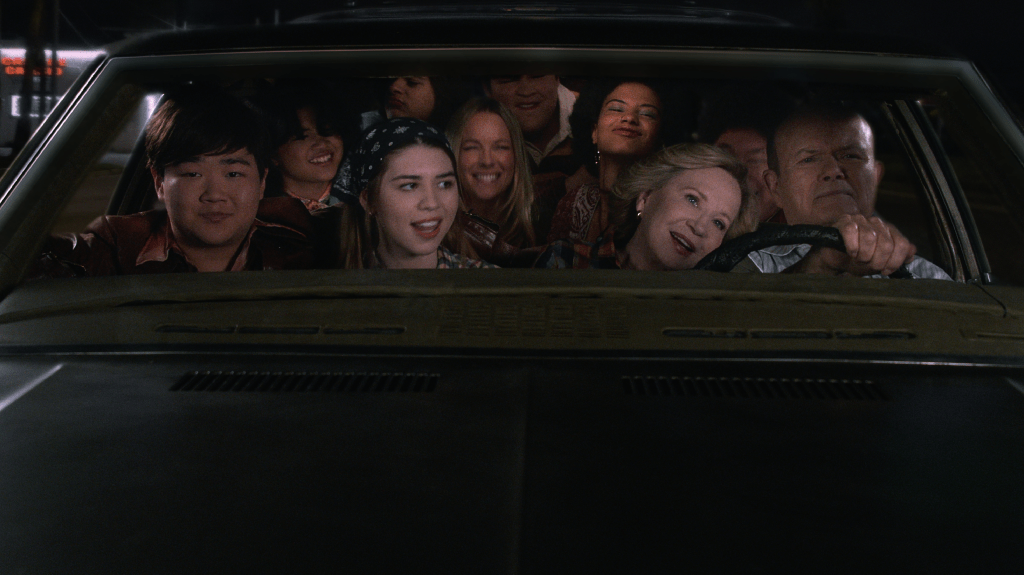
That ’90s Show has managed to move pass a legacy show and get its own touch. But it’s managed to do more than just be a reunion series like Murphy Brown or Roseanne. It’s nothing new. In the 1980s with the evolution of first-run syndication, TV production companies brought back the Beaver, the gang from What’s Happening and WKRP was back on the air.
However, these shows struggled to find their audience. What’s Happening Now lasted three seasons and The New WKRP in Cincinnati ran for two seasons. The New Leave it to Beaver stayed on the air for four season from 1983 to 1989 starting out with one season on The Disney Channel and the others on TBS. But I agree with some of the critics that squeezing stories about Wally, Beaver and Eddie Haskell and their families was a huge cast to deal with in just a half-hour format. It was actually more of a dramedy than a sitcom.
But That ’90s Show could’ve fallen into the same problem. Yet, after it’s first season of seeing everyone pop in for cameos (save for Danny Masterson who shouldn’t be near any of the young actresses on the show), the second and third seasons have focused on the young teenagers. And, of course, there is Red and Kitty Foreman (Kurtwood Smith and Debra Jo Rupp). Since the two actors are credited as executive producers as well, it just stands to reason they will have more episode plots centered around them.
And how the writers have been able to make it work with the young cast of teens is a testament to not only good writing but how to make a legacy work. Next to Cobra Kai, not many shows have been as successful. Even now that it’s 2024, watching a show that is set about 28 years in the past could be most about nostalgia. And like Happy Days, the setting may be suburban Wisconsin in the mid-1990s the plot lines can play in any decade.
To be honest, the writers and producers may have seen the problems with other TV shows and movies that rely too much on pop culture and have tried to avoid that. I mean who didn’t get tired a half hour in of Ready Player One of the characters doing their “Oh, how, it’s Chucky” or “You’re wearing a Buckaroo Banzai suit!” banter.
The series picks up about two weeks after the end of the second season as Jason (Kevin Smith) and his friend/roommate Bunch (Jason Mewes) crashed through the Foremans’ kitchen. And Bob Pinciotti (Don Stark) has lagged on fixing it. But Red and Kitty return from Europe to see the damage. Nate Runck (Maxwell Acee Donovan) takes the blame for it to impress Nikki Velasco (Sam Morelos), as their relationship is still rocky.
On the other side, series protagonist Leia Forman (Callie Haverda) is taking it to the next level with her boyfriend, Jay Kelso (Mace Coronel), and they have sex. Because it’s on Netflix, the series deals with more risky topics such as Leia discovering the joys of masturbation using shower handle settings. This is one of the best episodes as Red seems oblivious wondering how Leia could damage it but her mother, Donna (Laura Prepon), and even Kitty realizing what happened.
Because of the construction of his kitchen, Red goes down to the coffee house where he begins to berate the young people there, much to the pleasure of the workers. However, the episode where Red and Kitty try to get Leia to lie on a speeding ticket Kitty receives seems too sitcom generic. And we finally get to see Otis (Cedric Yarborough), the father of Gwen Runck (Ashley Aufderheide). At first, it seemed Gwen was being a female Hyde. But thankfully, Aufderheide and the writers have been able make her an individual. Gwen is upset that her father, who is a truck driver, spends more time sleeping with her mother, Sherri (Andrea Anders).
Not all the episodes are perfect but it seems we’re getting to know the characters a lot more and they’re growing on us the way they did years ago. Red seems to detect Nate is lying to impress a girl but admires his craftsmanship in repairing the kitchen. And Kitty helps Ozzie Takada (Reyn Doi), the openly gay member of the group getting together with Isaac (Raphael Alejandro) who becomes his boyfriend.
Also, not to give much away, but it seems the next seasons are going to be set at a different time other than the summer. Prepon directs all eight episodes and she’s more involved this season. Also, Smith and Mewes are used just enough their appearances are great. But seeing how the teens deal with normal issues show they are universal, no matter way decade it’s set in.
What do you think? Please comment.
 Zane Says