This post contains spoilers as well as reference sexual assault and incest!!
Jack Nicholson’s career is the type of most actors would fight each other to the deaths over to get. He’s won the Oscar three times, one of three male actors to do so next to Daniel Day-Lewis and Walter Brennan. He’s made a fortune off movies and his contract for residuals, royalties and points off the 1989 Batman is the stuff of legends. He hasn’t appeared in a movie in 2010, but it doesn’t matter. No one will ever say he’s a has-been.
Yet, in the 1980s, people began to notice his career was becoming repetitive. He wasn’t just playing roles anymore. He was playing “Jack” who was the middle-aged philandering hipster who commanded the room when he walked in. A perfect example of this is his role as Daryl Van Horne in The Witches of Eastwick. You can see where he began to perfect his tone and drawl of words. Even in Terms of Endearment, Prizzi’s Honor (where he had a thick New York accent) and A Few Good Men, you could see the Jack persona on full display.
But it didn’t start out that way. No, Nicholson was barely into adulthood when he was cast in the low-budget The Little Shop of Horrors as a masochistic dental patient. He continued to work with Roger Corman in horror movies and low-budget B-movies until the late 1960s where he actually threw up his hands and realized that he could do better work behind the camera. He co-wrote and co-produced Head, starring The Monkees, and famously appears during a meta-reference fourth-wall break. Now, it’s funnier to see him pop in from out of frame to talk with other crew members. But at the time, he was just another actor on screen.
Then, he was cast as a replacement for Rip Torn as George Hanson in Easy Rider. Nicholson is only in the middle of the movie and his role as a hard-drinking crummy attorney who puts on his football helmet to ride with Dennis Hopper and Peter Fonda brought him his first Oscar nomination. And a string of critically acclaimed roles in movies in the early 1970s followed. He was quickly become a leading man in his mid-30s, at a time in which many other actors would’ve already given up.
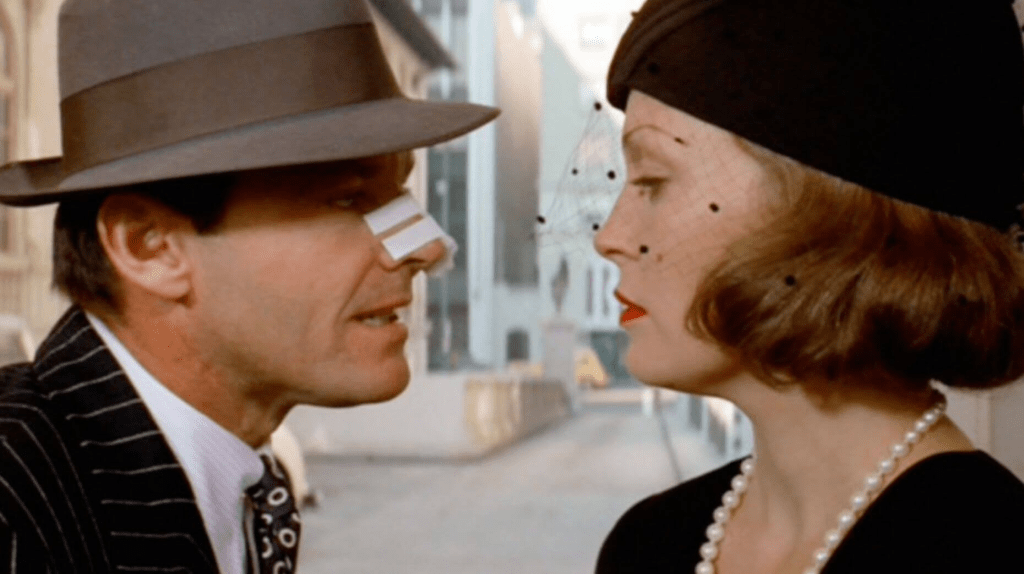
This is what makes his role as J.J. “Jake” Gittes in Chinatown so powerful. Jake is an ex-police officer in the Los Angeles area turned into a private investigator mainly hired to get photos of cheating spouses. The role needs the type of experience from a person who’s had some ups and downs in the past and possibly a failed marriage. The movie is set during the summer of 1937, which is the same year Nicholson was born. Prohibition has been over for a few years. Mobsters like Mickey Cohen and Benjamin Siegel haven’t traveled out west yet to take their reigns over the area. Nor have the black people making the exodus out of the Jim Crow south for a less-prejudice environment. There really doesn’t seem to be a need for a lot of law enforcement at this time. Even one of Jake’s former colleagues Lou Escobar has just been promoted to a detective lieutenant.
The Great Depression might still be an issue in other parts of the country, but southern California is flourishing. However, there’s a drought going on. Hollis Mulwray (Darrell Zwerling) is the chief engineer of the Department of Water and Power and he’s refusing to build a new dam on safety concerns. And one day, a woman (Diane Ladd) claims to be Hollis’ wife and is concerned he’s cheating on her and hires him. With help from his associates, Jake takes pictures of Hollis with a young teenage, and presumably underage blonde (Belinda Palmer).
This makes headlines for the private eye but he is later visited by the real wife of Hollis, Evelyn Mulwray (Faye Dunaway), who threatens litigation for what has happened. Wondering what is going on, Jake goes out to investigate at a reservoir where Escobar and other officers are investigating a drowning. But the person drowned is Hollis. Eventually, Evelyn hires him to clean up some loose ends that would otherwise make things look worse.
However, Jake gets more intrigued especially when he runs into Claude Mulvihill (Roy Jenson), who used to be sheriff of neighboring Ventura County. Mulvihill is working for the city of Los Angeles and Jake mocks him for being in cahoots with the rum runners during prohibition. It’s obvious there’s a lot of dirty activity going on and Jake might have been part of it when he was a cop. He later tells Evelyn when he was assigned to work in Chinatown he did “as little as possible.” Was Jack a little dirty when he was a cop? He wears nice suits and drives a nice car. He doesn’t have a lot of money. But he isn’t struggling. Also, having two associates and a secretary to work for you in an office must include a lot of overhead.
But the life of a private investigator pays more than the life of a cop, who no longer is able to get kickbacks and bribes from bootleggers. Jake isn’t a bad character but he knows the only way to get by in southern California is not to let your guard down. He may steal a few extra business cards to pretend to be Russ Yelburton (John Hillerman), a “Yes-Man” who takes Hollis’ job after his death, but he has standards. When he tells his associates Walsh (Joe Mantell) and Dufffy (Brian Glover) a dirty joke, he first asks his young secretary, Sophie (Nandu Hinds), to go run and take a break.
He also really believes there’s more to Hollis’ death than a simple drowning. He believes Hollis was murdered and made to look like he drowned, either by accident or suicide. The fake Evelyn calls and says her name is Ida Sessions and directs him to check out the obituary section in the day’s paper. The photographs were supposed to be used to make Hollis a shady figure. One of Hollis’ former business partners is Noah Cross (Jack Huston) a wealthy industrialist, who is hiding something behind his boisterous jovial manner. Noah is the father of Evelyn and there’s something odd, because every time Noah is mention, Evelyn’s mood changes and she gets nervous.
Jake eventually learns that a lot of the property in the Northwest Valley is being bought up cheaply. An orange grove farmer and his workers are hostile toward Jake believing he is working with the Water department. Also a sheep rancher played by Rance Howard appears at a council meeting with their livestock to show them the irrigation is drying out their lands. Water is being intentionally diverted to dry out the land that can be bought up by Noah by have the deceased people and nursing home residents unknowingly listed as the buyers. Hollis discovered the plan which is why he was opposed to the building of the dam. But now, Yelburton can go ahead with the construction, thus meaning the property owners will have to sell the land to the city at a bigger price than they paid for it.
It’s in the final act of the movie where Chinatown takes the road down a darker route than just a film noir. Robert Towne, who wrote the screenplay, actually was inspired by the true stories of how William Mulholland (a loose inspiration for Hollis) oversaw the construction of a 230-mile aqueduct that brought water from Owens Valley to L.A. Noah is hoping to make a lot of money but he also has a secret. Behind the boisterous persona, Noah is more of a scumbag when Jake realizes the young blonde, whose name is Katherine, is actually Evelyn’s daughter, the result of an incestuous rape by Noah. She reveals this when Jake suspects Evelyn might have something to do with Hollis’ murder and wonders why he sees her hiding Katherine in a safe house. Plagued with the trauma, Evelyn gives the famous line, “She’s my sister. My daughter.” as Jake slaps her because he’s growing tired of her lies.
This changes the tone of the movie as Jake had previously revealed to Evelyn that when he was a police officer in Chinatown, he was in love with a woman there. He tried to keep her from being hurt but she was inadvertently hurt anyway. It gives more depth to why Jake left the police department and why there is still some hostility among him with Mulvihill and Escobar. Very little is said as we’re left to believe for ourselves what actually happened or if the woman might have been a Chinese immigrant. Evelyn employs servants of Asian ancestry including her head butler, Khan (James Wong). Jake seems to talk casually among him but this could be from his interactions with them while working in Chinatown.
This also changes Evelyn from being a possible black widow femme fatale to a more central figure. Jake now realizes that with Hollis gone, there is nothing to stop Noah from getting close to Katherine. It’s also implied that Noah may actually want to sexually assault her too. When he confronts Evelyn about it in the end, he reminds her that Katherine is “my daughter too.” And this leads the movie down a darker path.
Again, the following contains spoilers so don’t read unless you know what happens.
Jake contacts one of his clients, Curly (Burt Young), whose wife he took pictures of with another man, to help him take Evelyn and Katherine to Mexico. Curly is to meet them in Chinatown, but after he contacts Noah about how he knows he had Hollis killed, Mulvihill and Noah force Jake to take them to Chinatown. At the same time, Escobar and his men have made contact with Duffy and Walsh who knew of Jake’s plan and has arrested them. And they arrest Jake as they suspect he knows more about Hollis’ death and Ida Sessions who was found dead in her house, murdered as well.
In a last-ditch effort to get away, Evelyn pulls a gun on Noah and shoots him in the shoulder when he tries to get too close to a terrified Katherine. This causes Escobar and other officers to fire on her as she drives away. She is is struck in the back of the head with a bullet and dies as Katherine screams in horror crying. Noah quickly confronts her and Jake watches stunned as he knows since he’s next of kin, he can take custody of her and probably abuse her.
Worse, Jake tried to prevent the same thing happening again but things are worse this time. He mutters “As little as possible” remembering the conversation he had earlier with Evelyn. Escobar releases Jake, Duffy and Walsh from custody realizing even if it’s not accurate, he can pin all the blame on Evelyn and since many witnesses saw her shoot Noah, no one will question his investigation. The police can also say Ida was murdered by Evelyn as her lawyer knew Ida impersonated her to get Jake hired.
Sadly, Jake realizes the corruption still lingers. The bootleggers are gone. Now, they’ve been replaced by greedy businessmen like Noah and willing bureaucrats like Yelburton. As Jake tries to compose himself but can’t keep from watching what is going on, Walsh says the iconic line, “Forget it, Jake. It’s Chinatown.” This means the police are going to do as little as possible because they have to maintain the status quo. Going back to a line Jake says earlier about Escobar, “He’s just made lieutenant. Wants to hang on to his gold bar.” Noah has the money, power and influence with L.A.’s top leaders to do whatever he wants and Escobar isn’t going to stop that.
Originally, the ending was supposed to be more upbeat with Noah being killed and Evelyn surviving. However, Towne and director Roman Polanski argued over the ending as Polanski felt it wouldn’t work. Towne left the movie’s production and Polanski rewrote the ending days before filming the ending. Polanski was still grieving the murder of his wife, Sharon Tate, and their unborn child along with others committed by the Manson Family. Polanski had actually gone to live in Europe following the murders initially refusing to come back to L.A. but he actually liked the script Towne had written.
Chinatown went into production during the Watergate hearings and when it was released on this date, June 20, Richard Nixon was drawing fire from Democrats and Republicans. He would resign less than two months later only to be pardon by his successor, Gerald Ford. Many people have interpreted Chinatown and its cynical approach to political corruption as a statement on the Nixon Administration and Watergate events. As detailed in All the President’s Men, a lot of people hadn’t heard about Watergate or didn’t care as people felt it was a ploy by the Democrats. Just like Escobar and the police, they wanted to do as little as possible as long as Nixon was elected.
At the time of filming, Nicholson had begun dating Huston’s daughter, Anjelica, in an odd life imitating art feel. Nicholson would also learn his “sister” had actually been his biological mother. At the time he was born, it was considered taboo for young women to have children out of wedlock, so Nicholson lived over 37 years believing his grandmother was his real mother and his mother was his older sister. In what would be another strange connection with the movie, Polanski would be arrested for drugging and raping a 13-year-old girl while at Nicholson’s home in 1977. He would later flee and live in France since then.
However, one thing people don’t mention is how the movie was released as the Equal Rights Amendment was trying to be ratified. Even though Jake is supposed to be the protagonist, his slapping of Evelyn when he thinks she’s lying shows the brutality of how men treated women. Curly’s wife is shown briefly with a black eye and he casually refers to Jake as the guy who took the pictures of her cheating. (Can you wonder why she would?) Really, the only good man in the movie is Hollis who was trying to be a father figure to Katherine, but people thought he was doing bad things. And he’s murdered because he doesn’t agree with Noah’s plan.
As for Noah himself, you can see comparisons with R. Kelly, Stephen Collins, Kevin Spacey, Sean “P. Diddy” Combs and even Polanski himself. They are men who thought money and power can get them anything, even younger people to groom and assault. And for the most part, they get away with it. They got away with it in 1937 and 1974. They’re still getting away with it because people don’t want to affect the status quo.
What do you think? Please comment.
 Zane Says