My aunt first told me about Blazing Saddles sometime in the 1980s but all she mentioned was the famous fart scene. A group of cowboy marauders are sitting around a campfire eating beans when one of them, Lyle (Burton Gilliam), leans over and lifts up his leg a little and lets one out. Then, the rest of the cowboys begin farting. In one of his comedy albums, George Carlin talked about how farting can’t even be referenced on TV and now a movie has a dozen actors pretending to pass gas. Gilliam, at 85, is one of the last surviving main cast members of the movie and when he dies, his epitaph should read he was the first actor to cut one on the screen.
Blazing Saddles was released 50 years ago today and would go on to be the highest grossing comedy of all time for a while. The movie came in the midst of an era in which many filmmakers were making “Revisionist Westerns.” These movies were intended to cut through the old traditions of the John Wayne movies and show more realism. The Spaghetti Westerns of the 1960s and 1970s helped give rise to movies like Butch Cassidy and the Sundance Kid, The Missouri Breaks, Little Big Man and just about anything featuring Clint Eastwood. The Old West wasn’t a cut and dry realm where men in the white hats were battling against the men in the black hats.
Mel Brooks, who directed, co-wrote and co-stars in Saddles, handles the movie by making it a western first and a comedy second. The first image is of the old Warner Bros. shield burning away as a the title comes flying up toward the screen with the crack of a whip as Frankie Laine sings the theme song. Anyone going blind into this movie would think it’s going to be an authentic western. Brooks does lets us know it’s going to be something different until Lyle drops a racial slur cracking a joke as a Chinese railroad worker collapses.
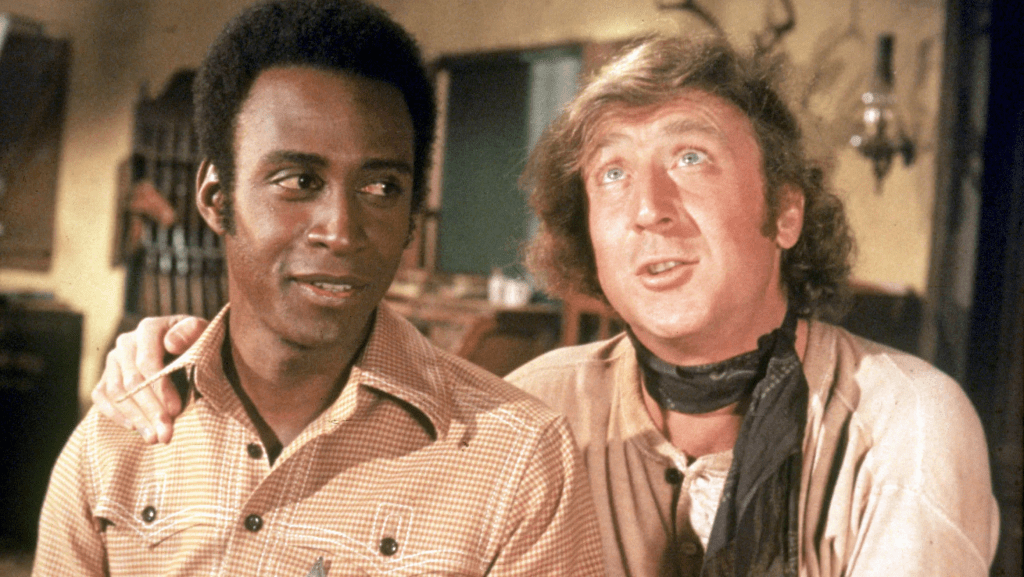
From that point on, the movie seems to move back and forth between absurdist slapstick gags and vulgar jokes in a western setting. Just as he did with Young Frankenstein, Brooks films in the style of the genre. The plot revolves around one of the railroad workers, Bart (Cleavon Little), being named Sheriff of an Arizona town. Bart has been condemned to be hung for attacking Lyle’s boss, Taggart (Slim Pickens), with a whack on the head with a shovel for leaving him to die in quicksand. The casting of Gilliam and Pickens is perfect as both look like they walked in from another western. Pickens had just appeared in Sam Peckinpah’s Pat Garrett and Billy the Kid the previous year.
But Arizona attorney general Hedley Lamarr (Harvey Korman) has a better idea than having Bart hung at the gallows, where Robert Ridgely plays the hangman as if he’s from a Medieval era. He will make Bart the sheriff of the town of Rock Ridge as Taggart has determine the quicksand means the railroad has to be diverted from its intended route through the town. This means the property and land in this area will be worth millions and Lamarr wants it. Lyle leads marauders through the town but the people stay.
The town elders telegram the governor’s office to send them a new sheriff. And the state’s governor, William J. LePetomane (Brooks), demands action is taken because it could hurt their “phony-baloney jobs.” With the first plan failed, Lamarr thinks that by sending Bart, the towns people will be so offended, they’ll leave. He also convinces the gullible LePetomane that it’s the best idea because it will define the governor’s legacy.
Of course, when Bart does arrive in Rock Ridge, the town elders don’t initially like him, aiming pistols and rifles at him as he tries to say his welcome speech. Brooks and his fellow writers which include Andrew Bergman, Richard Pryor, Norman Steinberg and Alan Uger are playing off the obvious racism that was in many of the old westerns. The Civil Rights Act had just been passed a decade before but many people in America weren’t too keen on the idea of integration. Even when Charles Schulz made A Charlie Brown Thanksgiving in 1970, animators were forced to have Franklin sitting by himself not to offend some viewers. The foolishness of how Bart pulls out his own pistol and talks in a deep voice as he turns the pistol on himself to get away from the elders shows just how foolish they are.
The townspeople, who all have the surname Johnson, at first all seem normal and they are perfectly cast by David Huddleston, John Hillerman, Liam Dunn, George Furth and Claude Ennis Starrett Jr. as the town drunk, Gabby. But the filmmakers are mocking them as they think they are perfect Americans but as Bart observes, “They are so dumb!” Bart discovers Jim (Gene Wilder), otherwise known as The Waco Kid, is in one of the jail cells. Jim is a play on the trope of the old gunslinger who is now a drunk. Wayne’s movies Rio Bravo and El Dorado have Dean Martin and Robert Mitchum, respectively, playing the local drunk who helps the sheriff Wilder was only 40 when making the movie whereas Brooks wanted Gig Young who had to be let go due to suffering from his own real-life alcoholism.
But for a movie like this, you’re not looking for accuracy. There are many anachronism throughout the whole movie, such as Bart having a saddle made by Gucci and passing by Count Basie. Taggart mentions the Wide World of Sports. Lamarr is often getting mad at people who call him “Hedy” instead of Hedley. (The real-life Hedy Lamarr wasn’t too happy she was used as a joke and really tried to sue the filmmakers.) The jokes work because Brooks, the writers and the cast don’t have any ill-will against the many black people and those of east Asian ancestry who were common in the Old West.
The tagline of Blazing Saddles is “Never give a saga an even break!” What Brooks and company are doing is tearing down the romance that sprung up in the 20th Century cinema of the Old West. It actually was a very progressive time where about 25 percent of the people who lived on the range were black. Most towns had strict gun laws as they were seen as market places and many people had to turn over their firearms to the local law enforcement.
And the life of a cowboy wasn’t as glamorous as it’s portrayed. Most cowboys worked long hours in the heat and slept on rough terrain in the rain and cold night temperatures. The campfire scene is a commentary on how many of them didn’t have much to eat at times. There’s a scene of Mongo (Alex Karras) dipping a huge spoon of beans off a fire. Pryor is credited with creating and writing most of the scenes with Mongo, according to Brooks. Pryor had initially been considered to play Bart but Warner Bros. wasn’t too keen on casting the controversial comic at the time.
But for those who say it’s racist apparently don’t understand what the movie is about. Initially, the towns people are critical of Bart but by the end they’ve learn they were wrong. Bart gets his railroad buddy, Charlie (Charles McGregor), and other railroad workers, most who are black and Chinese, to help the towns people build a replica of Rock Ridge to fool another bigger army of marauders out to destroy the town. They all work together in the end even though town elder Olson Johnson (Huddleston) proclaims “We don’t want the Irish!” which also shows there was criticism against other whites such as Irish during this time.
Saddles was Brooks’ first R-rated movie, even though it’s mostly for the sexual innuendo and some race-related jokes. There’s no F-bombs and graphic nudity. However, Brooks did say a line had to cut where Bart tells the singer/performer Lili von Shtupp (Madeline Kahn) that she’s sucking on his elbow. But along with the vulgarity comes a silliness that almost seems G-rated like everyone getting into a pie-fight in the commissary on the Warner Bros. studio lot. The gag at the end is that everyone kinda acts like they know they’re in a movie as the literal fourth wall is broken.
For those saying Blazing Saddles wouldn’t be made today, there’s no reason. Times have changes and so have our views. Saddles was also about breaking down real-life stereotypes that black people were inferior to white people. And while some might take offense to a flashback of Bart’s life as a child where Brooks appears as a chief of the Sioux tribe, it’s also a commentary on how Hollywood would cast white actors in ethnic roles, such as Mickey Rooney as a Chineseman in Breakfast at Tiffany’s as well as Italians being cast as Indigenous Native Americans on F Troop and how Iron Eyes Cody (aka the Crying Indian) was actually a Sicilian descendant Espera Oscar de Corti.
Oddly, a lot of criticism on Blazing Saddles hasn’t come from black viewers but from white people. My first roommate in college was of Nigerian ancestry and I was afraid he would get mad if I watched it but he liked it. And others like it because how it portrays Bart and the others like Charlie in positive lights. They’re not minstrels and stereotypes. They get laughs from doing things white people would’ve received in the same situation. That’s the difference between comedy and cruelty.
What do you think? Please comment.
 Zane Says