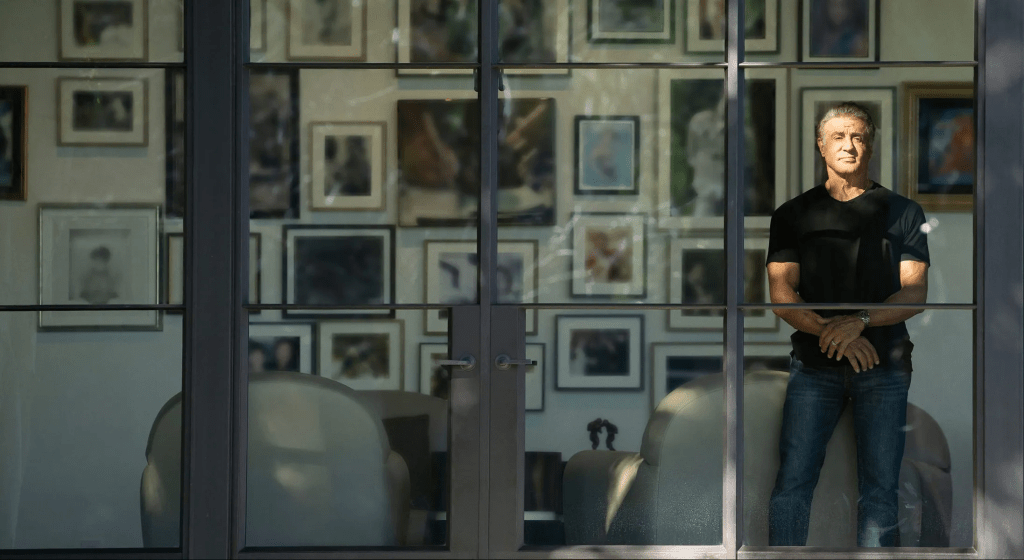
Sly is an appropriate name for the documentary on the life and career of Sylvester Stallone. The runtime is about an hour and a half, about half the length of the Netflix documentary on his rival, friend and business partner Arnold Schwarzenegger, but maybe that’s because the “Governator” has had more of a fascinating life.
That’s not to say Stallone’s life hasn’t been one of interest, but the crux of the documentary is mainly about Stallone’s rise from obscurity and meager bit roles to being one of the biggest stars of all time. And since he is credited as an executive producer and gives a lot of intimate details about his upbringing, there’s not much room for the real juicy tidbits of his life and career.
Like most men celebrities, he’s face accusations of sexual assault, naysayers criticizing him and on-set prima donna behavior that isn’t all glamorous. On the set of Cobra, he reportedly told all supporting casts and extras not to talk to him. Brian Thompson, who played the villain serial killer, said he wouldn’t come out of his trailer during a crucial scene because he was watching a ball game. Thus, Thompson acted with an assistant off camera reading lines. Other reports are he created problems on the set of Tango & Cash and has bad blood with James Cameron over the script for Rambo: First Blood Part II. Yet Cameron is also known for being unpleasant to work with. Stallone infamously got Richard Gere, then about as unknown as him, kicked off of The Lords of Flatbush when he said Gere spilled mustard on his clothes during a lunchbreak.
So, it’s a sly documentary about him that delves into more of his early life while giving a brief summary of everything that’s happened in the last 20 years or so. That’s not to say that Stallone didn’t “pay his dues” as he started out in the entertainment business making a unfinished silent movie with actor/filmmaker John Herzfeld called Horses. He then appeared as extras in movies like Klute, MASH, Mandingo and probably most notably a subway thug on Woody Allen’s Bananas before he was cast in Roger Corman movies like Capone and Death Race 2000.
There’s no mention of The Party at Kitty and Stud’s, which is considered a softcore pornography, but Stallone has commented he did it because he desperately needed the money and the only other thing to do was to rob someone. The money he received for Death Race 2000 he had to use to pay medical bills. But he realized if he couldn’t make it as an actor, he could try to make it as a writer.
And then came Rocky. The movie, Stallone says, didn’t initially start as a boxer, but just a man trying to make it in a world where the odds were against him everywhere. Rocky came out at the right time in America when it was going through some tough times. The aftermath of Watergate and the resignation of President Nixon was still fresh. There had been the Fall of Saigon and the Fall of Phnom Penh. There was a gasoline shortage. Rocky Balboa was a representation of the everyman who felt he had been forgotten.
Stallone gives stories of how he was born in what was then called Hell’s Kitchen, a neighborhood in the Manhattan borough of New York City. His parents were mostly absent as they worked a lot and at one point, he and his brother, Frank, had to go living in a boarding home. Then, his parents separated and he went to live with his father in Maryland and then his mother in Philadelphia. His facial features and speech was a complication at birth when forceps were used and a nerve was severed.
While Sly isn’t as juicy as it could be as it gives more of “This Is Your Life” version of Stallone’s life. I think the biggest problem is director Thom Zimny seems too fascinated on everything from the 1970s to the mid 1980s that we don’t really see much of his latter career. And this is a problem not just with this documentary but a lot of documentaries about entertainers. HBO’s Spielberg seemed to be too focused on the stuff he did in the 20th Century while critics have argued (and I agree) some of his best work is what’s happened in the 2000s and 2010s.
The Expendables which is mentioned briefly in a short few minutes helped revive his career as well as Rocky Balboa and the first Creed. Even though it didn’t get a lot of good reviews, Samaritan was a different change of pace for him. Remember, at one point he was called the next Marlon Brando by film critics. Quentin Tarantino talks about how wonderful he was in Flatbush and old buddy Henry Winkler says a lot of things about those days with his dog, Butkus.
But like I said, I think Stallone has been his worst enemy as the whole 1980s action hero scene helped curtail his career, something talking heads mention on the peripheral but don’t address directly. By his own admission, he said he did Over the Top just for the money and didn’t like the script. For someone who reportedly had to sleep in a friend’s walk-in closet, I can understand him taking a role for a huge paycheck.
Some other subjects such as the death of his son, Sage, at 36 are glossed over with imagery, but you can tell he’s still hurt by it more than a decade later. Yet not everything should be out on full display for everyone. Fans of Stallone will like Sly. And his critics will probably not like it or remain indifferent. It works best when Stallone lets his guard down and acts more natural.
What do you think? Please comment.
 Zane Says