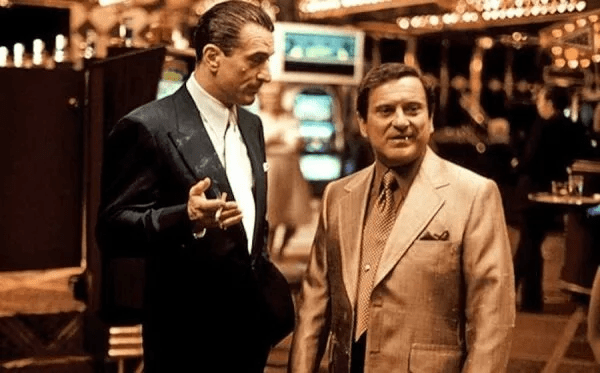
There’s a scene in Casino that sums up exactly what it was like 50 years ago in Las Vegas back when the Italian Mafia ruled the scene. Sam “Ace” Rothstein (Robert DeNiro) is meeting with a county commissioner, Pat Webb (L.Q Jones). Ace wears flashy, loud suits and clothing while Webb is a good ole boy cowboy through and through. A quick shot shows their footwear and you can see Ace’s designer dress shoes and slick pants he keeps hung up while he sits so they don’t wrinkle and Webb’s shiny cowboy boots and denim blue jeans oddly look similar even though they’re different.
They’re both cowboys really. They just don’t know how similar they are. That’s why they don’t get along too well. It’s like a warring of two factions during an era which you didn’t dare to cheat a casino out of a mere $5. Las Vegas was the final frontier of the American world. The gangsters who came into the area in the 1940s and built an entertainment and tourist oasis in the desert were no different than the “settlers” on the Oregon Trail or other pioneers who used guns and violence to get what they wanted from the indigenous people.
What Martin Scorsese’s epic drama doesn’t delve into that many don’t realize is that most of the Las Vegas strip isn’t technically in Las Vegas city limits. That’s why people like Ace and other gangsters had to more or less treat politicians like Webb and a Nevada state senator (Dick Smothers) who was the chair of the gaming commission with kid gloves. Even though they were bringing millions to the state’s economy, they were also taking millions away through a skim. And the skim wouldn’t work unless they play ball with the local good ole boys.
It’s ironic because it’s the exact same thing the Mafia has done – asking people to trade favors for permission to do this or that. Webb’s brother-in-law, Don Ward (John Bloom, aka Joe Bob Briggs) is terminated as slots manager after Ace said he didn’t handle a scam correctly and accuses him of being in on it. While Webb does agree with Ace that Don isn’t too competent, he still wants Ace to rehire him as a favor. And while Ace knows how favors work, he feels this isn’t the case to which Webb warns him to beware.
Webb tells Ace that him and the others are “still just our guests.” Yet, Las Vegas and that region of Neveda wouldn’t be anything if it wasn’t for the gambling and tourist industry. Webb is basiscally a gangster himself who thinks he can use strong-arm tactics too. The good ole boy politics still drive the area as Ace says the county sheriff will bury people out in the desert just like the Mafia does.
Ace doesn’t back down from Webb because he knows that he’s got more “friends” in higher places. Sadly, his association with mob boss Nicky Santoro (Joe Pesci) jeopardizes all of that. Casino was released in late November of 1995 with many saying it wasn’t as good as Goodfellas. But no one ever accused John Ford of making too many Westerns or Nancy Myers of making too many romantic comedies about well-to-do upper-class white people. Scorsese has said Killers of the Flower Moon is his first Western, but I beg to differ. Casino is. Scorsese has even said in interviews the gangsters were just cowboys in silk suits.
Casino is mostly set around a 10-year period from the early 1970s until 1983. It’s based on a true story but for legal reasons had to use the title card “Adapted from a true story.” Part of this was because some of the criminal cases connected to the movie were still ongoing. Scorsese co-wrote the script with Nicholas Pileggi, whose book by the same name went into further detail. Ace was based on Frank “Lefty” Rosenthal, who was known as a professional gambler and handicapper, making money for the Italian Mafia by studying several sporting teams at the college and professional level.
Lefty had been dealing with the mob since the 1950s was sent to Vegas by the Chicago Mafia outfit to run the Stardust, Hacienda, Marina and Fremont casinos to control the skim. For legal reason, the filmmakers couldn’t refer to where Lefty and Anthony “The Ant” Spilotro (basis for Nicky), a high-ranking mobster with the Chicago outfit, were from. So it was just called “Back Home.”
It’s shown that all the bigger mob bosses meet regularly at a location in Kansas City. Remo Gassi (Pasquale Cajano) is the boss both Ace and Nicky must answer to. Remo is based on Joseph Aiuppa, the leader in Chicago who was in charge of the skim from 1971 to his conviction in 1986. Aiuppa was still serving when the movie was released but released from prison in mid-January 1986. He died a year later. The unnamed senator is based on Harry Reid, who served as Nevada Gaming Commission chair from 1977 to 1981. The Kansas City outfit was reportedly in charge of the skim at the Tropicana Casino which helped blow the whole case wide open in the 1980s.
Nicky says he was sent to Vegas to make sure no one would mess with Ace, but after he arrived, Nicky decided to stay and begin his own crime wave. Since Ace is Jewish and not a made-man as Nicky, he can’t say much to divert Nicky’s interest. All he can do is try to use his social status to try to pass Nicky and his family off as the regular nuclear family. At the same time, Ace begins a relationship with Ginger McKenna (Sharon Stone), a prostitute/gambler/hustler, who doesn’t have true feelings for him but enjoys all the materials he lavishes on her.
They eventually get married after Ginger has a child with him. In real life, Lefty married Geri McKee, a model and Vegas showgirl, and they had two children (a son and a daughter). Pileggi writes in the book that Geri was mostly neglectful to their daughter but cherished their son more. Because the child isn’t in too many scenes and for budgetary reasons, Ace and Ginger only have one daughter. Also, for legal reasons, Ace is put in charge of the fictional Tangiers casino and hotel. (The real Riveria and defunct Landmark Hotel were used for settings.)
Eventually, Nicky’s crimewave with “desparados” as he calls them from back home create a lot of heat on Ace and the Tangiers. This along with some shady business dealings with their “squeaky clean” chairman of the board, Phillip Green (Kevin Pollak) create more problems. Ace tries to work with Andy Stone (Alan King), a bigwig in the Teamsters organization connected to the mob bosses but things goes from bad to worse.
Nicky continues his crimewave with his lieutenant, Frank Marino (Frank Vincent), loosely inspired by real-life mobster Frank Cullotta, who worked with Spilotro. Cullotta was a techical advisor on the movie and appears as a hitman. But the crimes go from thefts and robberies to suspected murder and car bombings. It’s never really determined if Nicky’s crew is behind this. Hunter S. Thompson wrote in Fear and Loathing in Las Vegas that there is only one rule in Vegas – Don’t burn the locals. And that’s what Nicky and even Ace do. It’s one thing to have a local law enforcement official or politician look another way while you’re stealing a few dollars, as long as you slip one to them. Ace even says the senator was expecting to be comped a lot when he frequented the Tangiers and even used on his expense reports.
But it’s hard to look the other way when thefts, burglaries and violent crimes spike. That’s the great divide between Ace and Nicky who were childhood friends. Ace wants to steal the smart way so that it doesn’t attract much attention. There’s so many ways to cheat the system without gaming officials getting too wise. However, Nicky wants to steal by any means necessary. As long as Nicky keeps sending “packages” of a percentage back home with Frank, why won’t the bosses be happy?
When the Nixon Administration started cracking down harder on drug-users and drug-dealers, it made it easier for law enforcement to go after the Mafia as they had become to get involved in the drug trade. The RICO (Racketeered Influenced and Corruption Organizations) Act has also been passed. As shown in Goodfellas, part of the reason the older bosses didn’t want drug dealing was that people could make deals to put them behind bars for years. It was a lot more than what’s portrayed here that led to the collapse of the Mafia’s hold over Vegas. It didn’t really end until the late 1980s/early 1990s.
Ace’s life does get sidetracked by Ginger’s involvement with her former pimp, Lester Diamond (James Woods), as it’s implied she still has feelings for him. Lester is a toxic abuser. Ginger turns to drugs and alcohol before finally beginning an affair with Nicky much to the surprise of the law officers surveilling him. It’s never known in real life is Spilotro and McGee had an affair but there was speculation. I guess this was put in the script to add tension between Ace, Ginger and Nicky. It also goes back to something that was left out of Goodfellas where Tommy (also played by Pesci) tried to sexually assault the wife of his associate.
Even at nearly three hours, there’s a lot Scorsese and Pileggi had to leave out or condense. Some things seem so ludicrous they actually did happen. In real life, Lefty did begin his own talk show from Vegas the way Ace does after the gaming commission deny his application once and for all. The real Rosenthal tried to get the talk show re-started following the release of Casino but couldn’t draw much interest. Yes, the real Rosenthal did survive a car bombing thanks to a manufacturing detail. However, it took place in 1982 instead of 1983.
On Oct. 4, 1982, Rosenthal had gotten into his 1981 Cadillac Eldorado outside the Tony Roma’s restaurant when a bomb detonated when he started his car. The bomb had been placed under the gasoline tank. What the people didn’t know was the Eldorado had been installed with a metal plate under the driver’s seat by General Motors to correct a balancing problem. Rosenthal had been tailed and surveilled by federal agents during this time who were sitting in a car not far away. They rushed into action when the bomb detonated and quickly pulled Rosenthal away from the car as he was able to get the door open and jump out.
Las Vegas area reporter Myram Borders, who had worked for the United Press International, was also in the vicinity when the car exploded and heard Rosenthal screaming, “They’re trying to kill me.” However, the movie only hints that Nicky was behind the car bombing. But in real life, it isn’t known. Rumors have speculated it was the Milwaukee or Kansas City outfits. Others say it was the outlaw bikers that McGee had hooked up with after her divorce from Rosenthal was finalized in 1981. Incidentally, McGee would die from an accidental drug overdose a month later. Her death was also rumored to be mob-related. In the movie, Ginger’s death is just implied by her own association with shady people.
About 20 years after Casino was released, it was revealed by FBI agents that Rosenthal and McGee had both unknowingly of each other been informants. This may explain why it’s never implied why Ace isn’t arrested along with the others involved in the skim and why Ace’s voice-over narration says law enforcement didn’t need Ginger after they initially arrest her. Rosenthal actually left Las Vegas about six months after the car bombing and later discovered he had been listed in the “Black Book.”
While it was unfairly compared to Goodfellas, it’s a different movie. The mob used gambling and sports betting to make millions. It was just barely touched on in Goodfellas. And Scorsese’s Mean Streets was really not even a mobster movie when you look at it. This is a Western like a said. It’s just a modern-day Western. The movie works better if you see Scorsese’s The Irishman which delves further into certain elements such as how the Teamsters Pension fund was used to help finance casinos. Allen Dorman (played by Jake Hoffman in that movie) is the basis for Andy Stone who suffered the same fate as in Casino.
Ace, Henry Hill from Goodfellas amnd Frank Sheehan from The Irishman are all one and the same. They had dreams of grandeur of how they wanted to do things, regardless of who it hurt in the end. Sadly, they never did see the error of their ways. All three movies are tradegies and morality plays about the dangers of organized crime. And despite Scorsese showing us criminals who never truly learn their lesson, just like the real-life Jordan Belfort in The Wolf of Wall Street, they never do really ever see themselves as the bad guys.
Worse is millions of filmgoers still romanticize them.
What do you think? Please comment.
 Zane Says