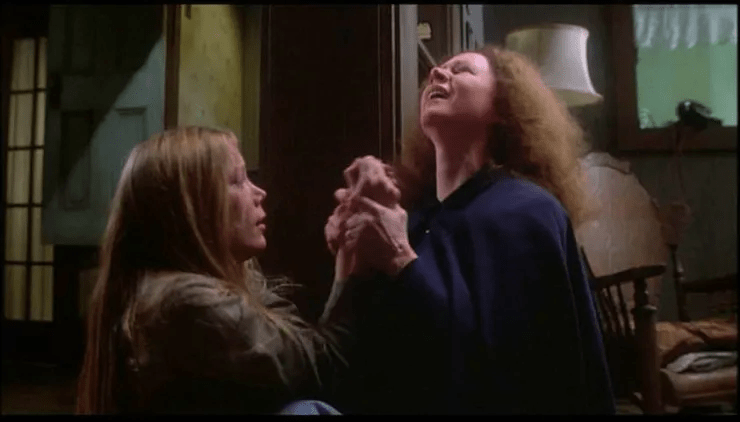
By the time, Piper Laurie accepted the role of Margaret White in Brian DePalma’s adaptation of Stephen King’s Carrie, she hadn’t appeared in a movie for almost 15 years since her Oscar-nominated performance in The Hustler. She had been doing TV work up until the mid-1960s before she took time off for about a decade.
And when she read the script, she first thought it was a comedy because Margaret seemed so over the top to her. So, she played the role as if she was in a comedy. On a side note, she wasn’t the only one. Nancy Allen didn’t see her character as too evil until seeing the final edit of the horror classic. But maybe it’s because Laurie didn’t take herself to seriously which is why the character is so disturbing.
Having seen the 2013 version, Julianne Moore, a fine actress by comparison, made Margaret too vicious and actually a little mentally unstable. In the first scene, she is having a home birth in her bed with no one to help and considers killing the newborn. On the flip side, DePalma and Laurie take their time with the character. I wouldn’t say that Margaret is as sadistic as Moore’s performance. (I haven’t seen Patricia Clarkson’s performance in the 2002 TV version. Nothing against another fine actress like Clarkson, but a TV movie of Carrie?)
On the surface, when we first see Margaret portrayed by Laurie, she is going door to door to spread the word. Nothing bad. She’s just religious and friendly to people. And it isn’t until Margaret recevies a phone call from the school that her daughter, played wonderfully by Sissy Spacek, had her first period. But the tragedy is that Margaret is mad at her daughter because she knows what’s happening next. Carries asks why her mother didn’t tell her as she’s unaware of what menstration is and thinks something is wrong. And since it happens at school while she’s in the gym showers, the other students tease her and throw tampons at her as she cowers naked on the shower floor scared and frightened.
Margaret is very religious and she’s sheltered Carrie from many things her whole life. I think of something the late Louise Fletcher said about her role as Nurse Mildred Ratched in One Flew Over the Cuckoo’s Nest where she said she played the role as if she thought she was doing the right thing for everyone. The same can be said for Laurie’s Margaret. She thinks that providing her daughter with a sheltered life centered around a huge Christian devotion, she can keep Carrie from following down the same dangerous path she thinks she went down in her youth. And that means she has to be a little abusive by hitting and beating her, then locking her in a closet where there is a crucified Jesus shrine is set up.
Like most parents, Margaret sees Carrie more as an extension of herself rather than an individual person. When one of the classmates, Sue Snell (Amy Irving), talks her boyfriend, Tommy Ross (William Katt) into asking out Carrie to the senior prom, Carrie reluctantly agrees and then makes her own dress. She attends the prom over her mom’s objections who forbids it telling Carrie “They’re all gonna laugh at you.” If you take away the religious aspect, Margaret is no different than many narcissistic parents who are afraid their stranglehold over their children is slipping through their grasp.
Carrie is a senior and close to graduating high school. She can’t stay home forever. And by seeing Carrie partaking in regular activities as other youth means it’s the beginning. Using her telekinetic powers to lock Margaret up so she can go with Tommy. Of course, Chris Hargensen (Allen) and her boyfriend, Billy Nolan (John Travolta), and their friends, Norma (P.J. Soles) and Freddy (Michael Talbot), have a prank planned. They put Tommy and Carrie on the ballot for Prom King and Queen and will rig the election so they win. Their plan is to dump a bucket of pig blood on Carrie during the coronation ceremony in front of everyone.
The tragedy of this scene is that when people see Carrie at the prom “looking normal,” most of the student body accept her finally. And Carrie herself finally comes out of her shell and seems to enjoy the activities. When the winners are announced through the rigged ballots, everyone is actually excited for Tommy and Carrie. It hints that the majority of those in attendance voted for them anyway. And after the blood is spilled on Carrie, everyone, but Norma, is horrified. When Norma begins to laugh, some people look at her with disgust for laughing and Tommy is angry that someone would do such a thing.
But because of the negative toxic world that Carrie has lived in, she sees everyone laughing and her mother’s words echoing in her mind, “They’re all gonna laugh at you!” over and over. She then flips out and uses her powers to get back at everyone killing students and faculty. Tommy is knocked out when the bucket falls on his head implying it was a huge trauma and he may have died from it. Even the gym coach Miss Collins (Betty Buckley) buys it and she kinda deserves it because she meddles too much by punishing Chris, Sue, Norma and others. In the 2013 remake, they made sure Judy Greer wasn’t as draconian and the bloodbath at prom isn’t as bad.
King, himself, has said over the years that he’s not a big fan of the novel. He even compares Carrie to Columbine killers Eric Harris and Dylan Klebold. That’s a little extreme, but I can understand where King is coming from. I think many people who were bullied by students, faculty/staff and even parents can look at Carrie as the moment they get their revenge. While most of us wouldn’t turn violent, neither would Carrie at any other time. Even the most gentle dog will turn violent if provoked enough.
But when she returns home to get support from her mother, the one person who should love her, she doesn’t get it. Margaret, who’s made it out of the same closet she would lock Carrie in, says that her husband raped her while he was drunk and she enjoyed it. I question if Margaret misinterpreted casual sex for rape. I’ve heard of strict religious people who get married and are afraid of having sex even for procreation. It’s possible Margaret views her enjoyment of sex for the reason Carrie has powers, which she calls her daughter a witch.
She tries to stab Carrie with a kitchen knife but Carrie is able to stab Margaret with other knives using her powers. Margaret is more or less crucified in the doorway and when she dies, her head comes at rest with a smile on her face. Like Jesus, she views her death as an accomplishment and she will go on to Heaven by living her life rejecting temptation and avoiding sin as possible. By attempting to kill Carrie, she saw what she was doing as the Lord’s work.
Whether or not the community continues to shun Carrie even in death is questionable. The final sequence in which Sue, who survived by not being in the gym during Carrie’s rage, dreams of herself placing flowers where the White house used to be. Carrie destroyed the house, and herself, in a fire by using her powers. There’s a sign reading “Carrie White burns in Hell!” But Carrie was nothing more than a victim. She was victimized by her mother which in turn allowed herself to be victimized by the school and community.
Like Nurse Ratched, Margaret makes people hurt themselves or others. She knows what to say and what to do to make bad things happen. And she believes she’s doing the right thing. Just as Billy Bibbit stands up to Ratched, Carrie stands up to Margaret and she can’t have that. The myth that bullies will back down when you stand up to them is just that – a myth. Most go to extremes to push you down further.
Margaret and the entire community is to blame for what happens. The school doesn’t get involved and shuns her. Granted it was the 1970s where most educators turned a blind eye to domestic abuse and bullying and no one cared. More sad, there really isn’t anything bad about Carrie. Nowadays, she would be considered an introvert or nuerodivergent. Only when people see Carrie wearing a dress and looking like them to they finally accept her.
In his book, On Writing, King said Carrie was actually based on a person who he went to school with whose family was very low income and students poked fun of her because she seemed to wear the same clothes until they became very worn. It happens at many schools even in the rural Maine schools where King attended even though his family was lower income as well.
In many ways, Margaret was a sign of things to come in the real world. As the emergence of cable TV in the 1980s led to the rise of the televangelists, more and more people who had never seen the ultra-religious people were getting their first glimpse. Laurie, herself, was born in the Detroit area in a Jewish family so it’s plausible she thought Margaret was over the top. I’ve heard of some people think those with thick southern accents was something only in the movies and on Hee Haw and The Beverly Hillbillies.
Like Carrie, Laurie was a shy person growing up before her parents enrolled her in elocution lessons. Along with The Hustler and Carrie, she would appear in movies like Return to Oz, Children of a Lesser God (which she was again nominated for an Oscar) and The Faculty, returning to horror. On TV she also appeared in the miniseries The Thorn Birds, a recurring role briefly on St. Elsewhere and a main role in the cult classic Twin Peaks.
Throughout her life, she was nominated for three Oscars, four Golden Globes awards and four Primetime Emmy Awards. She won a Golden Globe for her role as Catherine Martell in Twin Peaks and Emmy for the 1986 TV movie Promise. She was 91 at the time of her passing on Oct. 14 in Los Angeles.
What was your favorite role of hers? Please comment.
 Zane Says