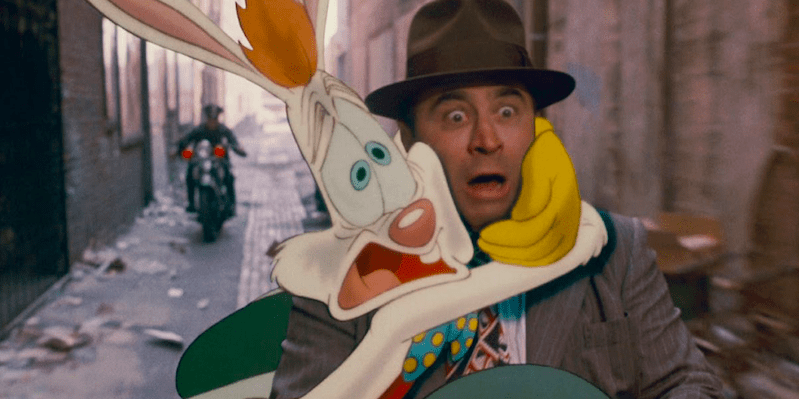
Who Framed Roger Rabbit is one of the most landmark movies of all time that I could write so much about it.
Did you know that it’s based on a book Who Censored Roger Rabbit? that is totally different and is about the titular character’s own murder? Gary K. Wolf, the writer, sued the filmmakers after they reportedly used “Hollywood accounting not to pay him residuals. I have the book and it’s not near as good as the movie, but that’s because it’s a different story.
The book was set in modern times in the Los Angeles area and the toons talked in bubbles that later evaporated. Roger is actually a newspaper comic actor as pictures are taken that are printed in the papers. It doesn’t work as good as animated cartoons who make movies. I won’t spoil the rest of the book, but it’s way different than what you’d expect.
There’s a lot of talk about the movie and how the filmmakers wanted Bill Murray to play Eddie Valiant, but as Murray was unable to reach, they cast Bob Hoskins instead. And Hoskins was a good choice because any bigger name star would’ve diverted from the animation. Hoskins, who was a brilliant actor, could play a wide range of characters. When you look at his role as Valiant, he’s perfectly cast as a former police officer turned private eye, who fits the cliched trope of the hardened alcoholic investigator doing whatever’s necessary to pay the bills.
Hoskins is also able to exert enough of comedy not to distract from the cartoons. As the late Roger Ebert said of Chevy Chase’s role in Funny Farm, “It’s an a performance, not an appearance.” Any other big name actor would’ve been too busy with the camera focusing on them and not willing to let Roger (voiced by Charles Fleischer) or any toons stand out. I think it’s because of Hoskins earlier work in London theater scene where he learned to give and take the way the role requires.
Of course, the story goes that Valiant is hired by a studio boss, R.K. Marroon (Alan Tilvern) to take explicit pictures of Roger’s wife, Jessica (voiced by an uncredited Kathleen Turner) a human toon whose modeled after Veronica Lake. It’s a snoop job and Valiant isn’t interested but he needs the money to repay Delores (Joanna Cassidy), a close friend who loan him money she shouldn’t have. When Roger sees the pics of Jessica playing patty-cake with Marvin Acme (Stubby Kaye), he has a breakdown.
Later Acme is killed in his factory when a safe drops on his head. The police suspect Roger did it as the pictures are leaked to the media. Judge Doom (Christopher Lloyd) of ToonTown sends his toon weasals out to track down Roger along with the police. But Valiant suspects Roger may have been framed and he works with him to clear his name.
It’s a classic film noir story as Valiant comes in contact with some of Hollywood and ToonTown’s characters. But below the surface is a deeper movie about race relations, politics, prejudice and racism. By calling them “Toons,” it’s obviously a reference the same way people will call someone, “the blacks” or worse derogatory words I won’t mention here. One of them rhymes with “Toon.”
Now, the rest of this will be spoilers. So if you haven’t seen it, then that’s just too bad. You should’ve seen it already. No, seriously, it’s a good movie. And it’s been 35 freaking years.
Valiant has prejudiced against the toons as we learn early on that his brother, Teddy, who was also his partner in a private eye business was killed when they were working in ToonTown. They were chasing a bank robber who was able to drop a piano on Teddy’s head, killing him. Valiant tolerates the Toons but he takes offense when a barfly jokes with him about working for toons.
Later when he goes to the Ink and Paint Club where Jessica sings, the guard is a hulking gorilla toon. This is obviously a subtle reference to how black people are referred to apes by racists. When he goes into the club, he notices that even though the clientele are human, the staff are toons. This is referencing how country clubs and private social clubs will have BIPOC working there, just not members.
On stage, Donald Duck and Daffy Duck are playing pianos and fighting. But this is actually a minstrel show the humans are watching and laughing at. An urban legend making the rounds is that Donald gets mad at calls Daffy the “N-word,” yet that has been debunked as Donald just screaming gibberish.
While Valiant doesn’t like toons, he seems to be surprised to see that Betty Boop is working as a cigarette girl and feels a little sorry for her. Growing up in the south, I’ve seen this type of behavior that prejudiced people seem to share some sympathy with older BIPOC as opposed to not caring for younger people. Since Betty is in black and white and the toons are in color, she’s unable to work in the entertainment industry and thus has to work in the club.
Jessica Rabbit is a human and her voluptuous hour-glass body attracts many human men who crowd the stage when she performs. Even Valiant is smitten with her at first. This is referencing how even bigoted men can find celebrities such as Beyonce Knowles, Kerry Washington and Halle Berry attractive but are turned off by Tiffany Haddish or Leslie Jones. Jessica represents the fantasy. She represents the sex bigoted men want in non-white women.
Doom and the Weasals operate similar to the lynch mobs of the Jim Crow era. Doom plans to kill Roger by dunking him into a dip that causes the Toons to melt into wet paint. Some can look at this as the anti-Semitism that sprung up a lot in the post-WWII era or how McCarthyism made people turning against each other because they might or might not be Communist.
But I think it’s more about lynching. Roger is accused of a murder even though there’s little evidence except circumstantial. Doom tries to kill Roger when he discovers Roger hiding in a bar while everyone else watches. In many ways, the movie is about how society during this era allowed lynchings to happen. In one scene, Doom shows disdain for a black military vet who has lost his arm by using the sleeve to wipe chalk off a board.
Doom is obviously a racist and he’s a lot like the judges and law enforcement during this era who did whatever they wanted to do. Los Angeles during this era was a hotbed of racial tension and still is as many black people were relocating there to get away from the Jim Crow South and many Mexican immigrants were crossing the border to live there. When William H. Parker became police chief of L.A. in 1950, he began to pull police from the Jim Crow south to turn the L.A.P.D. to a governmentally-funded KKK organization.
The irony of Doom’s revelation that he is a toon himself that hates other toons isn’t surprising. You can see the self-hatred in a lot of current people such as Supreme Court Justice Clarence Thomas and David Clarke, the former sheriff of Milwaukee County, Wis. Both are just examples of people who have an hatred for people of their own skin as well as Daniel Cameron, attorney general of Kentucky, who felt the Louisville police officers who killed Breonna Taylor should get away with murder.
Doom’s goal is to become rich over the construction of a freeway that will require the destruction of ToonTown. This is obviously gentrification of land that has often and continues to happen to this day. Even with the destruction of a wildfire in Lahaina, Hawai’i, that states governor talks of turning the damaged property where people lived into public land. But his office has been quick to go after realtors and property investors looking to exploit it.
You almost wonder if Doom is correct how no one will care if ToonTown is gone. It took the Watchmen TV show for people to finally learn about the Tulsa Race Massacre nearly 100 years earlier. And that was considered Black Wall Street. Did Jeffrey Price and Peter S. Seaman know of the Tulsa Race Massacre when they penned the script. The firebombing of a Philadelphia neighborhood that is predominantly black was only a few years earlier in 1985.
It’s interesting that Doom wears a mask as he’s trying to pass for human the way some BIPOC have passed for white/caucasian. Even though his marital status is presumed single, I imagined Doom would be married to a human woman the way Thomas and Cameron have married white women. Not that there’s anything wrong with that. But there was a joke on the sketch show Key & Peele where the Black Republicans all have white wives. Since it’s a family-friendly movie, it never does examine whether or not humans and toons have relations. My guess the toons’ version of sex would be something like “patty cake.”
But the movie is still a PG-rated Disney fare that is short on the sexual innuendo and violence. Robert Zemeckis, as director, knows to keep it subtle because a lot of children in the audience wouldn’t have understood the racial overtones. Some people call it the “unofficial sequel” to Chinatown, even though The Two Jakes was the official sequel. Rumor has it that Robert Towne and Jack Nicholson had planned on a trilogy with the third movie to be called Cloverleaf (based on the aerial view of a freeway interchange with on and off ramps) that never took off. Doom is the sole stockholder of Cloverleaf Industries which wants to buy ToonTown which could be easier since Acme’s last will and testament is missing. They’ve also purchased the Red Car Street Cars to dismantle them. This is also another true-life reference to how street cars were once the primary mode of public transport in many cities and towns before the automobile use became more popular in the post-WWII years.
However, despite all the references to real-life history, the feature still manages to be primarily a kids family-friendly movie. The opening is a hilarious cartoon as we see Roger trying to keep the accident-prone Baby Herman (also voiced by Fleischer) safe. It’s revealed Baby Herman is a grouchy old man in the body of a baby and Roger keeps screwing up a crucial scene. Like an animated precursor to Robert Altman’s The Player, there’s numerous famous characters that keep popping up and their cameos are well written into the script.
Even though the movie was made by Disney through their Touchstone Pictures banner, chartacters belonging to Looney Tunes (Daffy, Bugs Bunny, Sylvester the Cat, Tweety and Porky Pig) appear. Looney Tunes is property of Warner Bros. who through negotiations with executive producer Steven Spielberg allowed their usage under certain stipulations. And one of those was that Bugs had to have the same screen time (and same number of lines) as Mickey Mouse. (However, you can see Bugs walking in the background for a quick second earlier in the movie.)
Roger Rabbit, which had a huge budget of $50 million for the time, made over $350 million worldwide and won three Oscars (Editing, Sound Effects Editing and Visual Effects) as well as a special achievement award. And a sequel was immediately planned with a young J.J. Abram hired to work on a script. However, Disney disputes with Wolf and Spielberg objecting to a script treatment by TV writer Nat Mauldin to have a prequel set during WWII and satirizing Nazis, caused the project to languish in development hell for much of the 1990s before it was quietly abandoned as there had been too much time lapse.
But the idea of a sequel has been thrown around for decades with Spielberg and Zemeckis expressing interest in a sequel. Disney did produced some shorts to be aired before their movies, such as Honey I Shrunk the Kids. But they were heavily criticized for upping the sexual innuendo. With 35 years passed since the original as well as the death of Paul Reubens, who was originally considered to voice the titular character and did test work, the likelihood we’ll ever see a sequel is now slim to none.
The original was one of those lightning in a bottle moments that probably wouldn’t work today with sequels like Space Jam: A New Legacy and Ant-Man and the Wasp: Quantumania relying too much on special effects and pop culture references rather than plots and themes. The Chip and Dale’s Rescue Rangers movies is the closest we got. Now, audiences would want something with Rick and Morty.
What do you think? Please comment.
 Zane Says