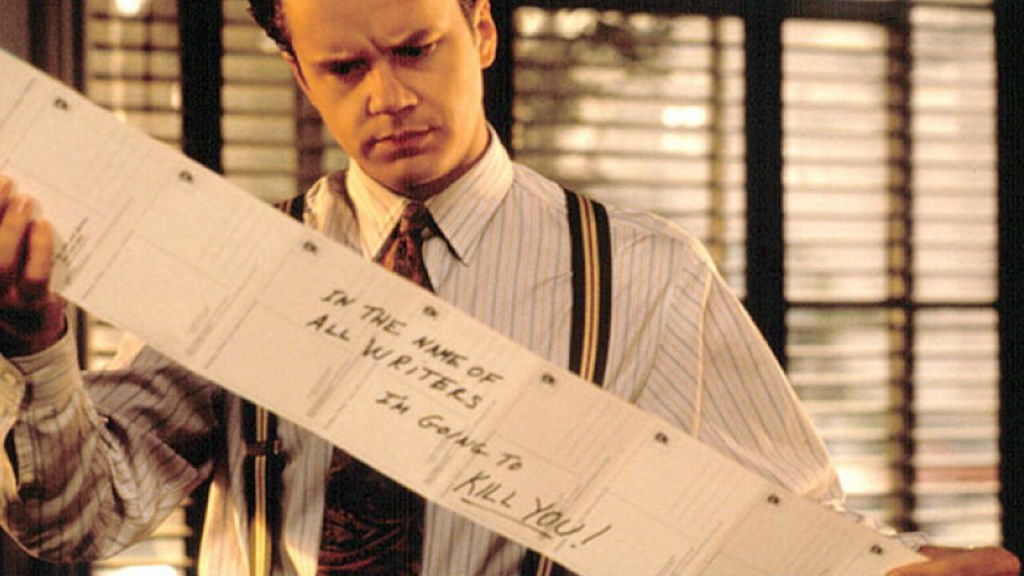
When The Player premiered in the spring of 1992, it was the buzz of Hollywood. Featuring Tim Robbins who was a rising celebrity at the time as a Hollywood executive who is hated by anyone and everyone but they still want a moment of his time, the movie was a biting satire of Hollywood. It seemed to slam the emergence of corporations owning movie studios in the 1970s and 1980s that were more concerned about turning a profit and winning awards than just making stuff that’s entertaining, or God forbid, thought-provoking and different.
The movie was directed by Robert Altman whose career had took a hit during the 1980s and written by Michael Tolkin based on his novel. Distributed by the now-defunct Fine Line Features, a subsidy of New Line Cinema, and produced by the now-defunct Spelling Entertainment, it arrived during the middle of the indie-film craze of the era. While the cast consisted of mainly character actors (Bryon James, Greta Scacchi, Peter Gallagher, Fred Ward, Stevenson and Dina Merrill), there was a mixture of a few big celebrities such as Whoopi Goldberg and Sydney Pollack in supporting roles and Jeremy Piven, Vincent D’Onofrio and Gina Gershon as they were rising like Robbins.
But the kicker is the 65 celebrity cameos the movie boasted appearing in anything from a blink-and-you’ll miss it shot to a more developed scene. You’ll see Jack Lemmon happily playing the piano at a party where Kathy Ireland and Jeff Goldblum mill around in the back. Or there’ll be a big-time gala where Cher, Nick Nolte, Gary Busey and Elliott Gould among others are dressed in tuxedos and ball gowns as Leeza Gibbons’ voice-over is heard with the Entertainment Tonight music. Then, you have scenes where the characters interact with Burt Reynolds, Joel Grey, Malcolm McDowell, Andie MacDowell, Anjelica Huston and John Cusack. It’s Hollywood where anyone can appear at a restaurant, bar or studio lot.
Robbins plays Griffin Mill, a young Hollywood studio executive who dresses like he’s read F. Scott Firtzgerald’s The Last Tycoon too much, but drives a Range Rover because it’s all about the prestige. His job is basically listening to writers, directors and actors giving him pitches for movie ideas. Unfortunately, Griffin is at the position where he can’t say “Yes” without having his boss, Joel Levison (James), approve it. And there’s some tension between Griffin and Levison as his boss is trying to get another executive, Larry Levy (Gallagher), away from 20th Century Fox. Griffin feels that Larry is going to replace him as he appears almost everywhere Griffin is before finally coming on board.
Griffin has also been receiving numerous anonymous postcards with threats on them supposedly from an unknown writer. Only his secretary, Jan (Angela Hall), seems to know about it. Jan, herself, is playing the system like Griffin is knowing when to keep her mouth shut and when to do as she’s told. But Griffin meets and talks with so many writers he’s lost track of who it might could be. Jan takes a phone call from an angry writer who doesn’t give his name. So, he does some looking through an appointment book and deduces it’s David Kahane (D’Onofrio), a struggling writer who lives in Pasadena, Calif.
Griffin goes to Kahane’s house but when he calls the house on his cell, he talks to Kahane’s live-in girlfriend, June Gudmundsdottir (Scacchi), who is an artist. Griffin observes June from the outside and chats with her as she tells him Kahane has gone to the nearby theater to watch The Bicycle Thief. Smitten with June who is from Iceland (not Greenland as she educates him on the confusion), Griffin goes to track down Kahane.
But he doesn’t recognize who it could be and after a failed attempt, notices the real Kahane who isn’t too excited to see him, especially since Griffin is trying to make it appear that this is a coincidence. Griffin passed by Kahane walking into the theater about five minutes before the movie ends. Despite trying to smooth things over drinks, Kahane isn’t having it and they get into an argument outside in the parking lot that turns physical when Kahane accidentally knocks Griffin down. And in anger, Griffin accidentally drowns him in a puddle of rainwater that has accumulated at the bottom of a ramp.
Now, there are problems. Griffin stages it like it was a mugging and leaves. But Walter Stuckel (Ward), head of security at the studio, finds out about Kahane’s death and how Griffin was last seen with him. Griffin also gets a fax in the drawing of a postcard with one word – Surprise! And Dets. Susan Avery (Goldberg) and Paul Longpre (Lyle Lovett) suspect Griffin knows more than he’s telling too. At the same time, Griffin gets closer to June who he meets in person at Kahane’s funeral.
Griffin gets closer to her even taking her to the black-tie gala and snubbing his girlfriend, Bonnie Sherow (Stevenson), who’s hoping to get ahead, so Griffin says she should go to New York City to work on a getting a contract approve. It’s obvious Griffin isn’t a likeable person. Reynolds ad-libbed a line calling him an “asshole” knowing he was probably in earshot. Altman said Griffin is like a lot of the studio executives he has dealth with. H even handwrote the postcards himself. McDowell had the same feelings and was allowed to ad-libbed a line when he bumps into Griffin in a bar lobby and isn’t too happy about what Griffin has been saying about him.
Griffin doesn’t really have much talent or abilities. None of the studio executives do. They seem to have lucked into a job where they can make a lot of money, hobnob with a lot of celebrities and live like important people. It’s about cliques and you can tell the studio executives sat at the “Cool Kids Table.” No one liked them, yet everyone wanted to sit there. And while most went on to sell insurance and have bad marriages, the few who are in Hollywood have the power. During a breakfast meeting, Griffin insults a waiter for bringing him the wrong glass to drink his mineral water and then leaves right as the waiter brings the right glass.
No wonder people in southern California want to kill him. And Griffin knows he’s worthless without the job title. He can talk to writers like Buck Henry and Alan Rudolph while feigning interest and can bar filmmaker Adam Simon from the studio lot just because he can. But if he loses his job especially as Walter says a corporate takeover could happen as profits are down at the studio, he’s a nobody. He knows it and everyone else does too.
The studio Griffin works at isn’t named and there’s no mention of who the main bosses are. There’s a reference to some investors and shareholders back east. A young man, Reg Goldman (Randall Batinkoff), is in town driving around in his Porsche trying to have sex with whoever he can. He wants to date Meg Ryan but is surprised to hear she is married or was at the time. It’s a crazy world these people live in. Reg is obviously the main boss’ son or grandson.
There’s also a subplot as Larry comes on board Griffin hopes to silence his thunder a little by getting him interested in a movie idea with an awful pitch. Two screenwriters, Andy Sivella (Dean Stockwell) and Tom Oakley (Richard E. Grant), want to make a movie, Habeas Corpus, which is different from the normal legal dramas. This one will have no major stars and a sad ending where a woman accused of killing her husband is wrongfully convicted and dies in the gas chamber.
But Griffin wants to entice Larry since Larry knows Tom and when they pitch it to Levison, he isn’t interested in it. But Larry believes like Tom and Andy the depressing ending will work and since Terms of Endearment was a big success with its sad ending, this could be an Oscar contender. And that attracts Levison who wants a sex scene by asking, “Do they screw?” which causes his assistant, Celia (Merrill) to roll her eyes in bemusement. Griffin feels that the failure of the movie during test screenings will result in him coming in to save the movie while putting both Levison and Larry in the hot seat.
As he gets closer to June, he pulls away from Bonnie. Also, Bonnie’s assistant, Whitney Gersh (Gershon), cozies up to Larry, which shows that even among people who work together and hang out, there really isn’t much loyalty at the end of the day. It’s apparent this isn’t the first time Griffin has used a woman and dumped her for someone else. You can just see in his callowness, he’s become a pro at this.
There are a few scenes I would like to note. A lot has been mentioned about the early tracking shot in which we’re mostly introduced to all studio characters as the camera follows them through the parking lot outside the main offices. It’s a wonderful shot as we see the world they live in where Griffin hears three pitches within a short time. The scene goes on for seven minutes and 47 seconds. Fifteen takes were used but reportedly they used the 10th one.
But there’s also a scene in which Griffin goes to the Pasadena Police Department to look at pictures and is questioned. The first thing Griffin does after being led by the suspicious DeLongpre into the room is walking into the lieutenant’s office which is empty. This is a tactic common in most movies where people are questioned in offices. But instead, it’s a open room with crowded desks and desk fans blowing in your face and flies buzzing around that DeLongpre swats at them as Avery gets on Griffin’s case.
This is more like it is in real life. Police stations are very populated and crowded. And police sometimes ask inappropriate questions. The scene starts out with Avery talking about how DeLongpre was telling them about seeing the movie Freaks the night before and then it turns into a tense moment when it seems they’re trying to get Griffin to slip up about Kahane’s death. But when he freaks out and can’t pronounce June’s last name, they all start laughing.
In many ways, Griffin is overreacting. But it sets up a later scene in which they bring Griffin in for a line-up. But Griffin is let go when an eye-witness points to DeLongpre, standing also in the line-up, as the one she saw. Avery and DeLongpre know he did it but there’s not enough evidence. A popular belief is the writer is actually Phil (Brian Brophy), who gives a eulogy at Kahane’s funeral, and sounds the same as a writer who admits he was sending Griffin the postcards at the end of the movie who pitches a story over the phone similar to what Griffin has gone through. But the writer says, if the price is right, it’ll have a “Happily Ever After” ending.
Griffin is now the top dog and turned even colder afer Levison was forced out when Goldman goes home with an STD. And he has Larry now sucking up to him and firing Bonnie so he doesn’t have to do it himself. As for the movie Habeas Corpus, it ends up being a huge celebrity spectacular with Bruce Willis as the sympathetic D.A. who falls in love with the wrongfully convicted housewife played by Julia Roberts. And the movie’s cast also includes Louise Fletcher, Rene Auberjunois, Peter Falk, Susan Sarandon, Paul Dooley and Ray Walston among others. Naturally, it ends with Willis’ character saving Roberts’ character at the last minute as he carries her out of the gas chamber and they kiss.
The movie-within-a-movie is so well filmed that it looks like the normal legal drama Hollywood was churning out. But it also references the original ending of Fatal Attraction which is mentioned earlier in the movie. In that movie, Glenn Close’s character killed herself with a kitchen knife she knew Michael Douglas’ character had touched to set him up. And the movie ends with him being arrested for her death and the Anne Archer wife finding the cassette tape that was made that helps exonerate him. However, this was hated by test audiences. So, we got the theatrical ending where Close’s character shows up at their suburban home acting crazy and Douglas’ character thinks he’s drowned her in the bathtub but she pops back up for a final scare the Archer character shoots her.
Many movies had to have their sad endings changed because test audiences hated. Tom tells Bonnie they changed it because everyone hated. Look at the 1986 film adaptation of Little Shop of Horrors which had to have its ending change because it was different from the musical play where the characters died at the end. Yet is this a question of who is really responsible for a movie’s ending, the audience or the executives?
Can you imagine Casablanca with Humphrey Bogart and Ingrid Bergman staying together? Or how about High Noon where Gary Cooper’s character accepts the townspeople’s forgiveness and stays on as sheriff? Or Michael Corleone realizes that Fredo just made a mistake and he’s still family and accepts Kay back into the house at the end of The Godfather Part II. Of course not. The movies’ wouldn’t have worked that way.
But it seems at that when New Hollywood (which Altman was considered a part of) collapsed in the early 1980s as Coca-Cola bought Columbia Pictures and Gulf+Western bought Paramount, there was more of a concern for ther shareholders than the audience. That’s why they put in studio executives who couldn’t do much of anything else except assert their power. And while Andy and Tom want to stand their ground on a movie with a sad ending, they’re finally willing to compromise when it means bigger and better things.
And Griffin may not get away with it much after the movie ends. His time as studio chief can’t last forever. But he’s basking in it while he has time. And people will allow him to do it as long as he says yes. You can see some of Bob Iger and David Zaslav in Griffin because as McDowell and Reynolds says, they’re all the same and they’re all assholes.
What do you think? Please comment.
 Zane Says