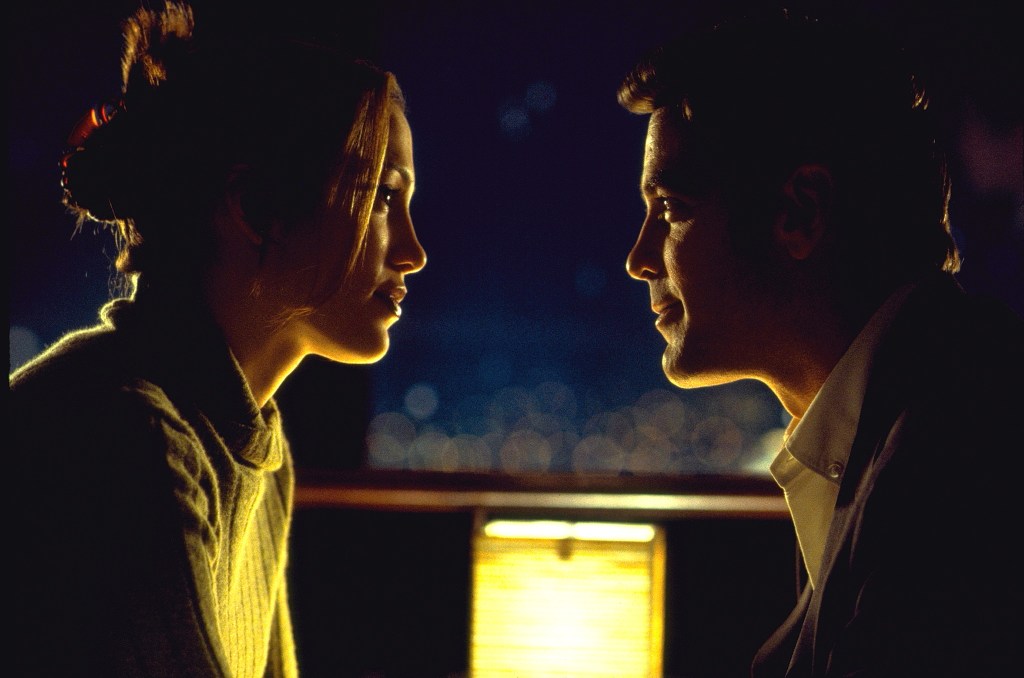
George Clooney may just well be the closest thing we have that reminds us of the Golden Era of Hollywood in which leading men were bigger than life who still commanded the silver screen when they turned into silver foxes and drove everyone from 8 to 88 wild. He has the playful mixture of comedy and dramatic timing that Jimmy Cagney honed during his years through vaudeville mixed with the debonair class and grace that Cary Grant brought to his roles mixed with the tough guy rawness of Steve McQueen. Even though they physically fought on the set on Three Kings, there was no surprise that David O. Russell named Clooney’s character Archie Gates, a nod to Grant’s real name of Archie Leach.
But for a while he cut his teeth in schlock horror like Return to Horror High and Return of the Killer Tomatoes, which is technically his first leading role. Then there were the TV roles in The Facts of Life, the other E/R and Roseanne to name a few before he became the first Dr. McDreamy as Dr. Doug Ross in ER from 1994 to 2000. When he got a haircut for From Dusk till Dawn, it was the talk of the tabloids as they said it was a Caesar haircut. He had appeared in lead roles in One Fine Day, Batman & Robin and The Peacemaker. It wasn’t too bad for an actor who had begun the 1990s in a show about a talking baby and had been more or less replaced by Scott Baio.
So by the summer of 1998, when Out of Sight opened, audiences turned out by they were more concerned about seeing Bruce Willis blow up an asteriod and Ben Stiller getting his nutsack stuck in his zipper in There’s Something About Mary. No, Out of Sight was more of a movie for adults who wanted to see a movie about adults. It got good reviews and worldwide still managed to turn a profit, but it had become mostly forgotten until award season where during a bold move the National Society of Film Critics awarded it Best Picture and Best Director over Saving Private Ryan and Steven Spielberg.
Now, people were thinking they needed to check this movie out and it found its audience on the home video market and cable. It was impressive because Steven Soderbergh, who was mostly known for arthouse and indie movies, had made the big leap so well to the major studio movies that it could’ve ruined his career. And it is a studio movie with a cast that is amazing, especially when you consider Viola Davis and Catherine Keener, both known as character actresses at the time, both in appear in supporting roles. There’s even a hilarious neat cameo by Michael Keaton playing the role of Ray Nicolette he had played in Jackie Brown. Both movies are based on the works of Elmore Leonard.
Even more surprising, Clooney was only in his mid-30s while making it. Infamous for not going on screen with make-up, he was one of the first Hollywood actors to embrace the grey. He looks older. Clooney looks like a career criminal who’s had hard times but not too hard that you’d never suspect. The movie juggles different genres of action-comedy, heist thrillers, buddy-comedies and crime drama. It’s hard to categorize it to one particular genre. Just like the movie’s non-linear editing, it tells multiple stories that all fit together nicely. The story opens with Jack Foley (Clooney) throwing a necktie on the sidewalks of a Miami business district. He’s angry and frustrated but of what we don’t know.
Foley walks into a nearby bank, pulls out a Zippo lighter and plays with it as he scans the area noticing a businessman talking with a bank manager. He then casually walks over to a young niave bank teller and tells her that the businessman is his partner and he is going to shoot the manager if she doesn’t give him all the money in the cash drawer. He’s smart enough to know what she doesn’t need to grab the dye packs or trip the alarm. But Foley’s plan is foiled when the car he’s driving want start.
Sent to Glades Prison some time later, he notices another prisoner, Chino (Luis Guzman) and his prison lover, are up to something. He’s known about their escape for a while but Chino says it’s been moved up because more fencing is being erected. Foley tells a guard to meet him later but also calls his ex-wife, Adele (Keener), to notify his friend/partner in crime, Buddy Bragg (Ving Rhames) of the change. What Foley plans to do is to knock out the prison guard, steal his uniform and follow the other prisoners out through and underground tunnel to make it appear he’s a guard so Buddy can arrive at the prison to help him escape.
Foley and Buddy have a score to settle. They plan to go after Richard Ripley (Albert Brooks) who did time with them years earlier in Lompoc. Ripley is a wealthy Wall Street investor who got went to prison for ripping over his customers. Through flashbacks, we learn that Foley and Buddy helped protect Ripley from the other convicts after he had a falling out with Maurice “Snoopy” Miller (Don Cheadle) a former professional boxer who got bigger cred after shivving another inmate. Maurice extorts money out of Ripley to get him things as well as keeping him from being jumped or raped, even by Maurice himself.
What neither Foley or Buddy counnted on was U.S. Deputy Marshal Karen Sisco (Jennifer Lopez) arriving at the prison minutes prior to the prison break on an unrelated case. She helps alert security guards to the prison break almost blowing everything for Foley and Buddy but they managed to subdue her and put her in the trunk with Foley as they leave the prison area. In the trunk, Foley and Karen talk some mostly about movies but he is offended that she might think he will try to sexually assault her. Soderbergh films this scene to show the claustrophobia as Foley does his best to keep his hands off but there’s not much room.
But when they stop on the side of the road to change cars with a former prison inmate, Glenn Michaels (Steve Zahn), Karen shoots at them with a handgun she had in the trunk her father, Marshall (Dennis Farina) had given her. They manage to move her to the other car where Glenn is waiting. But Karen is able to convince Glenn, who is very nervous, he hasn’t done anything illegal and to drive off leaving Foley and Buddy on the side of the road. But they get into an accident and Glenn takes off leaving Karen knocked out and sent to the hospital.
As the task force begins to track down the convicts, Nicolette joins them with Karen talking her way on to the team after arresting Chino who tracks down Adele to find Foley. The incompetency of the task force, which criticizes Karen because she is a woman, lead to Foley and Buddy getting out of the area so they can take off for Detroit. But it’s not without Karen spotting Foley and Buddy in a hotel elevator and pausing to radio it in when Foley spots her and gives a friendly wave.
It’s obvious that Foley and Karen seem to have an attraction to each other. And the performances of Clooney and Lopez keep this from becoming the normal deus ex machina of movies where the male and female leads have to hook up just because it’s in the script. I haven’t read the book that Leonard wrote but Scott Frank manages to deliver a good script with some great dialogue and three-dimensional characters. The attraction between Foley and Karen works. The way Clooney waves when Foley spots Karen has a certain innocence to it like when you spot someone you don’t expect to see in a public place but you’re happy to see them. And Marshall can tell from Karen’s questioning when she hears from Nicolette of an escapee being kill that she is too concerned over whether it was Foley or not. Karen also has a dream of finding Foley taking a bath and being attracted to his body.
I have a feeling that Karen has a soft spot for danger. Marshall doesn’t care for Ray because he’s technically still married to his wife. But yet, doesn’t question Karen’s relationship that much. I guess he’s a protective father who doesn’t want his daughter being used and abandoned. But I feel Karen knows a lot about criminals and felons she can tell Foley is different.
The supporting characters help make the movie what it is. Buddy is a good friend but he seems almost riddled with Christian guilt over his actions. He’s constantly calling his sister, who’s never seen, who’s a devout Christian, whenever he does something he thinks is bad. Adele tells Karen that’s how they ended up in Lompoc together. And even though she appears in a few scenes, Keener plays her role as an aging magician’s assistant like a woman who’s gullible but still caring which is why her and Foley keep in contact.
Then there’s Zahn as Glenn who is slowly seeing he’s getting in more than his head when he contacts Maurice in Detroit about going after Ripley. Apparently, Ripley has millions in uncut diamonds at his mansion there. He had promised Foley that he would take care of him when they got out of prison. But Ripley stiffed him offering him a job at his Miami location as a security guard, which angered Foley leading him to be thrown out which leads to the movie’s beginning of him throwing the necktie on the sidewalk. Brooks, who mostly plays comical roles, gives hints of his scene-stealing role as a villain in Drive, as he plays a man who is willing to do whatever it takes to get what he wants.
In Detroit, Maurice has built himself of a petty crime boss but he only seems to have Kenneth (Isiah Washington), a psychopath and sexual predator, and his muscle man White Boy Bob (Keith Loneker) whose muscles are bigger than his brains, as part of his crew. There are scenes of violence but Soderbergh and his cinematographer, Elliott Davis, film them without exploitation or glorification. The goal is to show the awfulness of violence and we see Glenn, who’s mostly a car theft and petty criminal, realizing there is a darker side.
Foley himself is infamous for using his wits to rob banks that he doesn’t need a gun. But when he has to discharge one in defense, his reaction is different from what is mostly shown in movies like this. Cheadler plays Maurice as a character who is too cocky and arrogant, it’s not a question of if he will end up being shot by the police or other criminals or when. When Karen discussing Maurice with a Detroit cop, he downplays the threat of Maurice because he knows what he’s like. There’s some good acting between Clooney and Cheadle as two men who really can’t stand each other and aren’t afraid of telling one another. This is kinda comical since the two have worked together numerous times since then.
But where the movie really works is how it portrays a sexy coolness to it. Considering that the movie takes its setting from the Miami Vice feel of Florida to the damp depressing Michigan winter and still manages to have sizzle is an accomplishment. There’s a scene in which Foley and Karen reconnect at a hotel bar where they pretend to be other people before they head to her room to have sex as the snow falls in the background that is wonderfully filmed, acted, directed and edited.
That’s what keep the movie memorable after 25 years. It gives us a plot that doesn’t seem too outrageous and characters who seem real. White Boy Bob’s demise is one big WTF moment but it shows the dangers of handling a firearm. And the ending doesn’t cop out. At the end of the day, Foley is still a criminal and Karen is still a law enforcement officer. Even though you know what’s going to happen, it’s one of those movies you want to watch again just because it’s a damn good story put together.
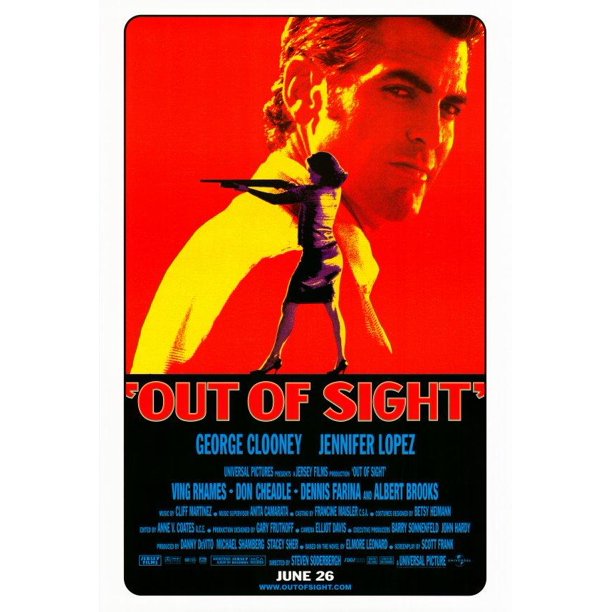
I feel the movie’s marketing helped contribute to its $37 million North America take which has a movie poster looking more like a 1970s grindhouse foreign action movie. The home video release went for a grittier take by showing the floating heads of Clooney and Lopez with a huge revolver left of them. I think the gritty look managed to get more people to be interested in it thinking it was a darker crime movie only to realize there was more comedy elements.
While this might be the hottest summer on record, it definitely is something to stay inside and watch to cool off. And it beats The Flash by many years for giving us two Batmans for the price of one admission. Because this movie is very cool.
What do you think? Please comment.
 Zane Says