An anthology show such as Amazing Stories was never really bound to last long. It seemed more like a lighter, less bleak version of The Twilight Zone, which in itself only lasted five seasons. Yet there are more than three times as many episodes during its original run.
Steven Spielberg spearheaded the anthology, creating and developing it as well as acting as a producer and directing the first episode. The tone of the overall series seemed to be similar to his “Kick the Can” segment in the Twilight Zone movie from 1983. And anyone’s who has seen this movie can conclude it’s the weakest. There’s just nothing that entertaining about Scatman Crothers as an elderly man who travels from retirement home to retirement home to teach elderly people how to be young again as they even revert back to their youthful bodies for a short period.
Stephen King said his script “Sorry Right Number” was rejected for being too bleak in its ending. It was later used in the anthology Tales from the Darkside which his friend and collaborator George A. Romero had created. There were a lot of anthologies during this period. The George Burns Comedy Week focused on comedy but it only lasted one season. With newer technology and edgier storylines, The Twilight Zone had a revival in the mid-1980s but after two seasons on CBS, it went into first-run syndication before being canceled. On HBO was The Hitchhiker which took advantage of the use of profanity, violence and sexual content to make for darker stories.
Amazing Stories only ran for two seasons even though it was nominated for 12 Primetime Emmys, winning five. But some people, such as young filmmaker Mick Garris, blamed Spielberg for being too involved. Of the first season’s 24 episodes, he either is credited as the sole writer or receives a “Story by” credit. People weren’t tuning in. Mainly because it was competing against the much more popular Murder, She Wrote.
Even with a change of behind the scenes activity during the second season, it didn’t help bring in viewers. The problem was the tone seemed to change from episode to episode from fantasy to comedy-drama to dark comedy and so on. It was a valiant effort with a number of famous directors (Clint Eastwood, Martin Scorsese and Joe Dante) helming episodes and many actors before they hit it big such as Kevin Costner, Charlie Sheen and Seth Green along with veterans such as Sid Caesar, Milton Berle and Hayley Mills.
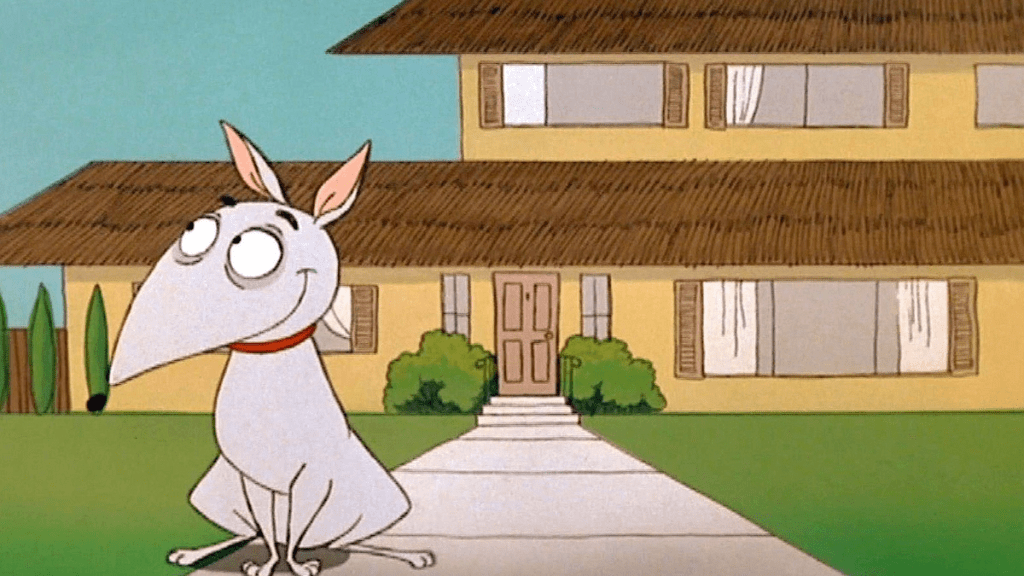
But by the winter of 1987, the series was beginning what would soon become its final episodes. And on Feb. 16, 1987, a young filmmaker named Brad Bird would get his moment to shine with the series’ only animated episode “Family Dog.” Bird would later go on to direct the Oscar-winning animated movies The Incredibles and Ratatouille as well as The Iron Giant, his first feature. He would also revive the Mission: Impossible franchise with the critically and commercially successful Ghost Protocol entry.
He would also go on to work on The Simpsons and you can see elements of that long-running show, which recently had its 800th episode air. The Amazing Stories episode is told mostly from the point of view of the titular character, a Bull Terrier, who is the pet of The Binfords, an obnoxious nuclear family. In many ways, Bird (who provides the vocal sounds for the dog) is mocking the American family sitcom format, which had families who didn’t seem to reflect the rest of America.
Sitcoms such as The Cosby Show, Growing Pains and Family Ties all seemed to present a saccharine view of the American family that seem to cohere with what the Reagan Administration wanted in its “Morning In America/City On A Hill” propaganda despite there was trouble as the AIDS epidemic was spreading. The Rust Belt had begun to form and many hard-working Americans found themselves either out of the job or having to take pay cuts as corporations reported record profits. Crack cocaine was also on the street and crime was rampant in major cities.
Also, the rise of No Fault Divorces and women taking higher positions with higher pays meant they didn’t have to stay in abusive marriages. It was becoming apparent more and more to many Gen Xers, there were less and less Ward Cleavers and more and more Al Bundys. At the same time, Ron Leavitt and Michael G. Moye, the creators of Married…with Children were pushing back as well. It was foolish to keep showing people a sitcom with easily solvable problems that ended with a hug. Most parents were off in their own worlds and their kids were left to their own devices as latchkey kids.
People tuning in expecting something cute and cuddly were immediately subjected to the Binfords’ son, Billy (voiced by Scott Menville) terrorizing the dog with the vacuum cleaner after his mom, Bev (voiced by Annie Potts) demands he do his chores before he can go outside. We then see the father, Skip (voiced by Stan Fresberg), sitting in the living room lazily watching the football game with a friend. Skip seems to not care too much as Bev is in the kitchen working and his daughter, Buffy (voiced by Brooke Ashley) claims the dog tried to bite her. Buffy is a young dimwitted chubby girl who had pushed the dog to his limits by trying to dress him up as a baby and referring to him as “Mary-Ann.”
Skip won’t even give the dog peace as he blames his flatulence on the dog to save the embarrassment from a friend/neighbor because it stinks too much. The show use of scatological humor was rare for an animated show especially during the prime time hours. The dog urinates on the carpet and disgusted by the taste of his canned dog food, he spits it in Bev’s slippers which she mistakes for feces. When an argument breaks out, Skip says it’s the “cheap damn dog food.” For many audiences, it was rare to hear a cartoon character swear.
It was pretty obvious the Binfords seemed typical of current families who seemed to be going through the motions as a unit rather than getting along. It harked back to the days of Norman Lear where families didn’t have the best furniture and housewives were frustrated because as Bev says to the dog when it wants food, she has no dreams or aspirations but “a toilet bowl that’s spring time fresh.”
Some people have argued the episode doesn’t fit the tone of the series, but I beg to differ. After Bird has introduced us to the Binfords, the second half of the episode focuses on the dog being trained to be a “quivering, snarly white-hot ball of canine terror” after burglars take a lot of appliances while the Binfords are out.
Skip blames it all on the dog, who during the first time was unable to move because Skip, Billy and Buffy fed him some awful mess of food Bev made that didn’t look appetizing. The dog is sent to an attack school operated by Ferta Lestrange (wonderfully voiced by Mercedes McCambridge). At first I thought it was Eileen Brennan as she had the same raspy voice as McCambridge. I had yet to see The Exorcist. It’s a nice cameo for the late actress. I’d argue that Bird used Lestrange as a model for the role of Edna Mode (which he himself voiced) in The Incredibles.
And when the same burglars (voiced by Marshall Efron and Stanley Ralph Ross) try to steal from the Binfords a third time, they get a surprise. There’s a lot going on and you have to be impressed by how Bird directs. It reminds me a little bit of the style of Ralph Bakshi when he made Fritz the Cat and Coonskin. It should be noted at this time that another young filmmaker Tim Burton was the animation designer of the show.
So, if you’re thinking you’ve seen the dog somewhere else, Burton used a similar style in his 2012 animated feature Frankenweenie.
The epsiode would go on to become one of the more popular entries into the anthology series. But it wasn’t enough to save it as NBC canceled the series after the second season. Bird would go on to be one of the writers of Batteries Not Included which Garris had created as an episode idea before Spielberg expanded it into a movie.
But his next role would be as an executive consultant on The Simpsons and even as an animation designer on some episodes from 1989 to the late 1990s. He directed the music video for “Do the Bartman.” He would then work with Pixar in the 1990s. “Family Dog” is the first time the A113 easter egg is seen. It’s been used in many Pixar productions.
Unfortunately, Bird’s work on The Simpsons would have a negative effect on “Family Dog” as Spielberg and Burton decided to make it a regular prime-time series. The extreme success of The Simpsons led to other prime-time animated shows such as ABC’s Capitol Critters (which focused on rats at The White House) and CBS’ Fish Police (which attempted to be a noir with marine life). Both aired during the first of 1992 and both were canceled and panned by critics.
However, Family Dog was expected to premiere in the early Spring of 1991 on CBS. But production of the animation of just 10 episodes had been delayed pushing the air date back almost two years. The problem was the failure of the animation shows in 1992 left CBS, Burton and Spielberg with little optimism for the show’s success especially since it had been six years since Bird’s anthology entry had aired. Bird himself had no involvement in the series but was credited as the creator.
Negative press had been buzzing around the show for a long time. This led CBS to just burn off the 10 episodes during the summer of 1993. Just FYI, burn off is what the networks do when they were contractually obligated to air shows they felt were poorly made and/or wouldn’t get much of a reception. This used to be done in the summer months when more popular and successful shows were on hiatus. Networks also did little marketing or advertising.
I tried to watch the first few episodes of Family Dog but immediately lost interest. The Binfords were more detestable and obnoxious. They didn’t have the likeability of the Simpsons or the Bundys. Now the show is mostly regarded as one of the biggest TV show disasters/blunders because of the involvement of Burton and Spielberg.
You can find bootleg episodes online.
Still, looking back at Bird’s 1987 episode, you can tell how it had a huge influence not just on The Simpsons but other animated TV shows that would follow. Cartoons didn’t always have to play it soft.
What do you think? Please comment.
 Zane Says