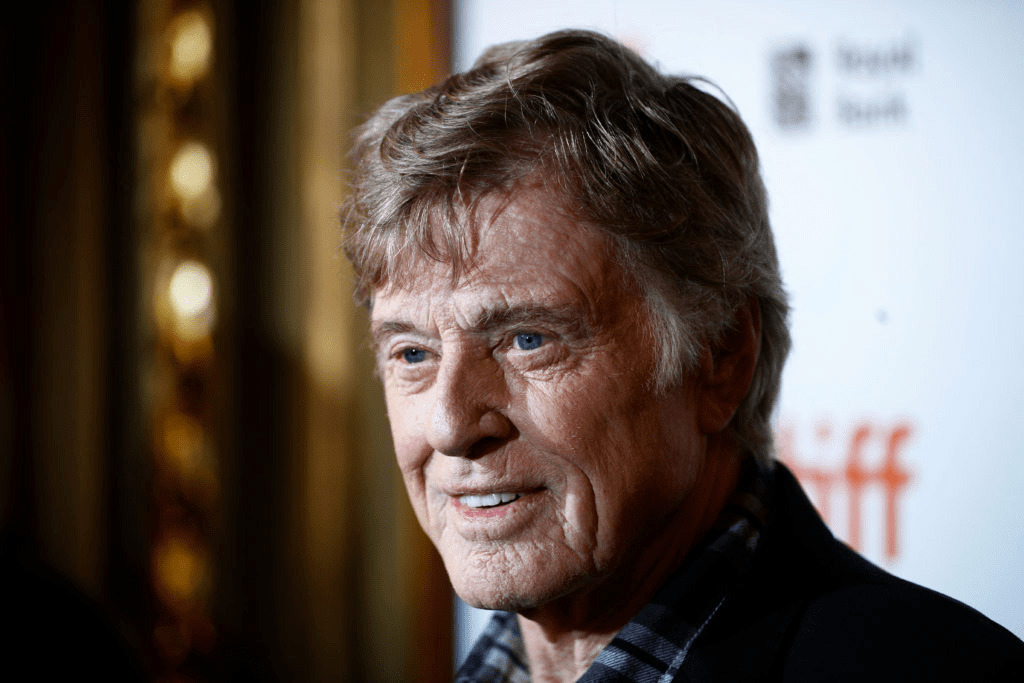
I don’t think many would argue with me that Robert Redford was one of the last of the classic legends of Hollywood. At 89 when he passed in Provo, Utah, Redford started out at a different time in Hollywood. The Hays Code still kept writers and directors from doing fully expressing themselves. But the Studio System with “contract players” was falling apart.
More and more people were buying television sets, so actors found themselves with more options as they could appear on TV shows to get their big breaks. And that’s what Redford did. He appeared in numerous popular TV shows of the time including Maverick, Naked City, The Untouchables and The Virginian.
In 1962, his All-American Boy looks got him cast as a young police officer in The Twilight Zone episode “Nothing in the Dark.” It’s basically a bottle episode as an elderly woman played by Gladys Cooper is scared of dying as she lives along in an abandoned tenement apartment. Eventually she discovers the young officer seeking help for a wound is Death to assure her comfortably that her time on Earth is ending and he’s to assist her into the afterlife.
As the 1960s ended, Redford’s career would explode with the movie adaptation of Barefoot in the Park and Butch Cassidy and the Sundance Kid. The latter movie would begin a new trend in Hollywood. Not only was it a revisionist Western, but it was also a buddy action comedy. Paul Newman was Cassidy and Redford was Sundance, aka Harry Alonzo Longabaugh. In real life, they were considered outlaws and criminals, but under William Goldman’s screenplay, they become antiheros for the Vietnam War era. The chemistry between Newman and Redford is also believed to created another genre – the bromance.
Redford and Newman would appear again in the Oscar-winning The Sting. According to Francis Ford Coppola, Paramount Pictures wanted Redford to play Michael Corleone in The Godfather. I don’t think that would’ve turned out well. Redford was on fire during the 1970s as a new era of filmmaking was forming as actors, directors and writers were changing things up.
Redford was one of the biggest stars of the decade. A scene from Jeremiah Johnson would become a popular meme. He competed with Warren Beatty for roles. Beatty made the political thriller The Parallex View, so Redford made Three Days of the Condor, teaming again with Barefoot co-star Jane Fonda. But Redford seemed to be in more demand, as he played Jay Gatsby in The Great Gatsby, co-starred with Barbra Streisand in The Way We Were, played real-life reporter Bob Woodward in All the President’s Men, who he also produced, reunited for another time with Fonda for The Electric Horseman and was in the all-star ensemble A Bridge Too Far.
The 1980s brought a new venture for the actor as he directed Ordinary People about a WASPish upper-class family in the Chicago suburbs dealing with the aftermath of a death in the family and suicide attempt. Redford picked up his sole Oscar for directing. The movie won Best Picture with Timothy Hutton winning the Oscar for Best Supporting Actor. And in a controversial move, Donald Sutherland wasn’t nominated at all as some people felt he was overshadowed by Mary Tyler Moore’s cold performance. When Sutherland flubbed a line during a crucial scene, Redford left it in as he felt it was more natural.
Redford didn’t act as much in the 1980s. In the prison thriller Brubaker, it’s believed to have been the first time the “slow clap” was used in a movie. But after a movie like The Natural, Redford could slow down. The movie based on the book by Bernard Malamud deviated from the book’s downer ending. Despite that, it’s consider one of the best sports movies ever as Redford played aging Roy Hobbs who becomes a star player for the fledging New York Knights.
While Barry Levinson got the Christ allegory correct up to the ending where Hobbs throws the game in the book, Hobbs knocks one out of the park that hits the night lights causing an explosion as he takes his homerun lap. Aside from the allegory, it’s also a look back to an era in America when athletic abilities were a metaphor for the nobility of humans. Along with the music by Randy Newman, it’s received more modern appraisal then during its run in 1984.
Of course, in the 1980s, Redford had something else going on behind the scene beside directing and producing. As the founder and trustee of the Sundance Institute, he helped spotlight movies and films that otherwise would’ve remained obscure and unseen. As the corporations began to take over the film studios and most independent movie theaters went out of business or sold to bigger companies, there was a need to honor untold stories. Redford also acknowledge Indigenous Native American films and their filmmakers.
Combining Sundance with the Utah Film Festival in the 1980s, the Sundance Film Festival, held during the winter each year, soon became a big name at the start of the 1990s thanks to young and upcoming directors like Steven Soderbergh and Quentin Tarantino. However, Redford wasn’t a huge fan of the graphic violence that seemed to be prevalent in the independent movies. He was notably critical of the violence in Danny Boyle’s directorial debut Shallow Grave.
But the 1990s brought Redford his best era as a director. After the disappointing The Milagro Beanfield War in 1988, he made A River Runs Through It with a young up and coming actor named Brad Pitt. Many people noted the physical similarities between Pitt and Redford. Based on the semi-autobiographical novella by Norman Maclean, Redford along with veteran cinematographer Phillipe Rousselot managed to capture the Zen serenity and beauty of fishing, especially fly fishing for trout. Rousselot won an Oscar for his work.
Yet it proved that just like fishing, you have to wait for the perfect catch. Redford followed that up with his wonderful Quiz Show, which was about the game show scandals of the 1950s particularly with NBC’s Twenty-One. In a bold move, he cast Ralph Fiennes, fresh off his groundbreaking role as the vicious Nazi Amon Goth, to play the real-life Charles Van Doren. At the heart of the movie, Redford cut through the growing romanticism of the 1950s to prove that we only looked at it through rose-collared glasses.
Quiz Show was a modest success at the box office but a critical hit with an all-star cast that also included Hank Azaria, John Turturro, Martin Scorsese, Paul Scofield, Mira Sorvino, Elizabeth Wilson, Rob Morrow, Griffin Dunne, David Paymer and Christopher McDonald. His next film to that would be The Horse Whisperer which was a huge success. While people have noted that Nicholas Evans’ prose was drab and boring, Redford was able to make it work as he also played the titular character as a rugged aging cowboy.
It was the first time Redford has appeared on-screen in a movie he directed. He provided narration in A River Runs Through It. You could argue rightfully that Redford had an eye for talent when it came to young actors. For the role of the young teenage girl who works with the horse whisperer, a young Scarlett Johannson was cast in the role. It didn’t make her a star overnight but it gave her some leverage so that she got bigger roles in the 2000s.
Unfortunately that’s where his role as a director his a skid. Redford directed The Legend of Bagger Vance only to see it criticized for racial stereotypes and the Magical Negro character of the titular character. Spike Lee openly criticized that during the South during Jim Crow Segregation era, a black man would be more concerned with helping a white man like Matt Damon perfect his golf swing than getting lynched.
Then there was Lions for Lambs, a major misfire of a war drama that featured Redford along with Meryl Streep and Tom Cruise. But by the mid-2000s, the era of independent filmmaking was beginning to end as it had ironically become too commercial. This was when Harvey Weinstein pretty much pulled the strings of all movies that were critical darlings in an era in big-budget movies were falling at the box office.
Redford parodied during a South Park episode mocking Sundance as being nothing but movies about “cowboys eating puddy.” And then there was Brokeback Mountain, about gay cowboys. Redford continued to balance his time on screen from blockbusters like Sneakers, Indecent Proposal and Spy Game and hidden gems like Our Souls at Night (his last pairing with Jane Fonda) where they play widowed neighbors who begin sleeping together (and just sleeping) before a more intimate relationship starts.
Other roles included All Is Lost in which he was the sole actor as a man lost at sea in the Indian Ocean. The movie has very little dialogue and only 51 spoken words. In one of his final roles, he played the villainous Alexander Peirce in Captain America: The Winter Soldier, which is one of he best entries in the Marvel Cinematic Universe. This reteamed him with Johansson. He appeared in a cameo as Pierce in Avengers: Endgame. However, his last leading role was as Forrest Tucker in The Old Man & The Gun. It was based on a real-life career criminal. But since it was directed by David Lowery, it was less of a crime movie and more of a character drama.
Redford said in a CBS News interview he wished he had taken on more roles. But his work with Sundance prohibited that. It was kind of ironic his last on-film screen credit was in one of the biggest blockbusters of all time. But the Covid pandemic seems to have changed with more movies being released to streaming, where they’re able to get my viewership. However, the Internet itself has become the next medium where fresh faces and filmmakers are seen.
Even though Sundance Film Festival had its highest in-person viewership in 2023, it also seems to have lost its luster. I take this to several of the studios following suit and trying to make independent labels in the 2000s. Another irony is that independently-made movies aren’t supposed to have a big audience.
Redford also double-down during an era when celebrities were supposed to remain out of politics. However, he never really openly supported a candidate despite being a Democrat, saying that he didn’t want to be used for show. He did cross sides and support a few Republican politicians. Mostly his activism was in environmental protections and rights for the LGBTQIA community and Native Americans.
 Zane Says