For the most part, most prequels usually never do work. We already know what’s going to happen so part of the thrill is gone. However, sometimes, it’s not just a quick cash grab. After the success of his book, Lonesome Dove, and the phenomenal miniseries, Larry McMurtry wrote and published Dead Man’s Walk showing the lives of Augustus McCrae and Woodrow Call in their youth. Yet, we already know of their fates in Lonesome Dove and its sequel Streets of Laredo. So, we know they weren’t in any real danger.
That being said, a prequel like The First Omen could have very easily been another blood and guts mess like The Texas Chainsaw Massacre: The Beginning or even a senseless remake like 2006’s The Omen. Yet, Arkasha Stevenson in her directorial debut turns the movie into a very eerie flick that is more about the themes of womanhood and the female body.
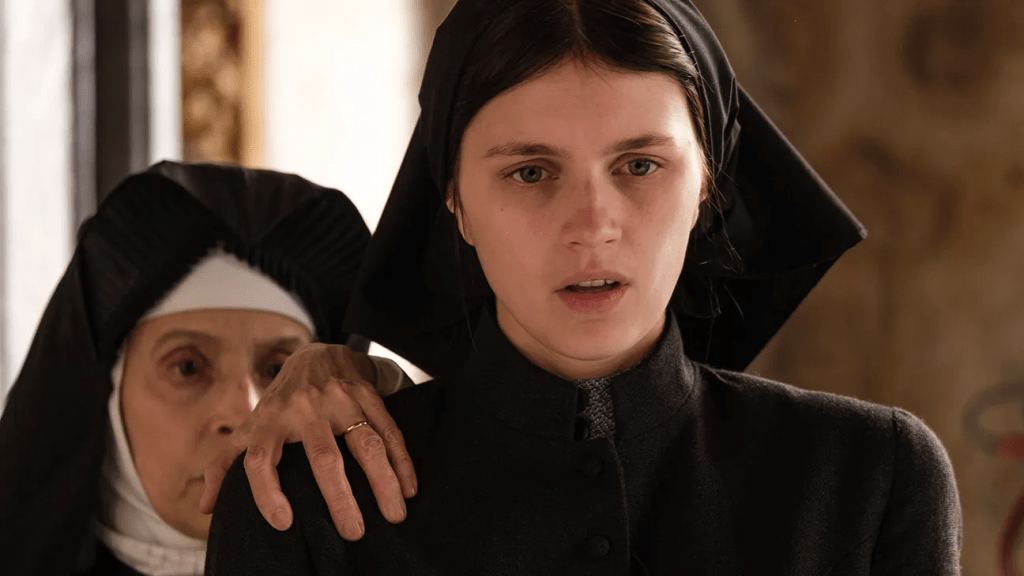
Set in Rome in 1971 amid the political protests that were going on there at the time, Margaret (Nell Tiger Free) has arrived to work in an orphanage before she takes the oath to be a nun. But it’s not all rosaries and Vespers. Luz (Maria Caballero), who is Margaret’s roommate, decide to go out to a night club dressed as the regular 20-something young women of the era.
However, the next morning, Margaret wakes up disoriented with not much memory of the night before especially after meeting a young man, Paolo (Andrea Arcangeli). Over time, Margaret bonds with Carlita (Nicole Sorace), an older child at the orphanage who has a troubled past just like Margaret. And things go worse when a disturbed nun commits suicide by self-immolation in a homage to the babysitter’s suicide in the 1976 original.
But Stevenson, who co-wrote the script with Tim Smith and Keith Thomas, based on a story idea by Ben Jacoby, aren’t looking for the same old jump scares and blood and guts one might seem to expect. There are some disturbing images that will leave you wondering what you just saw. If you thought the scene in the 1986 The Fly where Geena Davis’ character gives birth to a large maggot, there is a birth scene in this movie that makes that surpasses that in the most disturbing way.
However, the young Margaret, who witnesses this, wonders if she really saw it. That’s the feeling Stevenson is going through here. It’s Rome but back in America, there was beginning to be a fight for Women’s Lib and the Equal Rights Act. There’s a feeling throughout the movie that since Margaret is still young and she hasn’t fully committed to being a nun for the rest of her life, she isn’t fully aware.
The Roman Catholic Church, like all forms of organized religion, are based on a specific type of structure. And there can be little to no diversion to that structure. And the Catholic Church is very strong about the patriarchy, just like other religions and denominations. The priests have more authority over the nuns and Bill Nighy does his normal oddities as Cardinal Lawrence, a high-ranking priest. We’re not really sure we trust him or not.
We also don’t know the true meanings of Father Brennan (Ralph Inneson), who believes there is a conspiracy within the church to give birth to the Antichrist so it will bring people back to the Church. In April 1966, Time magazine ran one of its most popular and controversial cover stories when they asked bluntly “Is God dead?” This was shown in the 1968 Rosemary’s Baby.
In our current political climate, there is questions over who has control over a woman’s body, the woman or the government?. And the Roman Catholic Church functions itself as a pseudo-government. So, this touches a lot on the that with themes. I’ve also heard from a few woman that pregnancy and childbirth actually scare them.
The final act of the movie goes in a direction you might not be expecting but it works. I won’t give it away but you may be able to guess. I mean the title of the movie is The First Omen and it’s set five years before the original version was released. So, you can draw your own conclusions.
What do you think? Please comment.
 Zane Says