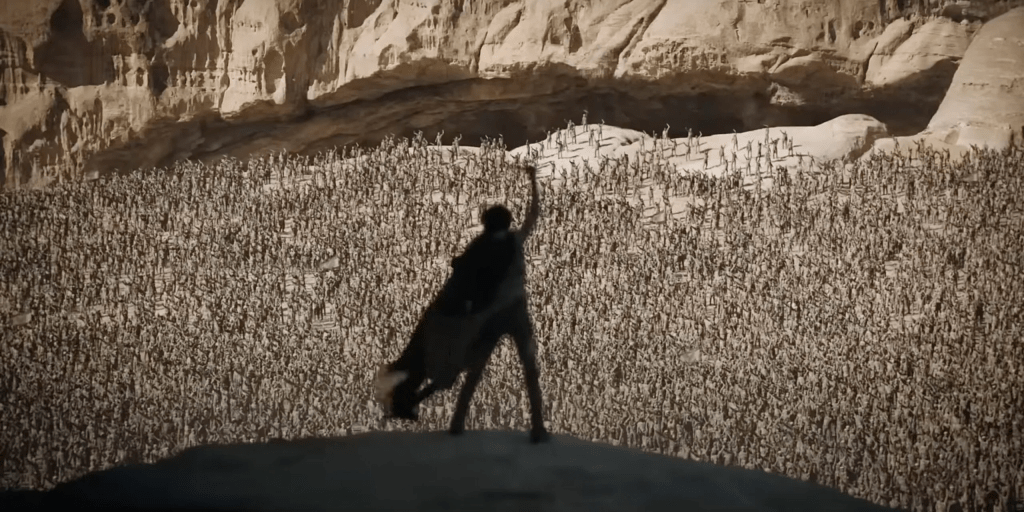
Dune: Part Two is more or less a continuation of the first part, but you feel filmmaker Denis Villeneuve had more freedom and abilities to take more chances. The two movies journey to the silver screen could be recorded as one of the best “Making of” documentaries of all time.
The first movie was originally scheduled for a late 2020 release, but Warner Bros. delayed it for almost a year because of the Covid-19 pandemic. The studio also hadn’t committed to a sequel wanting to see how the first movie went. As usual, this has happened with filmmakers unable to finish what they set out to. Ralph Bakshi ran into the same problems with his adaptation of The Lord of the Rings. The Chronicles of Narnia didn’t get too far in their adaptations. Even George Lucas was prepared to make a mediocre sequel to Star Wars, without Han Solo, if the 1977 blockbuster was a failure.
So, it had to be nerve-wracking to the filmmaker and the cast especially since the first part of Dune is mostly uneventful for half of its run time. Most of the characters are merely introduced in a few scenes as we go through the same routine that has been shown in the 1984 movie directed by David Lynch and the 2000 miniseries. Regardless, Villeneuve didn’t hold back but you can sense he wasn’t willing to go to far, knowing what the audience might expect. Zendaya seems mostly a glorified cameo as Chani.
Given the go-ahead after the success of the first movie which earned $407 million worldwide against a $165 million budget (something most studios would consider a flop nowadays), Villeneuve had to wait even longer when the strikes of the WGA and the SAG-AFTRA stretched across the summer of 2023. Originally scheduled to be released for the Christmas season of 2023, it was pushed back to March 1 of this year. Yet, it was a gamble that paid off as the movie has made over $700 million and received great acclaim.
One of the best things about the movie is that the story of the rise of Paul Arteidis (Timothee Chalamet) as he works with the Fremen of Arakis in their war against the House Harkonnen like Michael Corleone in the first Godfather. Not to give much away but there’s trouble brewing. And even though his romance with Chani is there from almost the beginning of the story, there is a change from Frank Herbert’s novel.
Paul and his mother, Lady Jessica (Rebecca Ferguson), learn how to live among the Fremen tribe led by Stilgar (Javier Bardem) even though some of their customs are odd. The Fremens have ways of sucking the body water out of corpses to be placed in a well in a cave to alter the climate of the desert planet. It’s still hard to watch Dune without the images of the the 1984 movie and miniseries clouding your judgment, but Villeneuve does one fine job making this his own vision.
I actually liked what he did with the Bene Gesserit women. Lynch made them too creepy. Yet here, there is still a haunting presence around them but they don’t look as bizarre as they did 40 years ago. Another thing Villeneuve does that Lynch couldn’t pull off was just to show the intense heat of Arakis by showing characters walking through the barren desert and just feeling how insanely hot it has to be. There was a sepia look in Lynch’s movie that made it look dirty. Here, it looks unbearable to live in. And this makes the value of water far more important as Stilgar wipes a tear off of Jessica and licks it.
Villeneuve is better at making Paul the conflicted character Herbert intended rather than boy wonder hero in previous adaptations. I’d say it’s kismet that Zendaya is in the role as Chani as she is portrayed as a more rounded character rather than just the obligatory love interest. Since Zendaya has a mother of Scottish and German ancestry, her skin color plays a factor as Paul seems to intentionally fall into the “White Savior” trope. And Chani becomes more and more skeptical of Paul as being the Kwisatz Haderach. Still, Zendaya’s constant scowling almost turns her into the “Angry Black Woman” stereotype.
With so many new characters introduced, it still feels like Villeneuve needed to make the movie longer. Reportedly, Tim Blake Nelson’s role was cut and the director has no desire to release a director’s cut. Austin Butler does what he can as Feyd, nephew of the Baron (Stellan Skarsgard), who at least has a more meaningful role in this version. But Feyd is a very underwritten character, just the obligatory tough guy villain. However, Christopher Walken as the Emperor Shaddam IV and Florence Pugh as his daughter, Princes Irulan, feel like most of their scenes were left on the cutting room floor.
Still, it’s quite possibly the best adaptation of Herbert’s novel so far. And the first one to fully understand Herbert’s intention, which was to show the dangers of religious and political figures as Stilgar seems to lead the Fremen in a worship of Paul. In previous adaptations, he functions more as Paul’s sidekick without the full power of the Fremen to make them see Paul as someone bigger than he is. Also, the knife battle with Feyd doesn’t turn into some deus ex machina climax yet it sets up something more.
Herbert wrote and published Dune Messiah in 1969 because he said fans of his first novel misunderstood his intentions. With the success of Dune: Part Two, Warner Bros. has given Villeneuve the go-ahead to do a third Dune movie based on this book. The ending does set up a sequel so if people were expecting an ending, they’ll have to wait until the next movie. I actually like how it’s handled.
The spice will continue to flow.
What do you think? Please comment.
 Zane Says