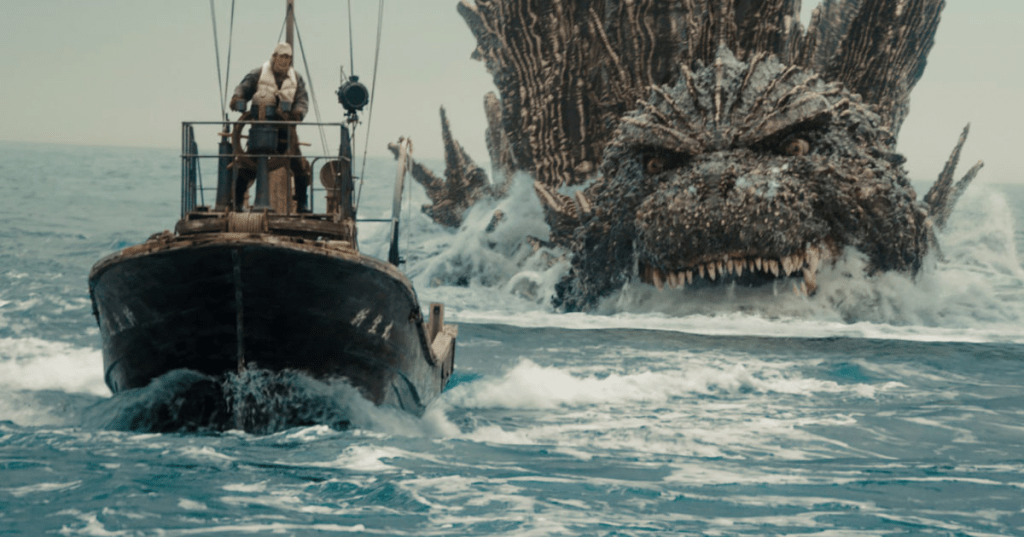
Godzilla Minus One has more action, excitement and thrills in its first 15-20 minutes than the last 15-20 movies released by Hollywood. With a budget only around $10-12 million, it’s a far better visual movie that The Expendables 4 which costs about 10 times as much and looks about 10 times worse. Ok, so maybe they’re have been disputes about actor labor wages but most big names get eight figures to stay in Hollywood movies like this that aren’t near as good. It’s obvious the big star is the title character.
Actors’ wages and salaries aside, filmmaker Takashi Yamazaki has made probably one of the best Godzilla movies ever. There have been about three dozens of them since 1954 with Gojira. Most of them were re-edited and poorly redubbed to appeal to American audiences and children. Some movies have been parodied on Mystery Science Theater 3000 with Godzilla sliding on his tail to knock a monster out.
Over the years, people have tried to reinvent the franchise with more serious darker tones. The Return of Godzilla became Godzilla 1985 to North American audiences and was bad. There was the disaster which was the Hollywood 1998 Godzilla, then the 2014 mediocre version that we didn’t know was going to launch a shared universe franchise with better movies. But Yamazaki has decided to go back to the beginning. Many of the movies have been retconned and rebooted even before it was famous among Hollywood producers.
The plot begins in the final days of World War II as Japan is still fighting the Allies in the Pacific Theater. a young kamikaze pilot Koichi Shikishima (Ryunosuke Kamiki) lands his Zero airplane on a small island saying there is mechanical issues. However, Sosaku Tachibana (Munataka Aoki) realizes after a thorough inspection, there is nothing wrong with the plane and Shikishima fled. As night falls, the island is attacked by Godzilla. Tachibana tells Shikishima to get into the plane and use the 20mm guns to fire on the creature.
However, Shikishima freezes up and can’t shoot. Scared, the other mechanics start firing their rifles at Godzilla who begins to focus on them killing all but Shikishima and Tachibana, who blasts the pilot for failure to fire on Godzilla. Shikishima returns to Tokyo only to discover his home destroyed and his parents dead. Struggling with guilt and post-traumatic stress, Shikishima tries to restart his life. He comes in contact with a young woman, Noriko Oishi (Minami Hamabe), whose parents are dead and has a baby, Akiko, who was orphaned herself with her.
As time passes, they settle into a homelife. Then, in 1946, Shikishima gets a job working on a minesweeper boat with three others tasking with disposing of naval mines. Work seems to go smoothly as they snag the mines pull them to the surface and then fire on them with a machine gun exploding them. However, one day, Shikishima notices dead fish float to the surface nearby which was the same thing that happened when Godzilla attacked the island.
The creature comes to the surface and terrorizes the small ship and sinks a heavy cruiser that was nearby. It’s revealed that Godzilla has been mutated by the nuclear testing at Bikini Atoll. It’s been given the ability to rejuvenate itself and is hard to destroy. And Godzilla is heading toward the Japanese mainland particularly the Ginza area of Tokyo where Shikishima is recovering from the last encounter with Godzilla and Oishi is heading to a job interview.
Still, watching these scenes, it’s thrilling to see how Yamazaki and the cast and crew make a movie that can take the Pepsi Challenge with anything that comes out of Hollywood. At the heart of the story is the human story of Shikishima as he struggles with problems. As Japan is a nation where honor and loyalty are huge virtues, Shikishima is struggling with his own demons during an era and in a culture where no one really talked about it.
Also, he’s having to deal with his relationship with Oishi and Akiko (Sae Nagatani) who has started calling him “Daddy.” Initially, Shikishima just let them stay there as they needed a place. As he’s made more money and gotten his house rebuilt. It gives the story more than people just running from Godzilla and screaming. It also is a change of pace to see WWII vets on the other side dealing with their own problems. In Clint Eastwood’s Letters from Iwo Jima and Terrance Malick’s The Thin Red Line, the filmmakers made us sympathize with people were branded our enemies. But they were just young men like those from America who were forced into fighting each other.
Add to that as a kamikaze pilot, Shikishima was supposed to put his country before his own life. For many Japanese military, to die in battle even if it was suicide was considered honorable. Of course, this leads to a moment in the climax where Shikishima is tasked with risking his life to destroy Godzilla. But I love how Yamazaki stages all of this to happen that in the end, you feel like you’re seeing something that you haven’t seen before even though you have.
As for the title creature itself, it’s more of a villain. And while the 1954 original seemed to have an anti-nuclear war stance, Yamazaki can’t avoid the subject either. Originally, the creature like a lot of monster movies during this era were seen as a warning sign of what would happen if we continue playing God and destroying the planet. There are a lot of scenes in the second half where there’s scenes of government officials talking too much. At just over two hours, Tamazai could’ve cut some scenes a little shorter by 10-15 minutes.
However, when the climax begins to start you can forgive him. And the ending does leave the possibility of a sequel but no one has been mentioned at this time. It would be hard to do something as better as this. Kamiki and Hamabe give good performances especially for a movie like this. You really cared for their characters and what happens.
Godzilla Minus One won the Oscar for Best Visual Effects, the only Oscar for which it was nominated, as well as other awards all over the world. It’s been a huge blockbuster grossing over $115 million worldwide. It’s also received praise from other filmmakers include Steven Spielberg, who Yamazaki was influenced by, Kevin Smith, John Landis, Jason Blum and Christopher Nolan. It’s proof that you can do more with less.
What do you think? Please comment.
 Zane Says