There is one scene in the TV series Lessons in Chemistry that’s directed and acted in such a way, it’s so wonderful. Elizabeth Zott (Brie Larson) bursts into the office of TV producer Walter Pine (Kevin Sussman), and begins to chide him for not providing an adequate school lunch for his daughter and suspecting that she’s stealing her daughter’s lunch. The way Larson delivers it like a librarian chiding someone for being too loud. She hands the man some soup she’s prepared so he can make his daughter it and double thinks about giving him a sweet before she does so anyway. Then, she leaves as brisky as she walked in as he looks perplexed and just decides to taste it.
Elizabeth is the main character of the show based on the best-selling book by Bonnie Garmus. She’s an unconventional woman for a very unconventional time where women like Elizabeth wouldn’t have dared do what she did. Maybe it’s because Walter, himself, is struggling with his own identity that in this era (in the early to mid-1960s), men didn’t show weakness, that he is amazed by her. And women like Elizabeth knew their place.
Larson seems to be the perfect actress to play Elizabeth. The Oscar-winning actress has become outspoken for her viewpoints on women’s rights and advocacy. It’s almost like she was tailor-made for this role, even though I’m sure Garmus didn’t think of Larson when she was writing the book. I just think Garmus based her on other women she knew. There’s probably a lot of Eizabeth Zotts out there who anger those around them, both men and women. Having seen the series and read the book, there is very few adaptations that work almost as good as the book.
Therefore, this will be an examination and review of both media for this post. Much of the novel and series are set in the 1950s and 1960s with flashbacks to the 1930s and 1940s. Elizabeth is a bold woman who is not afraid to admit she doesn’t believe in God. I would argue that her intelligence as she is interested in chemistry is part of her personality. She’s the type of person who you could tell a joke to and they wouldn’t get it. That doesn’t mean that she’s a bad person, but she would watch a science-fiction show or movie with a disdain for how illogical it would be. I’d equate her to a real-life Vulcan in how she can’t comprehend what other people such as Walter can.
Eventually, Elizabeth becomes the host of an afternoon cooking show that dares to shatter the status quo. Walter wants Elizabeth to adhere to the Betty Homemaker style of June Cleaver. However, Elizabeth can’t do that. She at first refuses to do a TV show mainly because doesn’t think highly of TV in general. Elizabeth only takes the job because she desperately needs the money. During this era, most women were only expected to be lab techs and not real scientist and doctors.
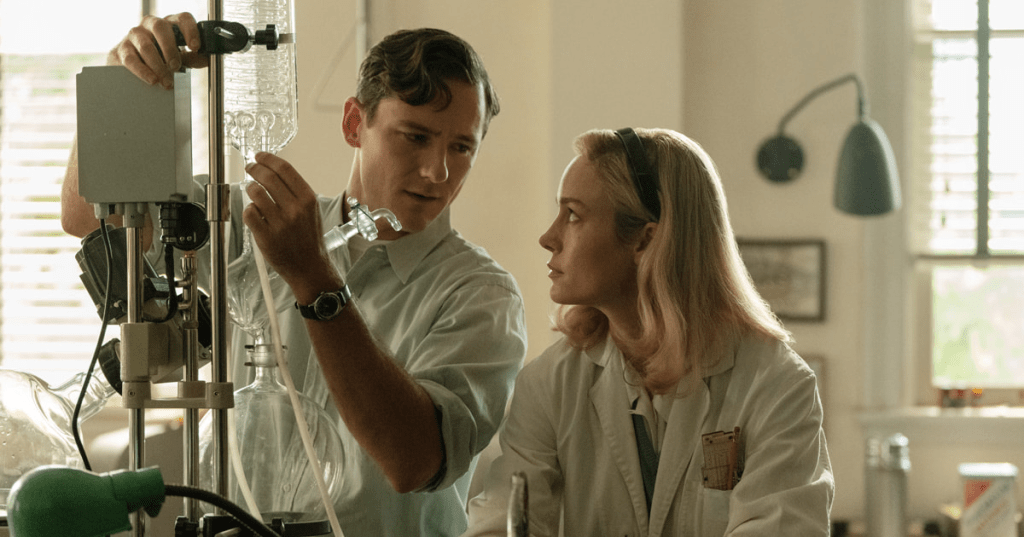
The following will contains spoilers. While studying for her Ph.D. in chemistry, Elizabeth is sexually assaulted by a professor. She stabbed him with a pencil to defend herself but didn’t get much help from the college nor the police. She had to take a job at a research facility in southern California where she would meet the brilliant Dr. Calvin Evans (played wonderfully well by Lewis Pullman.) Calvin is the equal that would only be attracted to Elizabeth because both could find some common interest despite some differences. Like Elizabeth, Calvin is not a social person and often hostile to those who interfere with his work. The series has him actually showering in his lab.
Unfortunately, Calvin is killed in a traffic accident leaving Elizabeth pregnant, even though she didn’t want to be. Elizabeth is a person who didn’t want to get married nor did she want to have kids. Her parents were religious charlatans who scammed people out of their money. Their beliefs and actions led her brother, who was a closeted homosexual, to commit suicide. In the book, he hangs himself. In the series, he shoots himself.
Because she is pregnant and working in a male-dominated industry, she is terminated from her job but manages to get by when her former colleagues pay for help. Derek Cecil is perfectly cast as Dr. Robert Donati, the head of Hastings, the research facility. Even though the series toned him down, he’s more despicable in the novel. And that’s the difference that’s lost in the adaptation. Some would argue both media take a biased approached toward men. However, the series, developed by Lee Eisenberg, manages to tone it down a bit.
One of the changes is making Phil Lebensmal (Rainn Wilson) the TV station owner/manager more buffoonish. He’s more of a creep in the novel and at one point tries to make Elizabeth perform a sexual act on him to keep her job. And Elizabeth seems to enjoy doing the show more in the novel whereas the show, she views it more as a means to an end. The novel has a focus more on rowing which both Charles and Elizabeth were interested in. Because Pullman manages to show off the same aw-shucks likeability that his father, Bill, has brought to roles, flashbacks and even hallucinations help give him more screen time.
A major difference that works in the series is changing Elizabeth and Charles’ neighbor, Harriet Sloane, to a younger age close to Elizabeth’s. She’s in her 50s in the novel. Also, Harriet is black in the series as she’s white in the novel. Played by Aja Naomi King, it’s a nice change. I feel this was done to give the series a more realistic feel of southern California in the post-WWII era where more black people were relocating. Harriet’s husband, Charles (Paul James), is different as a medical surgeon returning from military service. In the novel, he’s mostly a one-dimensional sleazy abusive creep.
This is Garmus’ first novel after a career of being mostly a copywriter. So, even though it does have some originality, she seems to fall down the same pratfalls a lot of first-time published writers do. I mean, go back and read Carrie by Stephen King and it doesn’t read the same as his other novels. There’s some nice style to both the novel and series as it’s also told from the point-of-view of their family dog, Six-Thirty.
What both the novel and series touch on is how even though it seems things have changed in the last 60-70 years, they really haven’t. Women and especially black people are still treated poorly. There’s a subplot of Harriet and others in the community opposing the construction of a freeway near their neighborhood that was totally new to the series. Fran Frask (Stephanie Koenig), who is the personnel manager at Hastings, isn’t as bad in the series as she is in the novel. In both media, eventually she turns around to support Elizabeth and become more friendly.
But this is Larson’s series and if she doesn’t get an Emmy for her role, there is no justice. There’s almost something timeless about Larson where she can play a woman from the 1950s-1960s and our current period. It’s hard to read Garmus’ book and not picture her. Also, Larson manages to convey that unspoken idea that Elizabeth might actually have ADHD or some form of neurodivergence. Scenes of her interacting with Alice Halsey who plays her daughter, Madeline, or just Mad, are the serie’s highlights. The novel hints more that Mad might be more highly intelligent just like her parents.
I think the purpose of the novel and the series is to show how many young women saw their talents and skills destroyed by a society that demanded they be subservient to their husbands and fathers. And in the end, they had to walk on eggshells at their place of employments and even in their own homes. We still face this to this day as conservatives and Christians battle what they see as “wokeness.” And how it’s been a week since Sen. Katie Britt (R-Alabama) basically was criticized by members of her own party for her rebuttal to the State of the Union Address, it shows how damaging this ideology still is.
Seth Rogen has been criticized himself for saying he and his wife, Lauren Miller, don’t want to have children. Elizabeth, Frank, Harriet and even Mad were from an era in which their options were to be teachers, secretaries or some menial service job that wouldn’t take the paychecks away from “men who have families.” Elizabeth becomes popular on a cooking show that was supposed to be basic. But she managed to change it up. One of my writing professors, Peter Christopher, said it’s best to play by the rules first. Then, break them.
Elizabeth didn’t want to break the rules. She just wanted to have the rules to also be favorable to her and other women the way they are to men. That’s what a lot of people don’t understand. And as long as women like Fran Frask continue to work against other women, then that’s not going to happen. Yet neither the series nor the novel really put the blame on women tearing other women down. And despite what some men might thing, it doesn’t have a bias.
Mad finds a friendship with a local pastor, Curtis Wakely (Patrick Walker). In the series, he’s black and friends with the Sloanes. In the novel, it’s not specified. Yet neither media really have a criticism toward organized religion. I think Garmus and the producers on the series want to show what happens when people listen to others tell them what to do and how to act, rather than forging their own paths and ideas despite the criticism.
What do you think? Please comment.
 Zane Says