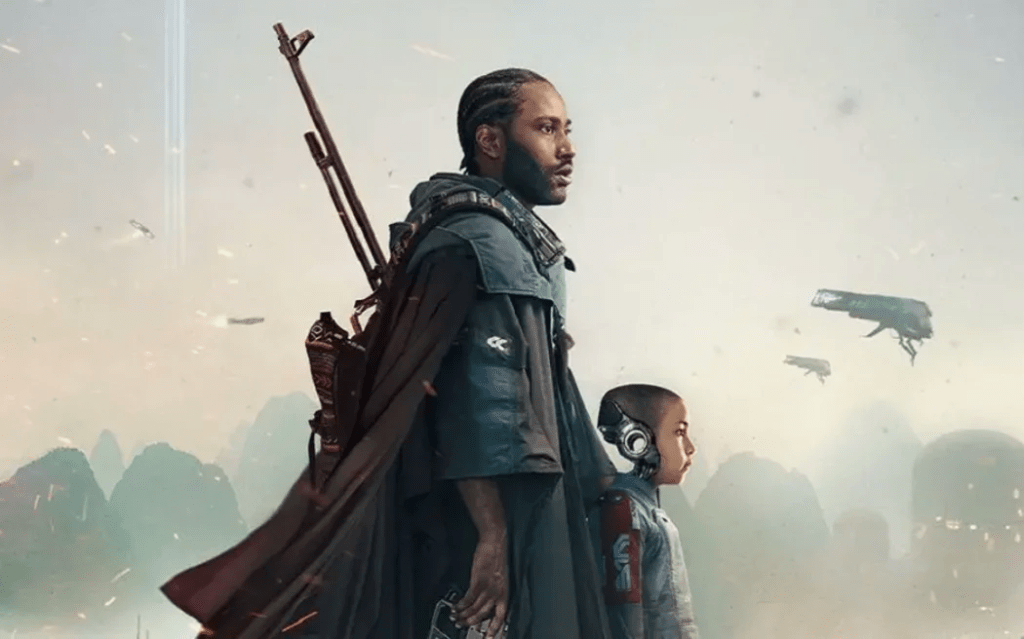
There’s been a lot of talk of artificial intelligence in the last few years with deep fakes and even pictures that look like they’re the real deal. There are numerous pictures online of supposed people who have never existed but they look like they’re flesh and bone. A movie like The Creator is one of those movies where you can tell it’s attempting to be more than its by-the-numbers format with an angle it thinks is different but really isn’t.
The Creator is directed by Gareth Edwards on a script he co-wrote with Chris Weitz, so it should be a lot better than what it does. Instead, it’s another dystopia warning set in the decades ahead about the dangers of AI. It starts off great with sequence of those old black-and-white short movies about the “world of tomorrow” with robotic machines that slowly turn into AI where machines are in sports and eventually law enforcement, which has the machines working riots and then there’s a nuclear explosion in Los Angeles.
The opening is so creative and wonderful I wish the filmmakers had focused on this. Where do you draw the line if AI can run track and field but gets out of control harming humans? Other filmmakers did this with Westworld and I, Robot where AI androids and robots are not supposed to harm humans but they do, either unintentionally or through a glitch. The nuclear explosion happens in 2055 and in a knee-jerk reaction, the western nations wage war against AI but find themselves at odds with New Asia, where it still is in use by 2070.
And almost immediately from this point on, the movie becomes a retread of the same tropes and plots that you’ve probably seen in better movies like first two Terminator movies and Blade Runner. It bounces around so quick so fast that I began to scratch my head. Why would the Ground Zero area of L.A. need to be cleaned up 15 years later? Wouldn’t they just abandoned the area like they did parts of Chernobyl? it doesn’t matter because it’s quickly done away with.
The problem with this movie is like Edwards’ highly overrated Rogue One: A Star Wars Story, there’s so much bouncing around from one area to another over one time frame to another, that when the plot really gets going, you really have stopped caring. Sgt. Joshua Taylor (John David Washington) was married to his wife, Maya Fey (Gemma Chan), who’s pregnant with their child, but she’s believed to have been killed in an explosion. Maya was believed to be the daughter of Nirmata, the “creator” in the title and Joshua was working undercover before a mission went wrong, as they also do.
Joshua is approached by military officials to destroy a new weapon engineered by Nirmata called “Alpha-O” which is actually an AI child (Madeleine Yuna Voyles). So, you know where this is going. Sci-fi stories like this lately have been making the rounds with people are trying to protect young children. In this case, Alpha-O, also called “Alphie” is a simulant who appears to be able to age. Simulants are what are considered AI with likeness of real people. This is another thing the movie really never does touch on. Would grieving people want to have a likeness of their loved ones who have passed?
The movie is very confusing but it doesn’t matter because soon all the bang-bang pow-pow happens as Col. Howell (Allison Janney) and other military wage war against the simulants in New Asia. Gunshots are fired. Explosions happen and ships and vehicles crash and burn. There could have been a good story here about the dangers of AI and who is the real villains – humans or simulants. Movies like Finch showed that AI can learn human emotions. And the Blade Runner movies have done the same showing AI that didn’t know it was AI.
But it feels like Edwards had a bolder less louder story he wanted to tell, before 20th Century Studios’ corporate daddy Disney took a cue from George Lucas’ playbook and said “Faster and more intense.”
What do you think? Please comment.
 Zane Says
It sounds like the beginning of the movie was a godsend that got neglected — that also wasn’t a true setup for the movie, as there was no linear connection between what came before and what comes after. A movie like Pulp Fiction shows how to do non-linear filmmaking well. As the Tarantino pic opens, we see two hired killers parking their car and getting their stuff out of the trunk. All the time they are talking. With the blue skies of L.A. and the unbusy streets behind them, the scene is camera-perfect for the dialogue. This is the kind of filmmaking we need more of.
Come visit my blog, and leave some comments, if you like
http://www.catxman.wordpress.com
LikeLike