Most TV shows revolving around Christmas had to have some time of goody-goody golly-jolly theme to them. Even The Twilight Zone and Amazing Stories had holiday-themed episodes but they still tried to tell a story with a moral to them. And by the time the 1980s rolled around, most Christmas-themed shows were hokey with stories about helping others.
There was that Growing Pains episode where they let a homeless teenager stay and she steals the gifts but returns them before calling her mother, implying that she’s going home to her own family. Then there was that narcissitic show during the first season of The Cosby Show where Cliff Huxtable displays his Father’s Day gifts. We should’ve known 40 years ago Bill Cosby was a horrible person but it was the 1980s and people were trying to tell themselves they weren’t racist by liking a show about a black family living in a Brownstone in Brooklyn.
Probably the closest thing the networks were allowed to get risque about was when Sam Malone (Ted Danson) thought getting his boss, Rebecca (Kirstie Alley), a gift on Christmas might result in getting to stuff her stocking. But on Dec. 17, 1989, Fox viewers tuned into some holiday-themed viewing and saw something they probably never saw nor were prepared for.
It was the first episode of The Simpsons titled “Simpsons Roasting on an Open Fire.” The animation was crude but the Simpsons had been popular for some time, thanks to those Butterfinger commercials and shorts on The Tracy Ullman Show. Roseanne had been on the show for about a year and a half, but The Simpsons portrayed a different family. The episode has Homer (voiced by Dan Castellaneta) not receiving his Christmas bonus and Marge (voiced by Julie Kavner) having to spend the money she had saved to get a tattoo removed off Bart’s arm.
Homer can’t tell Marge that he didn’t get his bonus to help buy the kids and her gifts but when he sees his friend, Barney Gumble (also voiced by Castellaneta) dressed up as a Santa Claus, he enrolls in a department Santa training program to work at a mall. But things go from bad to worse, when Homer discovers he’s only get $13 back after all the deductions. But Barney tells him to bet it on a sure thing at the dog racing track. With encouragment by Bart (voiced by Nancy Cartwright), he goes along.
Unfortunately, Homer thinks the late entry of Santa’s Little Helper is a sign and bets everything on the dog. But it comes in last and as they’re walking through the parking lot seeing if anyone has dropped a winning ticket, they see the dog coming toward them as its owners dumps it. The dog jumps into Homer’s arms and they take him home where the family is excited that they’ve brought a dog home despite Homer not getting his bonus.
While the show might have seemed wholesome, it had the brand of humor that would becoming common with the series. While dressed as Santa, Homer bumps his head and screams “Damn it!” in front of children and their stunned parents. When Milhouse bets Bart won’t pull the beard off of Santa, Bart gets in line and when Homer asks what his name is, Bart responds, “I’m Bart Simpson, who the hell are you?” And there’s something very hilarious about how Bart says “You must really love us to sink this low” upon hearing Homer is a department store Santa.
The show might have been a cartoon, but it wasn’t a cartoon for all children. Of course, conservatives, Christians and parental groups would begin a massive pushback over the first few seasons which would die off as the writers began to make more crisper and satirical episodes. The Simpsons, like Rick & Morty, would find themselves on many “Best of” lists at the end of each year.
But if certain groups didn’t like The Simpsons, they downright hated Married…With Children. It was the initial criticism that helped encourage viewership for the struggling network which had just started in 1987. The Bundys weren’t like other families on TV. Even the Conners still had some level of decency with their blue-collar lives. No the Bundys were the perfect representation of the selfishness of American society in the latter quarter of the 20th Century.
Politicians and religious groups were speaking about traditional family values. But most people saw themselves better represented in the Bundys, Conners and Simpsons. The Bundys didn’t have a tree, probably because it was either too expensive or they didn’t want to hassle with putting one up. Al (Ed O’Neill) is a shoe store salesman/manager at a department mall where he has to deal with snotty customers. His wife, Peggy (Katey Segal) ia a self-indulging lazy stay at home spouse.
Their children are even worse than them. Kelly (Christina Applegate) is a ditzy, low-intelligent promiscuous teenager. Bud (David Faustino) who is often as arrogrant and cocky as his parents and more obsessed with sex and schemes. They may not have been the Waltons but people could point to them and see people they knew. And despite their attitudes toward each other, they always stepped in when someone tried to mess with their family.
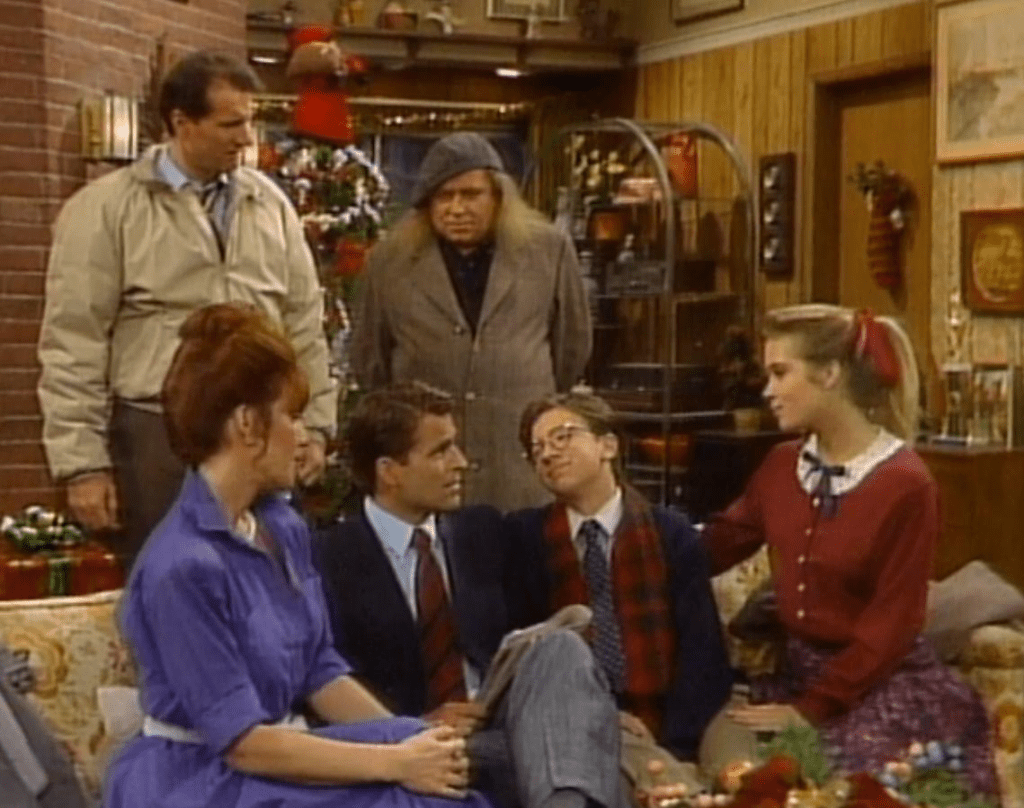
On the same night as the first Simpsons, “It’s a Bundyful Life” aired. It was a two-parter. Al has been saving money in a Christmas club account and managed to accumulate $280 which is surprisingly about $700 in today’s market so no wonder the family is happy when Al tells them. Of course, naturally, they all get selfish arguing that Al should spend more on one than the others.
However, the next day at work, which is Christmas Eve, Al is held up at the store by elderly customers as he tries to make it to the bank. But he arrives five minutes before they are set to close at 3 p.m., but discovers the office party has already started and they’re not letting him in. His neighbor, Marcy Rhoades (Amanda Bearse), has already gotten drunk and won’t let him in either. She’s upset that her husband, Steve (David Garrison), has abandoned her to spend the holiday with his mother without him.
Al is also accosted by department store Santas after a scuffle with one earlier that week. But he devises a plan to babysit children of shopping parents. Yet it resorts to tying them up and telling them his own version of “A Visit from St. Nicholas.” However, the parents are upset with how he treated their children and get their money back. Al goes home only to discover his family is mad that they’re going to have to wait until the day after Christmas.
Peg says she has some money for three to attend Denny’s so they leave Al at home. The comment about eating Christmas dinner at Denny’s is hilarious. I’m sure a lot of people have spent the holidays at restaurants. The Norman Rockwell myth of everyone gathering around a nice round table with a turkey or ham is just that – a myth for many. I’ve had take-out pizza, sandwiches and lunchmeat and even eaten at a Waffle House on Christmas Day.
Frustrated, Al goes out to work on the Christmas lights but gets shocked and passes out. He is woken up by his guardian angel (Sam Kinison) who is horrified to realize this is the person he has to look over. Kinison had originally been considered for the role of Al when the series was being developed. Initially thinking he’s a quack, Al believes the angel when he gets a glimpse of what his life would’ve been like if he wasn’t with his family.
It turns out that Peggy is actually a devoted housewife who cooks and cleans. Kelly is a successful college student. And Bud is a considerate gentleman as he was late to stop some other boys from harassing a young woman. When the man of the house, Norman Jablonsky (Ted McGinley), comes home, Al is horrified to see how everyone treats him, which is much better than they’ve treated him. (McGinley would later go on to play Marcy’s second husband, Jefferson D’Arcy as Garrison left after season four.)
This is obviously a satirical spin on It’s Wonderful Life and there’s something funny about how the angel says Al would’ve been the same but those around him would’ve been better off. In the end, Al decides to go back to wanting to be alive and with his family which means the angel will get his wings. What’s funny is how Kinison makes comments about God and Jesus, considering he had been a Pentecostal preacher from his late teens until the mid-20s.
The episode is written by show creators Michael G. Moye and Ron Leavitt whose goal was to create a show were every episode didn’t end with a big hug. They had previously had a show on NBC in the mid-1980s called It’s Your Move in which Jason Bateman played a scheming teenager. Garrison played a neighbor who was often a pawn or unwilling participant in the schemes. Bateman would say the show was canceled because people began to emulate his character and parental groups didn’t like that.
Bart Simpson would also become criticized by parental groups as an “underachiever” but those quickly died down once the elder Bush got out of the office. Both The Simpsons and Married…With Children would become very popular as the face of sitcoms in the 1990s would change. You can see the precursor of Seinfeld in Married. I think most people share a little bit of selfishness like the Bundys did that was also exposed in greater lengths on Seinfeld.
The Walking Dead franchise is built around completely narcissistic selfish arrogant people. I have seen Succession but I understand it’s the same mentality. Not every show had to have a moral or lesson to it. Just like how police procedurals show that not everything can be settled within an hour, life isn’t always easy even if you’re living in the Chicago suburbs as the Bundys were or wherever Springfield is for The Simpsons.
What do you think? Please comment.
 Zane Says