Going into The Caine Mutiny Court-Martial, it’s important to know three things. One – this is an adaptation of a play. Two – the play is an adaptation of a movie and a novel. And three – the movie The Caine Mutiny is considered a classic and one of Humphrey Bogart’s finest performances. It would be difficult for a director, even William Friedkin, to try to top legendary filmmaker Stanley Kramer. But Friedkin, who was part of the New Hollywood movement, was a well-revered filmmaker himself.
Friedkin passed away on Aug. 7 at the age of 87. His earlier movies such as The French Connection, The Exorcist and Sorcerer are viewed as ground-breaking movies in 1970s cinema for acting, scene set-ups and direction that inspired directors who have emerged in the last 50 years. The car chase scene in Connection is one of the most thrilling because it looks so real and the scene of the truck driving around a rickety bridge that can collapse at any moment in Sorcerer is such a thrill. And Exorcist remains one of the most terrifying movies ever.
But Friedkin was no stranger to making play adaptations. He had made The Boys in the Band in 1970, a movie that might seem dated but is a positive look at gay men struggling with a society that hates them. And then there was the 1997 adaptation of 12 Angry Men which won rave reviews. In the recent decades, Friedkin adapted two of Tracey Letts’ plays, Bug in 2006 which helped showcase the talents of Michael Shannon back when he was known more as a character actor and the tense Killer Joe which had Matthew McConaughey brilliantly cast as a corrupt cop who makes Gina Gershon perform fellatio on a fried chicken leg. Friedkin was about pushing the limits.
But a good director knows when to push and when to hold back. And that’s the beauty of Caine Mutiny. About 90 percent of it is set within the courtroom giving off a claustrophia feel. The other part include two short scenes in the hallway outside and one elsewhere. But the interior of all scenes makes it seem more unsettling. Considering this is about a Navy court-martial, you can laugh a little that everything is set on the land inside behind closed doors. But then again, the interior of the ships and submarines probably feel claustrophobic themselves.
Also, everything is presented through dialogue and the actions of the cast as they deliver it. With Michael Grady as director of photographer, Friedkin is able to use position the camera to give every actor’s performance a little extra. I’ve often heard film critics and filmmakers alike say it’s harder to film a scene indoors. Brian DePalma said directors only show you what they want to show you. And sometimes that can be more difficult if you have to just focus on an actor’s face or their body language to tell a story.
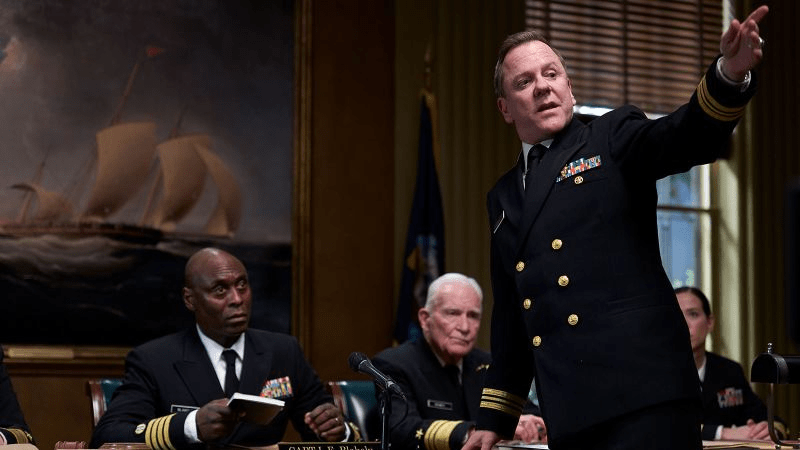
Lt. Commander Quegg (Kiefer Sutherland) is filmed so close up that he seems to appear so much in every frame he’s in. While the petty officer Urban (Gabe Kessler) is filmed so that others are seen in the frame and we’re able to see how the young Navy sailor is so fidgety as he sits during a cross-examination. Queeg remains mostly stoic and immobile during a cross-examination for the prosecution.
It says more about the contrast between the younger and the older people in the military. This is probably the first time Urban has ever appeared in any courtroom and he has a naive nervousness as he can’t fully understand the questions from the prosecutor, Lt. Commander Challee (Monica Raymund), the defense attorney, Lt. Greenwald (Jason Clarke), nor Capt. Blakely (Lance Reddick), head judge. While Queeg goes by every question with a sense that this isn’t the first time he’s been in a court-martial and as a naval officer, he should be allowed some leniency.
The casting of Sutherland is wonderful. I’ve heard Friedkin wanted him and wouldn’t relent. Sutherland also appeared in A Few Good Men, a movie that owes a lot to The Caine Mutinty so it works as a nice companion. Sutherland who has been acting since 1983 saw his status dwindle by the end of the 1990s as he was mostly doing smaller roles in less-stellar movies before switching to TV in 24 and Designated Survivor. While his father, Donald, has had a steady film career since the 1960s, Sutherland’s has been rocky. And his grandfather, Tommy Douglass, former Premier of Saskatchewan is known in Canada for making the Universal Health System available to all.
Sutherland has some big shoes to fill. And I got the sense that Queeg himself is part of a military family. But he’s only a lieutenant commander, which is about the same rank as a major in the Army, Marines or Air Force. I’d guess he’s also someone who joined pre-9/11 as an enlisted man but didn’t become an officer until much later. Yet, he was put in command of the U.S.S. Caine, a duty he took very seriously. He refers to himself as “captain” of the Caine several times, but it’s the same as referring to a college professor as a doctor. He’s not an official captain but thinks he should be. In reality, the Navy does assign commanders to ships, it’s possible the Caine is a smaller ship than what one might think.
The movie revolves around whether Lt. Maryk (Jake Lacy) who served as the Caine’s First Officer was justified in trying to releave Queeg from his duties as they were trying to avoid a cyclone in the Strait of Hormutz. Queeg felt they should turn the ship one way while Maryk felt they should do it another way. Most of Maryk’s actions are told by people on the witness stand. He remains mostly seated quiet as Challee, Greenwald and Blakely discuss with the crew what actually happened or what they saw happen. Lacy is a good choice for this role. He’s one of those actors who can play a good guy or bad guy depending on what the role calls. But is Maryk the bad guy or is he just inexperienced?
Lacy is about 18 years younger than Sutherland and Lewis Pullman, who plays Lt. Keefer, is only 30, young enough to be Sutherland’s son. You can sense the generational divide as Keefer, who is more an educated man and recently got a $10,000 advance on the publication of a book, is a firm ally of Maryk’s. In the TV miniseries Band of Brothers, Damian Lewis played a real-life military officer who rose higher in the ranks than the man he initially served under played by David Schwimmer. He got on to him for not saluting saying, “We salute the rank, not the man.” You feel that Queeg is upset these younger men, who are only one rank away from being his equal, aren’t being as subordinate. Queeg has been nicknamed “Old Yellowstain” for his attitude on the ship, such as being questioned about certain the way he handled a Navy sailor whose shirt tail wasn’t tucked in.
Pullman, himself, is the son of actor Bill Pullman, who has recently appeared in the blockbuster Top Gun: Maverick and the series Catch-22 where he played Major Major. Just as Sutherland, you wonder how big his career is going to go before it could possible stall and he has to do less than stellar movies. Casting is the majority of direction, many filmmakers have said and this works perfectly.
Reddick gives a wonderful performance as the stern but impartial judge. Reddick was one of those actors who could do more with one look at another character than a whole page of dialogue could do. Even though it’s not mentioned, you can tell he himself is being judged as a black man presiding over a potentially damaging trial. The same can be said for Raymund as Challee, who is Queeg’s equal. She’s also younger and a woman and a Latinx. As she questions people who support Maryk or question Queeg’s behavior, she walks a thin line between doing what’s best for the country, the Navy and the people on the Caine.
Clarke has a more difficult job because Greenwald quite possibly feels that Maryk was in the wrong. Most of the people wouldn’t know how to deal with a situation unless they were faced with it. And since there are no flashbacks, we have to question what each character says based on how they say it. That’s the work of a good director. When is too much too much and when is too little too little?
The Caine Mutiny Court-Martial has received rave reviews from critics but audiences seem divided. Yes, it’s about 100 minute of people just talking but what do you think trials are? The ending I think is a little ambiguous as who was right and who was wrong. Sutherland gives one of the best performances of his career and I think only an actor who’s had the career he has could pull it off so perfectly. Friedkin said this movie has been a pet project of his for years and it seems fitting this is his last movie.
While Quentin Tarantino is making a big hullabaloo about ending his career on a high note with his 10th movie, Friedkin has done just that in his death.
What do you think? Please comment.
 Zane Says