Judy Blume has shunned Hollywood for decades and for good reason. There’s a lot of things lost in adaptations. World War Z the book and movie are so different, I’m surprised Max Brooks didn’t sue to have them change the title. Stephen King sued New Line Cinema to take his name off the 1992 movie The Lawnmower Man as it bore little resemblance to his short story except someone telekinetically using a lawnmower.
Also, there’s another reason, Blume’s novels didn’t make the big leap to the big screen. The characters in her novels aren’t always the most likeable. Take Blubber for instance in which the main character is basically a mean girl who boasts about how her and her friends torment and bully a heavyset girl in their class. Or there’s Then Again, Maybe I Won’t where the protagonist and his friends engage in youth debauchery such as shoplifting and underage drinking.
It’s so easy for a studio executive or a high-profile producer to say “This won’t work” and “That needs to be changed.” And the next thing you know, it’s something that shares little in common with the source material except characters and a title. Take Forrest Gump or The Dark Tower for instance. In 2012, her novel, Tiger Eyes, was adapted into a theatrical movie. And now, Are You There God? It’s Me Margaret has been adapted and done quite well despite a few issues.
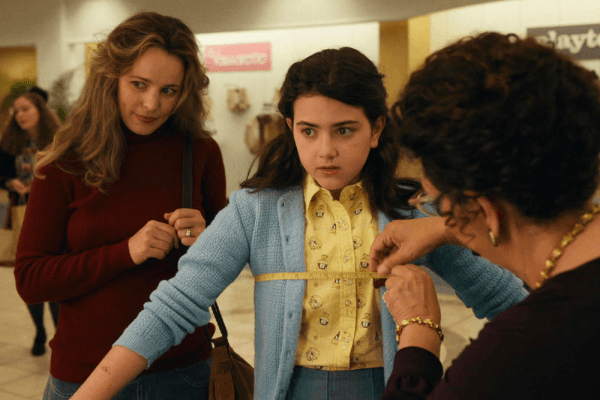
Keeping with the novel’s time frame of when it was written, the movie begins in the summer of 1970 when protagonist Margaret Simon (Abby Ryder Fortson), at 11, returns from summer camp to discover that her father, Herb (Benny Safdie), has gotten a promotion at his job and they’re moving from their New York City neighborhood to the New Jersey suburbs. Even though they assure Margaret that it’s only across the Hudson River, it seems like they’re moving far away.
It’s this part of the movie I have issues with and maybe because I’m not from NYC but the way it’s made out, they’re moving to Siberia. Another problem I have is how her mother, Barbara (Rachel McAdams), seems so out of place in 1970. It’s like McAdams read the script and decided she wasn’t going to change her hairstyle or wear any 1970s clothes. Barbara is an art teacher and I groaned a bit because using the artist/painter as the parent who is “different” from other parents is an old trope. And I like Kathy Bates, but she’s lays on the Jewish grandmother stereotype so much as Syliva Simon. As for Herb, he’s in the movie so little that he has one good scene at the end of the movie that I’ll get to next.
But this story is about Margaret and how she adapts herself to a new school and a new neighborhood. She meets her neighbor, Nancy Wheeler (Elle Graham), who is very critical of others and tries to act like she’s better than them. She also meets and begins to hang out with Janie Loomis (Amari Alexis Price) and Gretchen Potter (Katherine Kupferer). It’s obvious that Nancy has become friendly with the token black girl and the nerdy girl to feel superior and that’s why she makes herself known to Margaret.
Their school teacher, Mr. Benedict (Echo Kellum), discusses that Margaret work on a year-long assignment about religion after learning she hates holidays. Even though her father is Jewish, her mother isn’t. Margaret hasn’t even met Barbara’s parents and it’s because they were too critcal of Herb, since he’s Jewish. Barbara’s parents used their conservative Christian views to discriminate which is why they have decided to let Margaret choose if she wanted to follow a religion or none at all.
Throughout the year, she attends Sylvia’s synagogue while visiting but doesn’t like it. Nor does she like attending Janie’s church. Despite not having a religion preference, she still talks to God as she deals with all the problems from readjusting to a new setting and concerns over her body as Nancy says they should compare bra sizes. And many women will laugh as they do the “breast exercises” chanting “We must! We must! We must deliver our bust!”
But something else happens as the young girls learn of menstration and Gretchen is the first to have her period. At a classmate’s party, tension rise between Margaret and Nancy when the boys and girls play Spin the Bottle and Margaret gets kissed by Philip Leroy (Zackary Brooks) who Nancy likes. Later she disovers despite his good looks, Philip is a huge jerk. She also has interest in Moose Fred (Aidan Wojtak-Hissong), who cuts grass and she gets Herb to hire him after he foolishly has an accident.
At the same time, Barbara sinks into her own depression as she tries to be the Betty Homemaker type the rest of the suburban moms are but is overwhelmed by all that is involved. Herb and Barbara seem like good parents and it’s refreshing to see a father portrayed in movies that isn’t a jerk. Nor is he overprotective or a bully which is sometimes the cases in movies. You also can sense that Herb and Barbara still love each other and don’t argue much.
Kelly Fremon Craig, who made the wonderful The Edge of Seventeen, turns Blume novel into the type of movie that many women of all ages can relate to. Maybe the reason Blume held off for years was she was afraid some man director wouldn’t understand. Even though it’s a good movie, Steven Spielberg was criticized for directing The Color Purple. But it’s the little things such as when Margaret notices the small hair on Moose’s armpits growing or a scene in a public restroom where Nancy has her first period that I don’t think a man director would do correctly.
But a scene at the end where Barbara’s parents and Sylvia have a disagreement over Margaret’s faith and religion could’ve been handled differently. I’ve heard in the book, Sylvia doesn’t come as she was in Florida. It just seems like a cliched trope. The scene doesn’t work too well as Craig may have hoped even though it gives Herb is only scene where he really is a father and puts his foot down. I think it would’ve been better if it was just Barbara’s parents. But I did like the idea that it shows that Margaret realizes that religion is the problem, not spirituality.
I wouldn’t say this is a faith-based movie. I think it’s more about coming-of-age and sometimes that deals with as George Carlin joked, “The Age of Reason” when it comes to religion. So much has been said about the book and how it deals with menstration that it’s just not correct. There’s so little in this movie that deals with that. It’s about that difficult time in many people’s lives when they’re growing up and those around them expect them to stay young.
I don’t know if Blume or many readers saw Fortson as Margaret but she does a great job in the role, probably because she has gone through the same things Margaret has. And that has been why the book has been so popular. So many people can relate to Margaret and even see themselves. It’s still a good movie despite the few problems I mentioned. I also felt Craig and producer James L. Brooks, who produced the movie through his company, Gracie Films, could held back some of the music on the soundtrack as well. That’s become another tired trope whenever there’s a movie set in the 1960s or 1970s (and now 1980s) where they blast the same songs over and over.
But the scenes between Margaret and her friends and even seeing Barbara going through her own changes are the core of this movie and that’s what works.
What do you think? Please comment.
 Zane Says