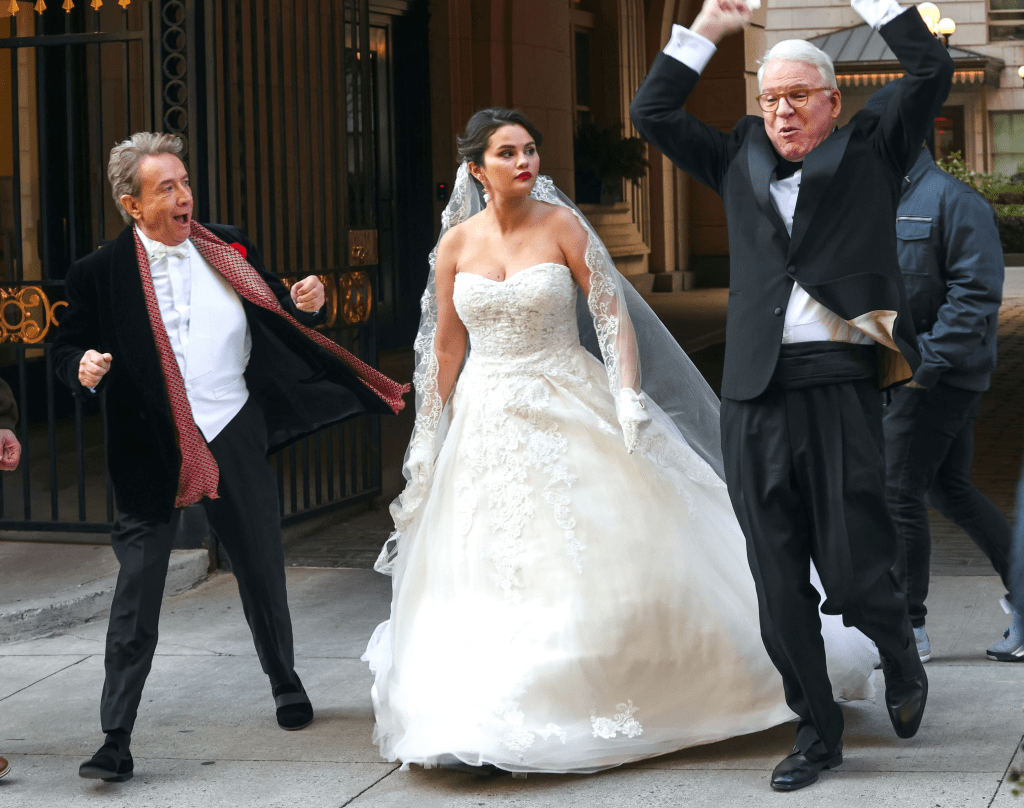
I’ve had this theory that most series that become big surprises during their initial season, usually start to show their cracks by the third season. Mainly, it’s because everyone anticipates the second season to be gangbusters and it usually is. This leaves some fatigue afterwards. Look at the third season of Friends and how some of those episodes didn’t work. The third season of Survivor seemed to lack some of the excitement of the first two and it became repetitive. People have criticized the third season of The Mandalorian. The third season of Cobra Kai seemed to be just a continuation of season two without much change.
On the other hand, I think the third season of Stranger Things was great and the fourth season was able to get through the malaise that starts to form around season four and season five of some shows. That being said, Only Murders in the Building in its third season works best when it’s trying new things and didn’t work best when it tried to stick to the same format. Thank God, Tina Fey’s annoying Cinda Canning was only in one episode and podcast fan played by Jaboukie Young-White was a no-show. I wish they had done more with Andrea Martin’s Joy but more on that later.
The following will contain spoilers, so if you have seen the entire 10-episode season, read no further if you don’t want to see anything about what happened.
At the end season two (which began immediately following the cliffhanger of season one), we witnessed Charles-Haden Savage (Steve Martin) getting into a scuffle with fellow actor Ben Gilroy (Paul Rudd) prior to curtain call of a new musical by Oliver Putnam (Martin Short) with Mabel Mora (Selena Gomez) attending in the audience. After the curtain goes up, Ben collapses and we presume he died. Picking up season four where we left off, Ben collapses and is presumed dead as he’s rushed to the hospital.
But Ben is alive, showing up at a party at The Arconia attributing what happened to food poisoning. Initially upset that their play is over, both Charles and Oliver are happy that Ben is alive. However he had been fighting with his co-star, Loretta Durkin (Meryl Streep) a stuggling actress waiting years, decades really, for this big break. Later in an elevator, Charles, Oliver and Mabel are shocked to find that Ben fell down an elevator shaft and has died when he hit the stop of the elevator.
So, once again they ponder if they should do a podcast while Oliver wants to continue on with the play with a different actor, despite word that a popular drama critic hates it. As usual, they go through the examination of the characters and we get a few red herrings here and there. By now the formula is about the same. I did like the series switches locations from mostly around the Arconia to also being set in the theater playhouse.
I also felt Streep’s Loretta is a nice addition to the series as she eventually becomes Oliver’s love interest. And Charles and Joy, who used to be his make-up artist on his show, Brazzos, have started a relationship but Joy is a sex maniac. The relationship between Loretta and Oliver is very authentic as Streep and Short have great chemisty together. A sequence when Oliver accidentally loses his tooth on a pork chop while eating at Loretta’s and they go out on the ferry because she says as a child her mother would take her out on the ferry when she lost a tooth. She was to throw the tooth as they approach the Brooklyn Bridge and make a wish. This really gives the series the feeling that we’re watching people that despite their quirks and eccentricities are good people we’d like to know more.
I just wish there was more to the Charles and Joy relationship that stops halfway through the season. Charles goes to the “White Room” when he gets nervous and before he knows it, he’s proposed to Joy but screws things up. Just like Short and Streep, they’re a delight to see on screen. Unfortunately, Charles is somewhat a selfish and sometimes narcissistic person which leads to the split. Mabel, herself, finds a love interest in Tobert (Jesse Williams), a filmmaker who Ben hired to make a documentary about his Broadway debut.
And that comes to Ben. Rudd seems like such a nice guy in real life but the stuck-up Hollywood actor stereotype has become old. It was old by the third season of The Larry Sanders Show and that was nearly 30 years ago. Yes, I’m sure some Hollywood celebrities are major jerks. But I felt that Ben was more of a caricature than a character. I feel he played this type of character better in Wet Hot American Summer. And since the murder victim this time is played by a real-life A-lister like Rudd, he has more scenes in the flashbacks. But the revelation of who the killer is, on the other hand, bypasses the Law of the Most Extraneous Character to the Law of the Most Ancillary Character.
Throwing out too many red herrings to characters like Joy, Loretta and Dickie Glenroy (Jeremy Shamos), Ben’s younger brother and assistant, got a little old. I felt the show benefitted from being set in the playhouse as we see the behind the scenes drama of a play. I especially like that Howard Morris (Michael Cyril Creighton), a resident of the Arconia, becomes Oliver’s stage manager and is just as eccentric as the main three.
However, a lot of characters who were introduced in the first two seasons don’t appear at all or are given little to do. Arconia resident Uma Heller (Jackie Hoffman) just does her usual ornery grumpy stuff in a few episodes. And Det. Donna Williams (Da’Vine Joy Randolph) makes a great appearance but she is underused. This is why the revelation of the killer seems more like a cheat because the killer is hardly in the series.
I got a kick out of Matthew Broderick as himself being brought in to replace Charles briefly in the play. And considering that Nathan Lane, Broderick’s co-star in The Producers, played an entirely different character in the first two seasons, is a nice Easter egg. There’s also another connection to The Producers that I won’t mention to those that haven’t seen this season.
At this point, I think the murders are just a reason for us to watch and get to know these characters more. Mixing dark comedy with cold-blooded murder is a risky matter. Sometimes it doesn’t work. Annie Hall was supposed to be about a murder mystery before Woody Allen realized it wasn’t going to work while filming it. But like Martin Scorsese’s After Hours, the plot becomes irrelevant as we focus more on the characters.
And the day after the season finale aired on Oct. 2, Hulu has announced a fourth season. And there’s another cliffhanger with a murder. At 78, Steve Martin, who co-created the series, has indicated this will be the last hoorah for him as he will retire. I have a suspicion that the fourth season will be the last and some of the characters absent will pop back up. You have to wonder how can the Arconia in Manhattan keep its high profile after they’ve been four murders in the building.
What do you think? Please comment.
 Zane Says