There seems to be a phenomenon in the recent spate of movies that are biopics about stranger than fiction true-stories about Air Jordans and Tetris. Pinball: The Man Who Saved the Game is another recent movie that focuses on something that doesn’t seem plausible but actually happened. For many decades, pinball was outlawed in New York City and other areas. If you’ve seen Licorice Pizza, there’s a subplot about this law being repealed in the San Fernando Valley area.
Yes, it seems odd that people outlawed pinball but it was the case. Their reasoning was simple. It was a subtle form of gambling and controlled by the mob, politicians and civic leaders told the public. Fiorello La Guardia, who had served as mayor of NYC from Jan. 1, 1934 to Jan. 1, 1946, led a successful campaign to outlaw it. However, if you didn’t live in NYC or any other areas where the powers that be outlawed it, it seemed rather odd.
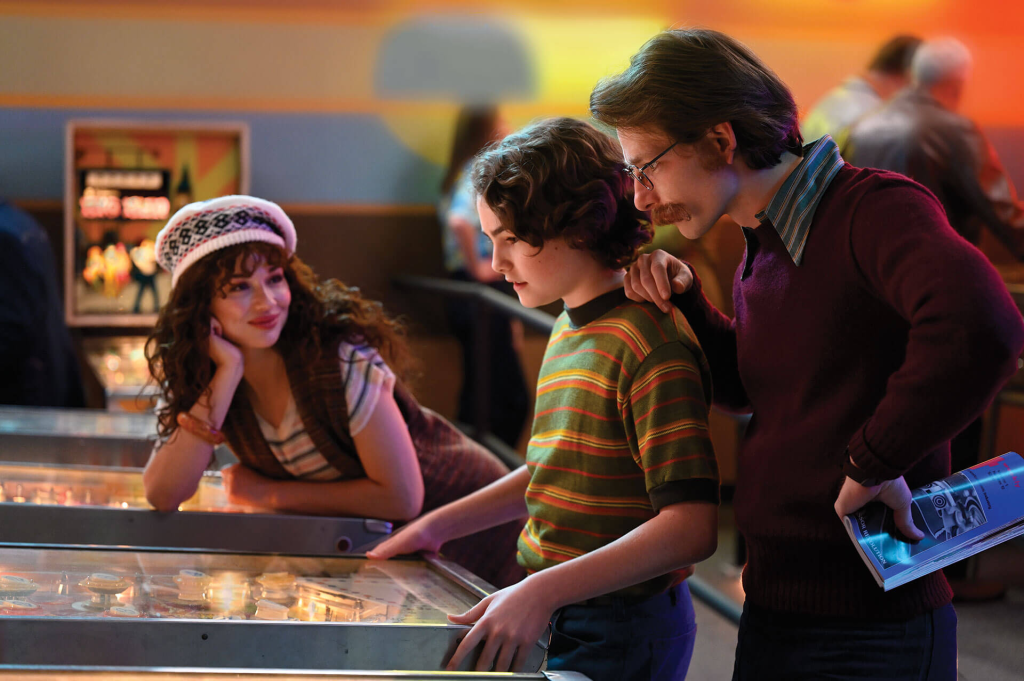
And it seems rather odd to Roger Sharpe (Mike Faist), a man who seems an oddity himself. With a slim lanky body type and a moustache that would make Sam Elliott jealous, he wears beady glasses and walks around in suits and ties that look like they were purchased from a second-hand shop. Roger got hooked on pinball while a student at the University of Wisconsin. He had dreams of being a writer someday but life happens as it often does. He marries and then divorces his college sweetheart who says his signature on the divorce papers is finally somthing important he wrote.
Ouch!
Moving from the Midwest to the Big Apple, Roger doesn’t have much and an apartment that looked like his neighbors could be squatters. Roger finds a pinball game in the oddest place in NYC – an adult superstore where porno books and peepshows bring in the crowds that the clerk barely notices as he reads a magazine. Roger gets hooked on the game but finds out the games are illegal because of the law.
Roger manages to get a job as a writer at GQ, which he refers to as Gentleman’s Quarterly. And his odd appearance stands out even there, considering what the magazine is notable for. But on the way to his job interview, he meets a woman on the elevator, Ellen (Crystal Reed), and they have a spark. He also doesn’t mind that she may be a little older and has a kid, Seth (Christopher Convery). They actually get along perferctly. Ellen is a struggling artist who works as a clerk.
Eventually, Roger begins to work on a magazine story and later a book about pinball interviewing people who enjoyed it and worked on the game. Even though he’s a writer, he’s not much of a typist. Ellen is and she types up what he hand writes. These scenes are so simple and innocent but they show the connection between the two. There’s something sweet and real about the way when he finishes the book, he leaves a handwritten note to go out and celebrate. And they take Seth out to a pizza place.
The heart of the movie is how Roger, Ellen and Seth become a surprisingly but unusual nuclear family. But Roger is still apprehensive about fully committing as he still can’t get over his failed marriage. This comes a little cliched that I wish the Bragg Brothers (Austin and Meredith), who wrote and directed, left it out. But I’m sure Roger had some problems with Ellen. All couples do.
And then there’s the obligatory hearing scene where Roger appears before a council board of NYC stereotypes who really don’t care one bit what Roger has to say about pinball. And he eventually plays the game as they crowd around him and in the end, Roger triumphs by showing them it’s not about gambling at all. This happened in real life so you can’t fault the Braggs for that.
There’s a performance by Dennis Boutsikaris as the older Roger who seems to narrate the story and quickly criticize the filmmakers for being to overdramatic and embellishing some points as filmmakers always do in these movies. Boutsikaris, who looks like Marc Maron’s older brother, has always been on the fringe of Hollywood even though he’s appeared in movies like the Steven Spielberg-produced Batteries Not Included and a recurring role on Better Call Saul. He is perfect for this role because he seems like the guy who would’ve been a writer in the 1970s trying to convince people pinball is perfectly safe and fun.
If anything else, this is a nice little quirky comedy-drama that manages to pull you in with real characters and nice performances on a story that seems outrageous. Even if you’re not a fan of pinball, you will like this movie.
What do you think? Please comment.
 Zane Says