I have nothing against Andy Griffith and Norman Rockwell. But they deserve a little bit of scorn for creating a mythos of how small-town life could, would and should be. Sadly, it varies from location to location. And even more sadder, most people looked through these two icons and their lives with rose-colored glasses.
Griffith was born in Mounty Airy, N.C. on the border with Virginia in Appalachia during the Jim Crow-era of the Segregated south. Rockwell, himself, was born and raised in and around New York City. He only moved to the idyllic Stockbridge, Mass., well into his 50s. By the time he started drawing for The Saturday Evening Post, he was living in the north NYC suburb of New Rochelle, N.Y. And Griffith’s Andy Taylor may have been seen as the model of small-town hero, but he was a single father who chainsmoked cigarettes and never carried a gun. One thing the people forget about The Andy Griffith Show was how neither Taylor nor Barney Fife were peace officers not law enforcement officers. Also, both Rockwell and Griffith were each married three times in their lives. Rockwell’s second wife died but they were both seeking a happy married life.
Sadly, nowadays, all law enforcement have enough weaponry on them they can kill everyone in Mayberry in a matter of seconds. CBS ran a story two years on how Boomers, most of them white, saw Mount Airy as the perfect town. But it’s a facade to attract tourism. Most small towns are nothing more than flyspects on a map that you’ll never hear about nor ever care to visit and for good reason. Mount Airy was also the town where the famous Siamest Twins (Chang and Eng Bunker) lived. They were also slave owners. Needless to say as Mo Rocca noted in his Mobituaries, some ancestors weren’t too happy with them.
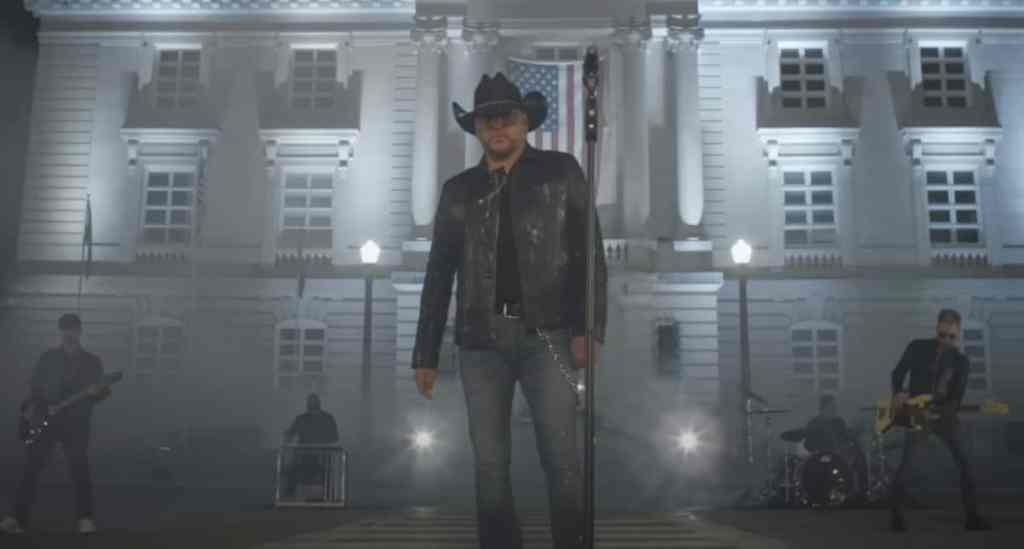
Recently, Jason Aldean has come under controversy for his song “Try That in a Small Town.” He was born and raised in the city of Macon, Ga., which is nowhere near Mayberry, and lives in Nashville, which is also the capital of Tennessee. It’s basically what Bo Burnham referenced in his appropriately titled song, “Pandering.” It’s typical of a lot of country-western music since the early days of post-9/11 when Toby Keith sung “Compliments of the Red, White and Blue” which had the atrociously bad lyrics “Cause we’ll put a boot in your ass/It’s the American way.”
Before that was the equally bad “God Bless the U.S.A.” which only gained popularity during the Persian Gulf War of 1991, seven years after it was released. Funny side note about this song, when I worked at the Piggly Wiggly in my hometown the summer of 1998, it was July 4 and I was taking some groceries out to some SUV parked in the fire lane (because the richies didn’t want to park in the designated areas). And as I was loading the groceries in the back of the SUV with only this woman slightly helping, her husband was blasting this song so loud, they could hear it two counties over. I had this crazy notion that they were driving around the town with this song on repeat playing at full volume.
Speaking of my hometown, I grew up in a very racially divided town. The same Piggly Wiggly I worked at had people chase down an African-American woman who had stolen probably $15 worth of meat. Across town years later, when I worked at K-Mart, I was told to keep my eye on all the Mexican immigrants who were shopping. Needless to say, they all were ok when two teenage white boys tried to steal condoms, letting them off with a warning. You know, because they were white and probably knew someone who wouldn’t be happy if the police were called.
And that’s the problem with small-town life, it’s only a good way of life if you have a certain privilege. For some people who grow up in the foothills of the Appalachians like I did or who currently live in the foothills of the Ozarks like I do now, there’s very little they can do to get ahead in life. I’ve also lived and worked in the rural jerkwater towns of southwestern Georgia and went to school at Georgia Southern University in Statesboro, the only contemporary sign of modern civilization between Macon and Savannah.
And there were a lot of place south of Macon where the towns resemebled something you’d find in a third world country. Images of Eastern Europe after the fall of the Soviet Union and through the Bosnian War are hard to distinguish from some of these towns where there isn’t much but a lot of lost hopes and dreams. That’s not to say everyone in these towns are destitute. Many of them do have people who live lavishly, but that’s the problem. You got the big fish in the small pond. They’re not leaving. Because out in the sea, there’s always a bigger fish.
The last time I went to where I grew up in the winter of 2020 before Covid, I was surprised at how commercial the town of Adairsville, Ga. had become. It’s about 10 miles from Calhoun, where I grew up and was often just a flyspeck on the map off Interstate 75. If someone needed to pull over quickly and gas up because they wouldn’t think they’d make it 10 miles down the road, they pulled in there. But it looked like it was flourishing with more stores and businesses than I’d ever seen. The population has almost doubled since I left there.
My dad says this was because the powers that be who kept the town small had died off and newer people had come in. While some people may not like the newer businesses, they do help the economy. Things change in some towns. But some people want to keep things just the way they were. Covering education over the years, one thing I have noticed is the elders don’t want many changes to the school buildings, even if they are falling apart. They’d rather the school district spend more money to renovate and repair buildings rather build something else from scratch.
Usually, that requires that a building has to be torn down. And most of the times, the buildings are is such bad shape, they can’t be repaired. Every school building I attended myself is no more. They tore down the elementary school, both buldings that housed the middle schools and the high school building. Looking back, I wish I could’ve operated the wrecking ball. They should’ve had a raffle for that. I’m sure they would’ve been able to raise some extra money.
But that’s the problem. There’s two types of people. You have those who cling to the past and those who leave the past behind them. It’s been my experience most of these small-town types are stuck in the past. I’m not saying you can’t live in a nice peaceful town. But I’ve been to too many city/town council meetings and it’s hard to believe some of these people are actually adults who probably make more money than you and I.
And I’ve also lived in towns that were different along racial lines. In the Calhoun area, it was predominantly white with about three-fourths of the populaton. That has since changed to 60 percent white with about 25 percent Latino/Hispanic. In Statesboro and Americus, you had a higher percentage of African-Americans. Even though Statesboro has about 40 percent African-American, I think if you included the college students, it probably closer to half or even more than half because Georgia Southern does have a higher percentage of African-American students compared to other non-HBCU colleges in the state. In Americus, it’s over 60 percent African-American. However, Tahlequah, Okla., 15 miles east of where I live, has about 30 percent of the population who are Indigenous/Native American. But it was 53-54 percent who are white/caucasian, but does that include the people (such as myself who have Indigenous heritage) but can’t claim it through the lack of proper documentation. Yet Wagoner, Okla. (located 10 miles west of where I live) has more of 70 percent of white/caucasian.
This small town that Aldean is singing about isn’t really indicative of all small towns. It’s indicative of “sundown” towns. It’s indicative of towns were the opioid epidemic has ravished the area but everyone criticizes Latinos/Hispanics from bringing in drugs. It’s indicative of a very conservative and very prejudiced town where Andy Taylor and Barney Fife would’ve been fired after one week on the police force. It’s a generalization of towns in which people should “know their place.”
What’s so unsettling is that Aldean sings of violence and guns rights, even though in 2017, he was performing in Las Vegas when Steven Paddock, 60, opened fire from his Mandalay Bay suite killing 60 people and injuring 413. Aldean seems to continue the conservative hypocrisy that no matter what affects you personally, you should still cater to the conservaive base. I’m not doubting that Aldean may have suffered from post-traumatic stress following the incident. But it’s in poor taste to sing about violence because you don’t agree with someone. His lyrics come off as that of a violent bully.
Ironically, most of what he sings in the song is bullshit. No one is coming for your guns. Also, people don’t look out for each other, the way we’d like to think. I can tell you that it’s all about social standing and prestige. And especially if you’re a disabled person or have a lot of illnesses or health issues, more people will turn their backs on you that it’s alarming.
Also the lyrics hint toward lynching with “See how far ya make it down the road.” His music video was filmed outside the Maury County Courthouse in Columbia, Tenn. In 1927, Henry Coate, a 18-year-old African-American man, was accused of assaulting a younger white girl. He was kidnapped, tied to the back of a car and dragged before he was hung in front of the courthouse. So, using this and footage of the Black Lives Matter protests, obviously sends a message even if it’s unintentional.
Even more misleading is the notion that all BLM protests are violent. It’s been widely said they’ve been mostly misreported by the media. Even protests in major cities such as Atlanta, eyewitnesses reported seeing white people causing vandalism. Several officers in law enforcement have actually supported BLM protests. In Calhoun during the summer of 2020, some of the racist people falsely reported BLM protestors to the police who showed up and didn’t disperse the people but agreed with their right to assemble and protest under the First Amendment. Many gun ethusiasts were also shown protesting outside the courthouse at a later date with no incidents.
The myth of small-towns grew from White Flight and redlining in the post-WWII era. I’ve heard from several people who lived in more metropolitan areas that they got along better with their neighbors than in smaller towns. There’s not one person out there who grew up in the suburbs or the small-towns Aldean romanticizes who’s had some angry homeowner get mad for even getting close to their property. In more populated areas, you got to share the sidewalks and the shops and the parks with other people. It’s accepted. Yet there are people in the smaller towns who literally will scream at you for walking on the sidewalk in front of their house, even though by most municpal standards, the sidewalk to the roadway isn’t part of the homeowner’s property.
The myth that people in big cities are not friendly and hostile is something that based on poor representation in the media and pop culture. You’re going to find people of all walks of life in all areas who will help you and those who won’t help you. I’ll never forget hearing stories the afternoon of 9/11 strangers came together to help first-responders by making stretchers. Yet, in the aftermath of Hurricane Katrina, just four years later, there were reports the people of Gretna, La., stopped people from New Orleans from seeking shelter and even fired threatening gun shots from law enforcement.
Need I remind people that there is no legal restrictions on passing through borders from state to state in America unless you are on probation and a judge prevents it. These were people seeking help. Worse, we romanticized that psychopath Chris Kyle who said he was hired to shoot looters in New Orleans, even though there were no such reports. It seems we don’t hear about how people turned out to help in the aftermath of 9/11 or the Boston Marathon bombing, even if it’s to donate blood, because we want to present a narrative that those who live in urban/metropolitan areas lack basic sympathy.
We really need to break down this “Us vs. Them” mentality when it comes to small-town life and big-city life, because neither side is better nor worse. You’re going to find the same type of assholes in both settings. It’s just that bigger cities have more of them because of population but on a per capita basis, I bet it equals out.
One thing I will credit Aldean is leaving out the Christian crap that people associate with small-town life. I never will forget that the First Baptist Church in Statesboro had a buzzer system. Remember this wasn’t a big area that only had about 22,000-23,000 population when I was going to school. It’s since gained about 10,000 more in the last 20-25 years. There were a lot of people who worked there and were going in and out. So, why did they need a buzzer system? I guess they didn’t want the wrong elements getting in.
I’ve seen churchs, mostly Catholic, in Atlanta that were open to the public during normal daily hours. I can understand some churches can’t be open because the pastor and deacons have regular weekly jobs. But most of these bigger churches in small towns are more about appearances. They’re also the ones who will be the last to help out when people really need it. If they do the “Christian” thing and help out, they make a point to notify the local media to pat themselves on the back and get the publicity.
But from covering these churches who offer assistances and have food pantries (as well as personal experience), it’s been my observance these church buildings are modest. They may not even haved a paved parking lot or it’s in need of being repaved. The carpet might be older and the whole place could use a paint job. Yet, these are the congregations that help out and help the most giving money for gas, utility payments or offering food.
It’s no surpise if you go on comment threads or message boards, you’ll see mostly white people supporting Aldean and questioning why the song is so controversial and why CMT removed the music video. Some are just plain ignorant. They’ve lived a certain life sheltered from certain truths they can’t understand. And it’s futile to even try to explain it to them.
But it’s also futile to argue with those who agree with the lyrics and the music video. There is a lot of competition in small towns and there’s a lot of racism that people won’t admit. The school district I went to would often stick some of the lower income students in special ed. And a lot of them were African-Americans. My theory is this was done so they wouldn’t have to deal with students underpreforming because they don’t have the rights materials. It’s also a good way for the administrators to make sure the right students get access to the right scholarships, programs and opportunities.
There’s no right place for a person to live and we shouldn’t be criticizing people if they choose to live in a bigger city or a smaller town. Unfortunately, most people in the small towns don’t have access to basic programs. One of the schools I covered, Okay Public Schools, did away with its music program, even though it had students who marched in the Macy’s Thanksgiving Day Parade. These students went to other schools.
The school district also ended its football program because it didn’t have enough eligible students. I believe the last season they had to forfeit each game. Sadly, this also affects the few students at that school who are good with athletics. They either have to go to another district, which might be difficult, or see their hopes and dreams end.
And that’s a harsh reality for people in smaller towns, especially young women. When you’re not able to get a good education, you can’t go on even to a good technical college. Instead, they have to compete with other people for the limited job opportunities. Most will have to settle for working at gas stations or whatever meanial jobs they can find. Worse, young women are expected to settle down and get married before they’re even old enough to purchase alcohol legally.
Anyone who watched Son in Law and saw the terror of Carla Gugino’s character as she knows her high school boyfriend, played by Dan Gauthier, is going to sucker her into a marriage proposal during Thanksgiving break as she’s home from college. It’s a comedy and a Pauly Shore comedy to say the least. But there’s probably millions of young women who have watched this movie knowing exactly what she’s going through, especially when her boyfriend, who has been cheating on her, does it in front of a lot of people at community dinner while her parents look on happily.
While some people might want that life, it shouldn’t be a death sentence to others. Also the notion that someone is going to go away to college, like her character, and just return to the small-town they grew up in to take some meanial job is something we need to stop expecting. Parents, friends, family and elders should stop treating people who take jobs in bigger cities, other states and even other countries as something bad. If you think you’re being left behind because someone else is moving on with their life, maybe you need to take that first step forward to improve your own life.
Speaking of Son in Law which came out in 1993, The Wonder Years ended its run around the same time. Many people were upset that Kevin Arnold (Fred Savage) and Winnie Cooper (Danica McKellar) didn’t end up happily married. But that’s life sometimes. Kevin met someone else and married her but maintained his friendship with Winnie. I’ve known too many people who married their high school sweetheart only to have it end in divorce, but later find someone special that they are more happy with. And I’ve also know many people who married their high school sweetheart and are still going strong.
If you try to live your life to someone else’s standards and goals, you’re never going to be satisfied.
What do you think? Please comment.
 Zane Says