Sarah Polley often makes movies a lot of other filmmakers wouldn’t make. Her directorial debut Away From Her was a completely different (and honest) movie that looked at Alzheimer’s and the effects on a married couple that didn’t have the Lifetime/Hallmark sentiments other movies did. That being said, Women Talking, for which she won an Oscar for Best Adapted Screenplay, has me divided.
It tackles a serious subject only the way a woman director would, but at the same time, I felt there was a lot left to explore. Set at an unnamed, isolated Mennonite community mostly over the course of a couple of days, it involves the women making a decision whether to stay or leave following a traumatic event. The movie starts with a woman walking up to discover she was violently sexually assaulted while she slept. Some of the women fight back and the attackers are arrested and taken to a nearby town/city for their protection. Most of the men leave to bail them out.
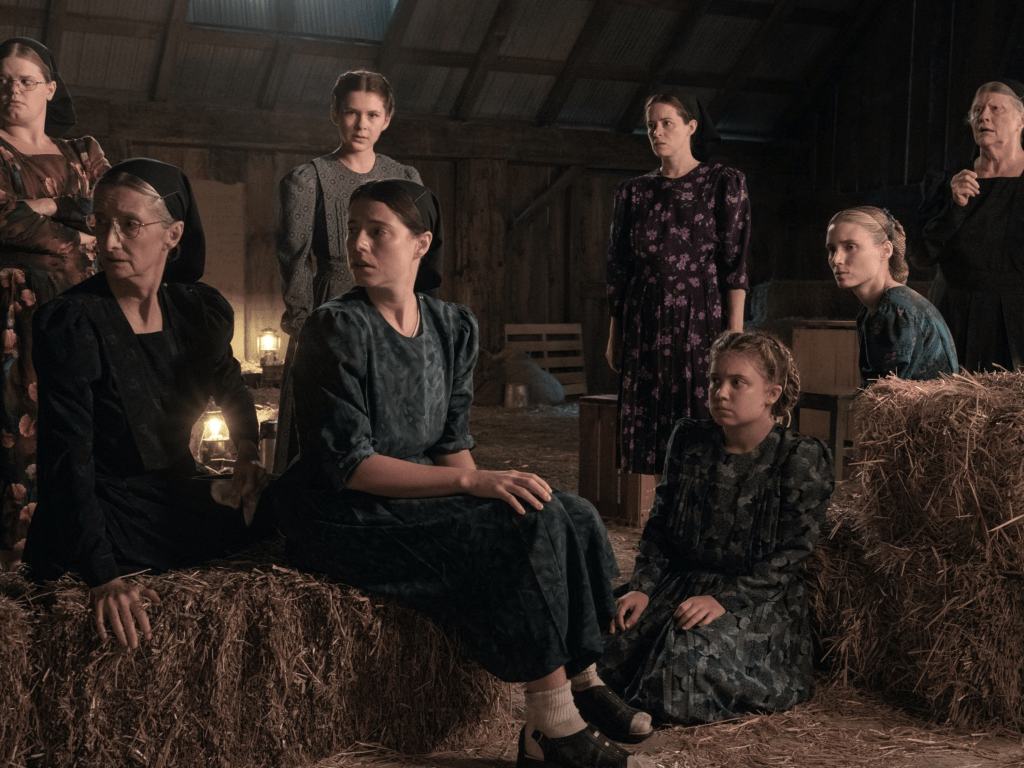
In the meantime, the women make a rushed decision to vote on what to do. Since most are uneducated and illiterrate, they use drawings to put it to a vote. They either do nothing. Or they stay and fight. Or they leave. The vote is tied between staying and fighting and leaving. Eleven of the women meet in a hayloft and discuss what to do. Their ages varying from very young to elderly.
Ona (Rooney Mara) who has become pregnant after being raped has voted to stay and fight. Salome (Claire Foy), whose daughter has been injured after being assaulted, also thinks they should stay and fight. However, Mariche (Jessie Buckley) whose husband, Klaas is abusive, is also conflicted against leaving. But the abuse has made her angry herself as she is very critical of August (Ben Whishaw), the colony’s school teacher, who they have asked to collect the minutes. She constantly berates him when he says anything that sounds like he’s voicing his opinons. She’s also short with the other women.
What conflicts the women is their devotion to their faith and whether they should still allow it. The other man left at the colony is Melvin, who is transgender, and was raped himself that he no longer speaks to anyone but the children. There’s also a debate on how old should the boys be to go with them if they do leave. This causes a riff between some of the women because they don’t want their sons to stay but at the same time, as they go through puberty, they may develop the same views the men have about the women.
While the movie isn’t set at a specific place, it’s reportedly set in 2010 a time before MeToo but after the 2008 Presidential Election where the country was divided over how Hillary Clinto and Sarah Palin should be treated. While both sides were quick to criticize Clinton, it seemed Palin was off-limits. While I don’t know much about Amish or Mennonite communities (even though both are within a 30-mile radius of where I live), I’m not surprised they would keep women from learning basic reading and writing. The one way you suppress people is by limiting their abilities to function outside the environment in which they lived.
Despite some good performances by Mara, Buckley and Foy as well Judith Ivey and Sheila McCarthy as the elder women, I couldn’t shake the feeling the movie feels rushed at the end. It also has a stage-like feel that Polley tries to counter with images of children playing as The Monkee’s “Daydream Believer” plays. My biggest problem is the casting of Frances McDormand as Scarface Janz who doesn’t speak and barely appears much on screen is a form of stunt casting. McDormand, who is credited also as a producer, I feel was brought in to help secure financing. The actress who has won three Oscars for acting and one for producing so she carries a lot of weight in the industry. But she brings nothing to the role.
It’s no surprise it’s had some people divided. There’s very little action and about three-fourths of the runtime consists of the women in the hayloft talking sometimes with scenes that need to be trimmed tighter. Some things are brought up that are never mentioned again. The other women aside from those played by Buckley, Foy, Mara, Ivey and McCarthy seem to focus more as background extras. It’s a shame Polley nor any of the previously mentioned actresses didn’t get Oscar nominations. The script does have problems their acting makes up for.
I feel the nomiation and win for Polley was a consolation prize, which makes it more ironic when you consider the movie’s themes. Even though I felt it Polley added a different touch on the movie that makes it’s unique, it also feels like someone has entered a conversation already in progress not fully understanding much. I don’t know if Polley was limited to the budget but it feels like some of these scenes could’ve been better directed and edited. Still, I recommend it even though I’m not willing interested in watching it ever again.
What do you think? Please comment.
 Zane Says